Scalarama 2019

The September Festival celebrating all forms of moving image exhibition returns to Leeds. The city is one of the areas which has an extensive and varied selection of titles; in both theatrical and non-theatrical settings. And the programme offers classics, less-known films, documentaries and animation.

‘Animated in Leeds’ on September 7th at Chapel FM Arts Centre offers a selection of some of the short films made by this pioneering Women’s Collective. The Leeds Animation Workshop has high standards of technical accomplishments and the productions invariably address important social issues.

Cutter’s Way (1981) is what is known as a neo-noir. It features many of the characteristics of the classic film noir. There is the world of chaos into which the protagonist is drawn by the siren call of, here, a mystery rather than a mysterious woman. The  film is in colour but offers many sequences shot in chiaroscuro. And, intriguingly, one could argue that the film offers both a seeker and a victim hero; both caught up in triangular relationships. It screens at the HEART in Headingley on September 9th.

A series of events highlight the film work of Bob Fosse, ‘Fosse in film’. Fosse started out as  performer and dancer and took up stage choreography. He then worked on several Hollywood productions and progressed to direction. He directed five features between 1963 (Sweet Charity) and 1983 (Star). The screenings in the Festival are of this three most famous and successful films.

Cabaret (1972) Thu 12 September at Wardrobe, ST. PETER’S SQUARE      One of the great film musicals and the best film version of Christopher Isherwood’s memoir

Lenny (1974) Sat 14 September @ 10:30 pm. Hyde Park Picture House.       Dustin Hoffman is perfectly cast as the scabrous and subversive stand-up comic Lenny Bruce. The film is beautifully shot in black and white by Bruce Surtees. [Unfortunately the Sunday screening is gone!]

All That Jazz (1979) with post film discussion on Bob Fosse and Power & Exploitation     Thu 26 September @ 6:30 pm – 9:00 pm                         Northern School of Contemporary Dance, Riley Theatre, 98 Chapeltown Road. Fosse uses his own life and experiences to present the story of a Broadway director, choreographer and film director (Roy Scheider). The parts are better than the whole with some brilliantly staged sequences.

To celebrate Babylon’s recent U.S. release, and commemorate the Windrush generation, we’re holding a special screening of Franco Rosso’s film, followed by a DJ set …

Babylon(1980) Tue 17 September @ 8:00 pm – 10:00 pm   Square Chapel Arts Centre, 10 Square Road.                                                                                 A seminal film on black culture set in the 1980s. Directed by an Italian film-maker who had already made a documentary about the infamous ‘Mangrove 9’ case. The eye of an outsider brings a distinct sensibility to a world that British cinema had yet to address in a meaningful way.

A series of short films on life and art and music of Palestinians in Palestine and exile today: as their struggle for National Liberation continues.

Films include Colours of Resistance about art and music of Palestinians trying to retain their identity with a country that is being deprived of its right to exist, Palestine Underground showing the music and hip-hop scene in Ramallah and Made  in Palestine.                                                       Tue 24 September @ 8:00 pm – 9:30 pm  LS-Ten Skatepark, Unit 1 Kitson Rd, Leeds.

If you want more information or to check our other parts of the programme visit the Leeds Web Pages.

If you are away from Leeds there maybe Scalarama where you are going, so check out the National Web Pages.

Pain and Glory (Spain, 2019)

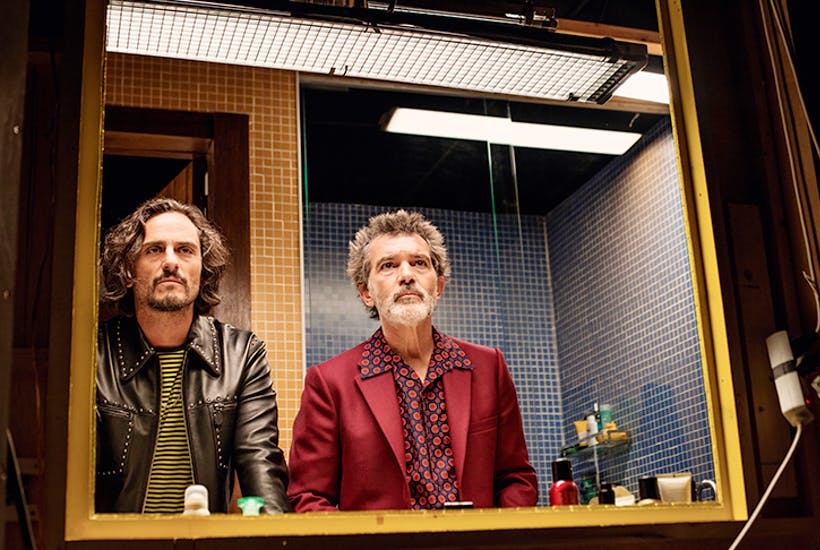
Antonio Banderas as Salvador Mallo and Asier Etxeandia as Alberto

Pedro Almodóvar is a man of many stories. I find his vivid blend of heroism, tragedy and flashes of utter absurdity a heady combination. His films have spanned grand themes and domestic oddities, drugged gazpacho and heroin dealing, tiger owning nuns, but this time the spotlight shines back at the director himself. Or rather, it shines at the idea of ‘the Director’; Antonio Banderas stars as Salvador Mallo, an aging filmmaker whose ill health, the significant anniversary of one of his early movies and an encounter with a former friend cause him to review his life and works. Mallo’s life unfolds for the audience, encompassing a childhood with his mother (played by Penelope Cruz), his early career and first loves, through a series of flashbacks and reflections.

It seems almost unavoidable to consider this film as something of a self portrait; Banderas’ appearance is grizzled with a dandelion clock of hair similar to Almodóvar’s own, he reportedly wore the director’s clothes during filming – parts of which even took place in his own Madrid apartment. We have more than a few hints then that Mallo might be a version of the director himself. Almodóvar has shrugged off comparisons at interview, saying he wouldn’t write or direct an autobiographical work, but it feels unlikely that the similarities are entirely coincidental.

There’s a lot to look forward to here. At Cannes this year, Banderas won the Best Actor award for his portrayal of Mallo and Alberto Iglesias (another frequent Almodóvar collaborator, having worked on Volver (2006) and Julieta (2016) amongst others) won the award for Best Soundtrack. Cruz and Banderas are giants of Spanish cinema who’ve made the leap into Hollywood and both keep one foot squarely in Europe. While the pair feature in different timelines in this film, it’ll be a treat to see them on screen together – something that hasn’t happened since their brief cameos in 2013’s Los Amantes Pasajeros (I’m So Excited!). I hope that the actors’ transatlantic popularity can help to bring a wider audience than existing fans to the intense visual feast of an Almodóvar picture. If you’ve not seen any of his work to date, hunt out Volver (2006) featuring Penelope Cruz returning from the dead, try Women on the Edge of a Nervous Breakdown (1989), a dark domestic comedy with Carmen Maura and The Skin I Live In (2011) where Banderas is a sinister Dr Frankenstein-esque character haunted by his past.

On top of the Cannes gongs, there are rumours of other nominations for Pain and Glory, with reviewers describing Banderas’ performance as ‘career defining’ and the role he was ‘born to play’. I’m convinced and can’t wait to see it.

Pain and Glory will be showing at the Picture House from Friday.


Hannah Bingle

Notorious (UK 1946)


Alicia Huberman’s (Ingrid Bergman) behaviour is NOTORIOUS.

Has she had enough to drink? “The important drinking hasn’t started yet.”

“You can add Sebastian’s name to my list of playmates”

And personally I wouldn’t trust her as my chauffeuse!

So what’s on the menu of this excellent melodrama? For a start it includes some dodgy fare … burnt chicken, indigestible wine and adulterated coffee. And you’ll find a heady stew of manipulation and blackmail, disappointment  and murder, all seasoned with occasional expressions of trust and openness to love.

T.R. Devlin(Cary Grant) is a government agent aiming to infiltrate a group of Nazis who fled Germany for Brazil after World War 2. The setting is Rio de Janeiro in 1946. Essentially, Notorious is a Hitchcockian romance highlighting tensions between feelings of love and duty, which rivals Michael Curtiz’s film Casablanca (1942) for style and entertainment. The script, acting, screenplay and photography all showcase director Alfred Hitchcock at his best. If you are quick you can even see Hitchcock quaffing a glass of champagne just over an hour into the film.

Alicia: This is a very strange love affair.
Devlin: Why?
Alicia: Maybe the fact that you don’t love me.
Despite this, there is an extended kiss, the longest on screen at the time. In the 1930s Hollywood had introduced the Hays Motion Picture Production Code which dictated strict rules to writers and directors about permissible limits to lovemaking, immorality and vulgarity in their films. For example, in love scenes women had to have at least one foot on the ground at all times, and kisses could only last three seconds. Hitchcock got around the last one by having the lovers kiss for three seconds, stop, say a few words, kiss again, walk for a little bit and then kiss again, for a total of two and a half minutes. See the results for yourself!

Another psychological element is Alex Sebastian’s (Claude Rains) intriguing relationship with his mother, Anna Sebastain (Leopoldine Konstantin).

Madame Sebastian to her son: “We are protected by the enormity of your stupidity … for a time”.

Maybe I should have mentioned that Alex is also in love with Alicia …

So get along to the Picture House to see this iconic film at 2pm this August Bank Holiday Monday.


Bill Walton

Never Look Away / Werk ohne Autor, Germany, Italy, USA, Czech republic 2019.

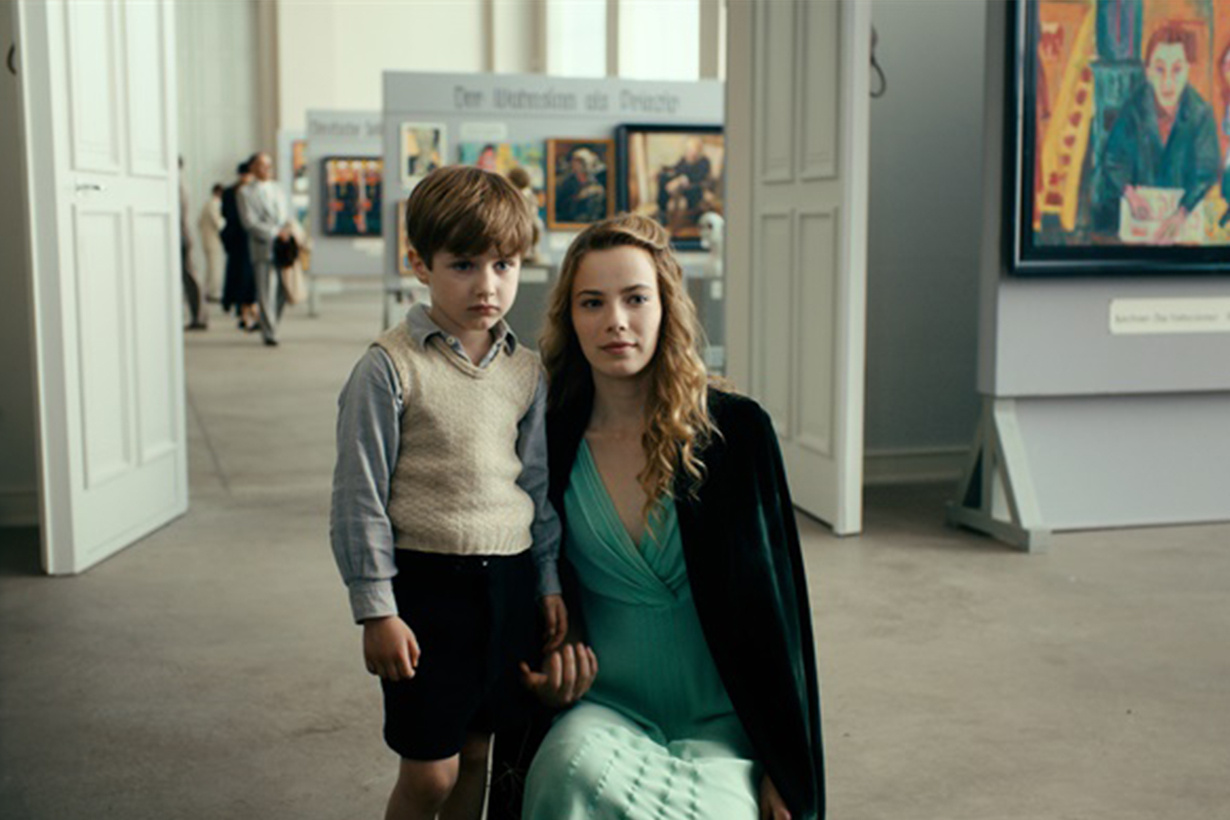
Young Kurt with Elizabeth and ‘degenerate art’

This new title had two screenings at the Picture House. I managed the second which had a small but respectable audience.  They all stayed to the end, which was 188 minutes later. In fact the film did not seem three hours to me as the characters and the stories were absorbing.

I write ‘stories’ as there are two narrative strands in the film and I thought one weakness was that they never seemed to completely mesh. The English language title refers to the personal and family drama strand. This starts in 1937 as we see the young Kurt [Cai Cohrs) with his Aunt Elizabeth (Saskia Rosendahl) as they follow a guided tour of the Nazi exhibition of ‘degenerate art’. Kurt already has ambitions to be  a painter. But the emphasis is on the personal. Elizabeth admonishes the young Kurt to

‘never look away’ because ‘everything that is true holds beauty in it’.

But she is soon lost and becomes a victim of the Nazi policies of sterilization and extermination of people deemed physically and mentally ‘unfit’.

After the war Kurt and his family find themselves in the zone liberated by the Soviet armies and then the German Democratic Republic. Kurt goes to art school where the official style is ‘Socialist realism’. He meets and falls in love with another student Elizabeth, ‘Ellie’ (Paula Beer). Her father Carl (Sebastian Koch) is a gynecologist and the audience [but not Kurt or Ellie] know that he has a suspect past from the era of the Third Reich. As this starts to catch up with him he leaves for the West. Now married Kurt and Ellie follow just before the erection of the infamous ‘Wall’.

This latter part of the film is closer to the German title, which translates as ‘Without an Author’. This refers to the film using some of the life story of an actual German artist, Gerhard Richter, whose paintings figure in the film. Kurt enrolls at the Düsseldorf Art Academy, at the time a centre of avant-garde art. Here we see another thinly veiled character from real life, the artist  Joseph Beuys. Now Kurt finds an artistic voice  and critical acclaim.

Adult Kurt with a Socialist Realist portrait and an experimental canvas

Less focused is family life, but Kurt and Ellie have children and happiness. The fate of her father Carl is not revealed but there is a hint that nemesis is closing in.

The cast work well, Tom Schilling and Paula Beer are reasonably good.  Sebastian Koch is excellent with a real sense of malevolence. The stand-out performance is Saskia Rosendahl, though she is only seen in the early part of the film.

The production is extremely well done. The design, cinematography and sound all work well to produce a convincing creation of the places and times. And there are both subtle and less subtle references in the style that draw the characters and their experiences together. The music does this at times, but other sequences have a rather obvious accompaniment, sometimes with a Wagnerian tone. I suspect the film-makers were not confident that all the key moments of development totally worked.

This contributes to the sense of a division in the film. And the personal drama, especially the romantic, is rather conventional in presentation. Whereas the artistic is less so. But I think both maintain the interest of the viewer.

The film  is written and directed  by Florian Henckel von Donnersmarck who was responsible for the very fine The Lives of Others  / Das Leben der Anderen (2006). This film lacks the complexity of the earlier title. The treatment of both the German Democratic Republic and of the later Art Academy rely on rather simple motifs.   I think the director’s craft suffered from a trip to the mainstream and a completely forgettable The Tourist (2010). However, this production is vastly superior to that and, in a year where the new releases  of real quality are sparse, stands out. It is in  colour, full widescreen and has English sub-titles;  definitely a movie to be seen in a cinema.

Yorkshire Day: Sculpture On Screen

Thursday 1st August 6:15pm

Yorkshire Day

Our Yorkshire Day screening this year is a special programme of films, showing as part of Yorkshire Sculpture International, celebrating some of the regions most famous sculptors.

Tickets are free for all members/friends.

Damien Hirst: Thoughts, Work, Life (2012) was directed and edited by BAFTA award winner Chris King (Senna) and features an exclusive interview with the artist, and rare early archive footage and stills.

Figures in Landscape (1953) is a poetic portrait of sculptor Barbara Hepworth and the otherworldly Cornish landscapes which inspired her.

Henry Moore Recollections of A Yorkshire Childhood (1981) is a documentary, taken from the Yorkshire Film Archive, of Moore looking back at his childhood, aged 83. And a previously unseen clip from Henry Moore on Film (1971) shows the sculptor at work – made available to screen thanks to the Frank & John Farnham Archive and the Henry Moore Foundation.

Review: Support The Girls

Support The Girls

Support the Girls has a great cast. The standouts for me are Regina Hall, Shayna McHayle and Haley Lu Richardson. Their dynamic works really well on screen.

This film shows a day in the life of sports bar Double Whammies’ boss Lisa and the many challenges she faces trying to keep the bar and staff running throughout a busy day. The film starts with Lisa crying in her car before starting work as some girls begin to turn up to be interviewed for a job which requires the female waitresses to wear denim hotpants and crop tops. From that point onwards, Lisa’s day full of issues and confrontations.

There were a lot of interesting characters such as the bar owner Cubby and Lisa’s husband, who I would have liked to see more of and see their backstories. Either way, there were both disappointing figures in Lisa’s life.

As I watched the film unfold, I kept waiting for the main story to kick in and just when I thought it would, it skipped to another scene, which gave the film a slightly disjointed feel. I did enjoy that it was a great observation into the life of someone who just wanted to get by and help others but failed to receive the same amount of support back – apart from two loyal members of staff Maci and Danyelle. There were some distinct laugh out loud moments and it did a good job of showing how hard day-to-day life can be when you’re trying to keep your head above water. I would recommend this film for a rainy afternoon.

Too Late To Die Young/Tarde Para Morir Joven (Chile*, 2018)

Tuesday Wonder 30th July 6:30pm.Children on bikes

The second feature film from Chilean director Dominga Sotomayor Castillo, it was released with great acclaim at Switzerland’s Locarno Film Festival in August 2018 where Sotomayor Castillo was recognised as the  first female winner of the festival’s Best Direction Award.

It’s December 1989, the Pinochet government has recently fallen and Chile is holding its breath through a tinder-box summer. Sofía (Demian Hernández) is a teenager working out her place in her close-knit and newly-established agricultural community that is finding its feet on the cusp of the new year. The heat of the summer and the boil of teenage frustration is tangible as Sofía, her siblings and the adults who surround them attempt to settle into their new lives and prepare for the village’s new year celebrations. We see the families building their homes, raising their animals and testing the political dynamics of their new settlement while their children explore the forest (which holds a spectacular tree house), and their relationships with each other. Village life is largely unhurried and inward-looking and it becomes clear that the adults have as little clue as the teenagers when it comes to making new lives in the countryside. The events following the party force the community to confront their place in nature and face the reality of summer in the wilderness.

In casting, Sotomayor Castillo included a handful of professional actors but sourced the larger part of the cast – including Sofía and all of the children’s roles – from the community where the film was shot. Portions of the dialogue are improvised, giving an authentic tone to the domestic scenes.

Like the Italian summer in Call Me By Your Name (2017), Too Late to Die Young has a definite date but there’s a hazy, languid quality to the piece that means it could be placed in any year of a decade. The director herself has pointed out in interviews that the soundtrack features music audible to the characters that wasn’t released until years after the film is set. The themes of finding one’s place in the world, the unsettling changes of teenager-hood and the contrast of local politics with national turmoil have played out over and again in film, but Too Late To Die Young explores these organically and sensitively, keeping a distance between the viewer and the characters that means we don’t learn their every thought.

This film has to be seen at the cinema for the enormity of the landscape alone. You might think you’ve had enough of the hot weather after the last week, but there’s a certain magic to flooding your senses with a summer viewed from the cool, dark safety of the picture house that you won’t want to miss.

Too Late to Die Young screens at the Picture House at 6:30 on Tuesday, 30th of July.
*Chile/Brazil/Argentina/Netherlands, 2018, 110mins, Cert.15


Hannah Bingle

Performance (UK 1970)

Saturday July 27th 5.30 p.m.

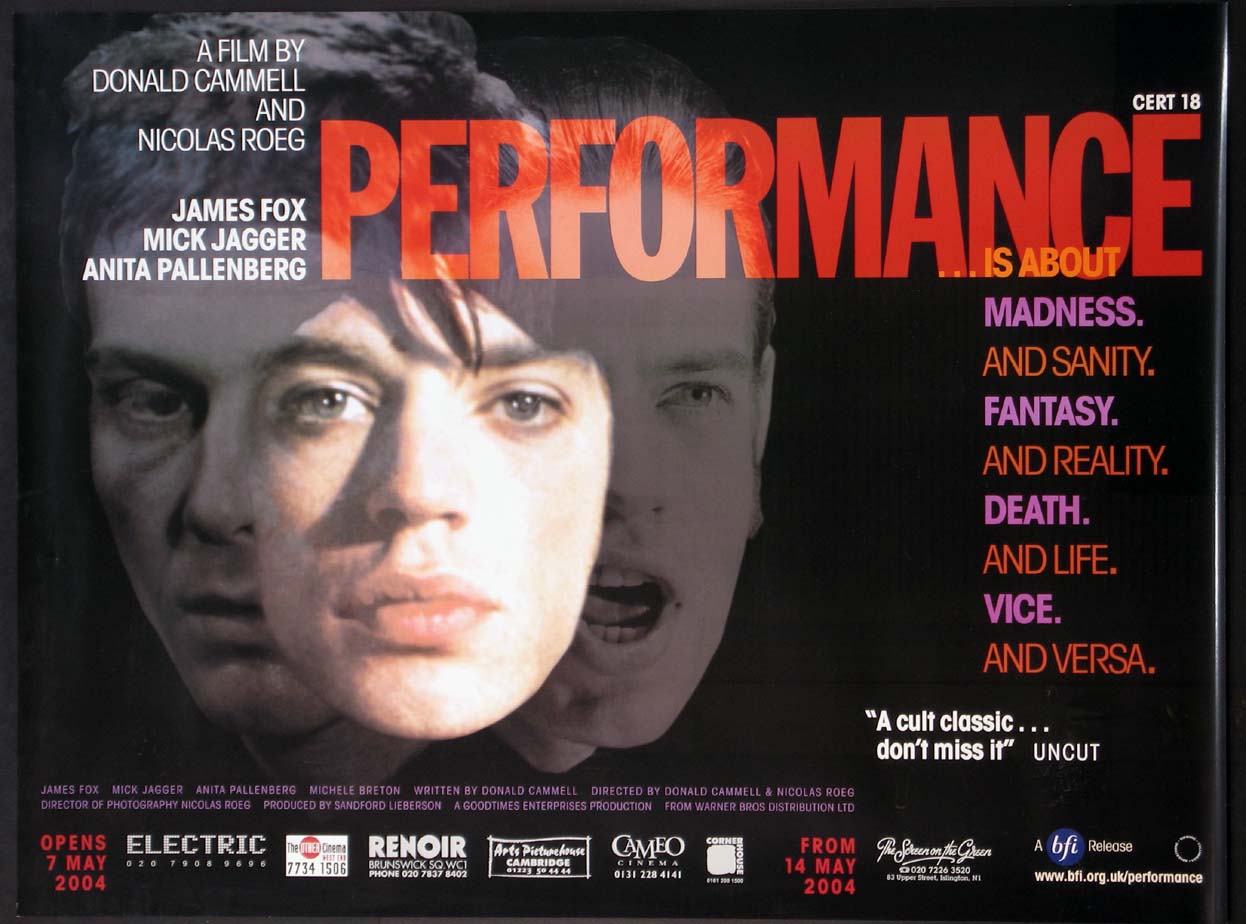
This is both a cult movie and a seminal British film. Chas, (James Fox) is an East End gang member who collects protection money. When his methods result in a killing he goes on the run and hides out in Notting Hill Gate basement, where, upstairs there is a ménage à trois. Chas becomes involved in the hedonistic activities at the house and, in particular with an ex-rock musician Turner (Mick Jagger).

The film became infamous for its melee of explicit violence, sex and drug-taking. The 1970s also became infamous for the clash between adventurous film-making and conservative values, embodied in another British film The Devils (1971) and the campaign against it by an organisation called ‘The Festival of Light’.

This film was produced by Warner Brothers, who also were involved in the equally controversial A Clockwork Orange (1971). The studio executives did not know how to manage the film and enforced cuts in the finished property. The British Board of Film Censorship [as it then was] made more cuts. On release it received an ‘X certificate’ whilst in the USA it received an ‘R’ rating. It received similar certificates in other territories and often additional cuts. The USA release suffered the further indignity of having some cockney dialogue being dubbed [re-voiced]; a fate also experienced by the radically different Kes (1969).

Two people received director credits. Donald Cammell, a bona fide maverick, who wrote the screenplay and was also associate producer. He was born in Edinburgh in the ‘Outlook Tower’ later home for a ‘Camera Obscura’; how apt. Cammell started out as a painter, took up script-writing and then Performance. This is his most famous and successful film; later works have a similar combination of the exotic and the erotic, but not the acclaim.

His fellow director was Nicolas Roeg. He was born in London; and also appropriately nearly opposite the old Marylebone Film Studio, used at one point by Hammer Films. He started out as a cinematographer and indeed shot this film. He went onto direct several successful and highly praised films, including Don’t Look Now (1973), screened in a digital version here last week. He had an unconventional style of film photography. One critic, Steve Rose, remarked that his films

“shatter reality into a thousand pieces” .

His film work, as in this title, is always memorable.

The film runs 105 minutes in colour and black and white, and in the European widescreen ratio. This screening presents the restoration by the BFI from 2004 in 35mm.

The background to the film and its handling by the industry and censors will be illuminated in the Q&A that follows with Sanford Lieberson, the producer on the film. His other work includes a number of documentaries including the very fine ‘Brother Can You Spare a Dime (1975). He will be accompanied by Jay Glennie who has produced a book; ‘Performance: 50th Anniversary Book’.

One Giant Leap

Screenings celebrating the 50th anniversary of the Apollo 11 moon landingApollo 11

With the 50th Anniversary of the Apollo 11 moon landings this year, filmmakers across the world have been endeavoring to tell their interpretation of the events that led the human race to make one small step for [a] man. First, Damien Chazelle brought us the underwhelming First Man towards the end of 2018. Despite a career defining score from Justin Hurwitz and breathtaking Apollo sequences, the focus on flat character drama drew away from the best elements of the film – the awe, wonder and danger of the missions themselves. For a more gripping take, it may be worth checking out documentary: Armstrong, coming to the picture house this weekend (Sat 3pm, Sun 1:15pm). It’s a must-see film for anyone who wants to look behind the curtain to see the true story of a quiet man’s journey from rural Ohio to taking the first steps on the moon.

There’s one more screening at the Picture House of the unmissable Apollo 11 (Wed 24th 1:20pm) . It’s clear from the start that this is the definitive moon landing film. Using stunning remastered footage from 1969 alongside a score rendered only using techniques from the same decade; Apollo 11 fully transports you back in time. For those familiar with the rhythms and beats of the famous journey already you can rest assured that this film will bring you something new. The film is so effective in its storytelling power that you feel tension and mystery at every moment. Will the eagle make its landing? Of course, it will, we know that. But somehow, I found myself questioning the facts I knew to be true every step of the way. The film is by no means perfect – sometimes overdramatic while at other points slowing down to focus on what feels like trivialities. But by the time that Mother Country starts playing on Buzz Aldrin’s tape deck none of that matters. The USS Hornet comes into view and we know that despite absurd odds, an American dream came true.

Keep a look out for Apollo 11 in the documentary category in awards season. It’s currently the frontrunner in the category with Asif Kapadia’s Diego Maradona just behind.


Callum Isaac

Half a year’s viewing

‘An Elephant Sitting Still’

The following are the films that I most enjoyed and was most impressed by in the first six months of the year.

An Elephant Sitting Still / Da xiang xi di er zuo (China, 2018)

This is a four hour epic in ‘miserabilism’ but a powerful representation of life on the lowest rungs of society. It was the first and only feature directed by Bo Hu.

Ash Is Purest White / Jiang hu er nü (China, France, Japan 2018)

Another fine movie from director Zhangke Jia; he follows his muse Tao Zhao across regions and periods in the manner of the preceding Mountains May Depart / Shan he gu ren (China, France, Japan 2015, not seen in Leeds].

Happy as Lazzaro / Lazzaro felice (Italy, Switzerland, France. Germany 2018)

A ‘holy fool’ is found first in the countryside then in the run-down urban setting. Mixing myth and contemporary exploitation in a fascinating parable.

Rosie (Eire 2018)

This is a powerful drama taken from real life. The screening was also an event in which participants in the film talked about the work.

‘Rosie’

3 Faces / Se rokh (Iran 2018)

Film-maker Jafar Panahi produces another exploration of Iranian culture in typical quirky fashion.

And one archive film,

Rosa Luxemburg (West Germany, Czechoslovakia 1986)

Part of the programme of films directed by Margarethe von Trotta. Whilst the political representation is limited Barbara Sukowa is excellent as the revolutionary heroine.