A Season in France/Une Saison en France (France, 2017)

Friday 28th June at 6.15 p.m. and Wednesday 3rd July at 6.15 p.m.

This is the new film by Mahamat-Saleh Haroun, a filmmaker from Chad who has lived and partially worked in France since 1982. His new film deals with the important issue of refugees and migrants and dramatizes the experience of an African widower and his children who  are forced to flee to France from Central African Republic.

Several of Haroun’s earlier films have screened at the Picture house. There was Bye Bye Africa (1999), an unconventional docu-drama in which a slightly fictionalized Haroun visits and films his native country of Chad. It is an ironic and occasionally bitter record of Neo-colonialism in Africa. His next film Abouna (France, Chad 2002) follows two young boys who seek their father across Chad, including in the desert regions. A powerful drama which was beautifully filmed by Abraham Haile Biru, it won the prize for cinematography at The Panafrican Film and Television Festival of Ouagadougou (Festival panafricain du cinéma et de la télévision de Ouagadougou or FESPACO). This Festival is a major forum for African film.

Daratt  (which translates as ‘Dry Season’, was funded by France, Belgium, Chad and Austria in 2006). The film follows a young boy who has suffered in the Civil War [2005 to 2010] but who finds a new life in a bakery. A Screaming Man  / Un homme qui crie  (France, Belgium, Chad 2010)was once again set in the period of the Civil War as a father and son struggle to cope with the adversities of their situation.  Grigris (Chad, France, Belgium 2013) only received a single screening at the London Film Festival but no British-wide distribution.

Haroun’s film dramatize the ill effects of Colonialism and Neo-colonialism in Africa, especially that region once termed ‘Francophone’. His stories also frequently revolve around fathers and sons, making for powerful and emotional dramas. And he has a fine sense of visual presentation and has worked with really talented craft teams. Now his new film is receiving the release [though limited] his work deserves. But the two screenings at the Picture House are likely to be rare opportunities to see the movie in its proper theatrical setting.

If you want a preview:

A Report From the AGM

My first time at Hyde Park Picture House (HPPH) was to see Much Ado About Nothing in 1993 – I was still at High School. I’m a huge Keanu Reeves fan and because this film was not to be shown at the former Odeon or ABC cinemas, off I went to the HPPH feeling exceptionally cultured to watch my true love play a plain-dealing Shakespearean villain.

I’m sure there are many of us who have similar first-time memories of visiting the HPPH. I took the opportunity to volunteer to contribute blog posts to the Friends of Hyde Park Picture House (The Friends) and was really excited about being invited to attend the AGM and to write a report from the perspective of a new volunteer.

The AGM

The meeting started with committee member Ian Sanderson giving a tribute of a founding member and former Chair Peter Chandley who died last year. It was nice to hear about Peter and how passionate he was about the cinema.

10% of members needed to be in attendance at the meeting to be quorate (having the necessary number of people present for decisions to be made). There were only 49 at the meeting out of approximately 700 members. I wondered how well it had been advertised and if the importance of being in attendance was stressed, especially if decisions were to be made.  Fortunately there were only procedural matters that required a vote this year and these will be carried over to a Special General Meeting on July 15th.  The Friends are now a registered charity and the committee wanted the group to stay focussed and relevant to members (who pay an annual membership fee) and recognise the importance of getting more people to attend future AGMs.

The purpose of the committee and The Friends was discussed at length and to me, it was not as clear as it should be (something the committee acknowledged and want to work on). When the cinema was in danger of closing, The Friends are the ones who saved it. Now it’s thriving and from January 2020-December 2020 the cinema will be closed and massive renovations will take place. Plans will be to add a second screen, meeting rooms, to extend opening times, to increase programming and the number of film-related activities.

Where will The Friends fit into this new phase of specialist film showing in Leeds? One way is to ensure that HPPH continues to deliver a good variety of films. Should the HPPH be doing more or something different?

Wendy Cook (Head of Cinema) continued the meeting with an informative presentation on what had been achieved throughout the past year such as showing 374 different films and hosting 1172 private events. Two new members of staff have been recruited to join the small team – Creative Engagement Officer and Young Audience Officer. The HPPH is expanding into a new entity and the committee of The Friends would like to expand with it. There was a call for more volunteers to join the committee that reflects the community of Leeds. The Friends ultimately are the voice of the community who love and appreciate specialist films.

It’s an exciting time of change.

All ideas and names of potential committee members should be submitted before the 15 July 2019 via the contact form, Twitter (@friendsofhpph) or Facebook (FOHPPH) which is when there will be a Special General Meeting.

Meeting Highlights

  • The membership scheme is under review (suggestions are welcome)
  • Volunteers are needed to help sift through the archives
  • The topic of reinstating film appreciation clubs and group discussions was suggested
  • A variety of alternative venues will be used throughout the temporary closure
  • More blog contributors are needed

Links

Sometimes Always Never (UK, 2018)

Showing 21st-23rd June and 26th JuneSometimes Always Never Poster

A quick recommendation for Sometimes Always Never, the debut feature film from Carl Hunter which is showing this weekend at the Picture House. Scripted by Frank Cottrell-Boyce who has previously collaborated with Danny Boyle (Millions, 2012 Olympics Opening Ceremony) and Michael Winterbottom (Welcome to Sarajevo, 24 Hour Party People). It tells the story of a father (Bill Nighy) who is preoccupied by the disappearance of his grown son who stormed out over a Scrabble disagreement years earlier.

When I saw the film at the Keswick Film Festival, Hunter said he wanted to make something that was British but uniquely so and he employs many different techniques to achieve this. It will remind you of other things, for me it was Wes Anderson, but as a whole it is unlike anything else. The strong cast and writing tell a heartfelt and charming story and some great cameos and funny moments provide lots of entertainment.

There’s a great soundtrack by Edwyn Collins as well.

Come to the AGM

We’d really like to see more of you at the AGM on Sunday 16th June. Not only is it a great chance to find out what’s been happening at the cinema over the last year, there’s also free food and a screening of Let The Right One In in memory of our former Chair Peter Chandley who passed away late last year.

Our constitution requires 10% of the membership (around 70) to be present in order to vote on anything. We may not have any big decisions to make this year but if we don’t have a quorum another meeting will have to be arranged and we’d rather spend our time working towards our charitable aims.

Let the Right One In (Sweden, 2008)

Showing in memory of Peter Chandley as part of our 2019 AGM
Sunday 16th June: AGM 1pm,  Film 3:30pm
Let The Right One In

This work of art is a romance … a love story, but with vampires. The clue is in the title. Vampires must be invited in before they can safely enter someone’s home. But Let the Right One In is not simply a story of vampires, or a fresh take on serial killing. The film opens with Oskar (Kåre Hedebrant) exclaiming : “Squeal like a pig. So, squeal.” Our film tells a story of loneliness, of being picked on, of seeking revenge; and also of acceptance, loyalty and friendship.

Our backdrop is a snowy suburb of Stockholm in 1982. The locals cope with the desolation, freezing temperatures and the absence of sunshine through companionship, shots of alcohol, and Swedish humour. Lacke (Peter Carlberg): Thank you again for another evening steeped in merriment and friendship. Let the Right One In is a story told in pictures rather than words. You will discover that not everything is as it seems in the suburb of Blackeberg. Our film is also a story about identity, mortality, and sacrifice. The title’s English translation from the Swedish original is taken from lyrics to the song “Let the Right One Slip In” by Morrissey. And this sentiment applies to both love and dreams. While the film has a wintry backdrop a little red or orange colour creeps into most scenes. Expect surprises!

The central characters are Oskar and Eli (Lina Leandersson). Theirs is a beautifully acted, poignant relationship that seems to raise more questions than answers. We see humour and sensitivity. But underneath, is that a dark and dysfunctional friendship or a demonstration of love and interdependence? Are Oskar and Eli two sides of the same coin? Is there a barrier between them?

The end of Let the Right One In leaves us to ponder the future. Is anything resolved? Have we seen a happy ending? The film gives food for thought. Let the Right One In has won many awards for direction (director Tomas Alfredson), cinematography, acting and screenplay. John Ajvide Lindqvist wrote the screenplay which is adapted from his novel.

The Friends of the Hyde Park Picture House are screening this film in memory of Peter Chandley. Until his death late last year Peter was the Chair of the Friends, and we are indebted to him for the part he played in saving the cinema from closure in the 1980’s. Peter was an enthusiast for films like Let the Right One In. We hope you can join us.

The film forms part of the Annual General Meeting of the Friends of the Hyde Park Picture House on Sunday 16th June and both are free for members. It’s really important that we get at least 70 people to attend in order to be quorate so please try and make it along if you can.


Bill Walton

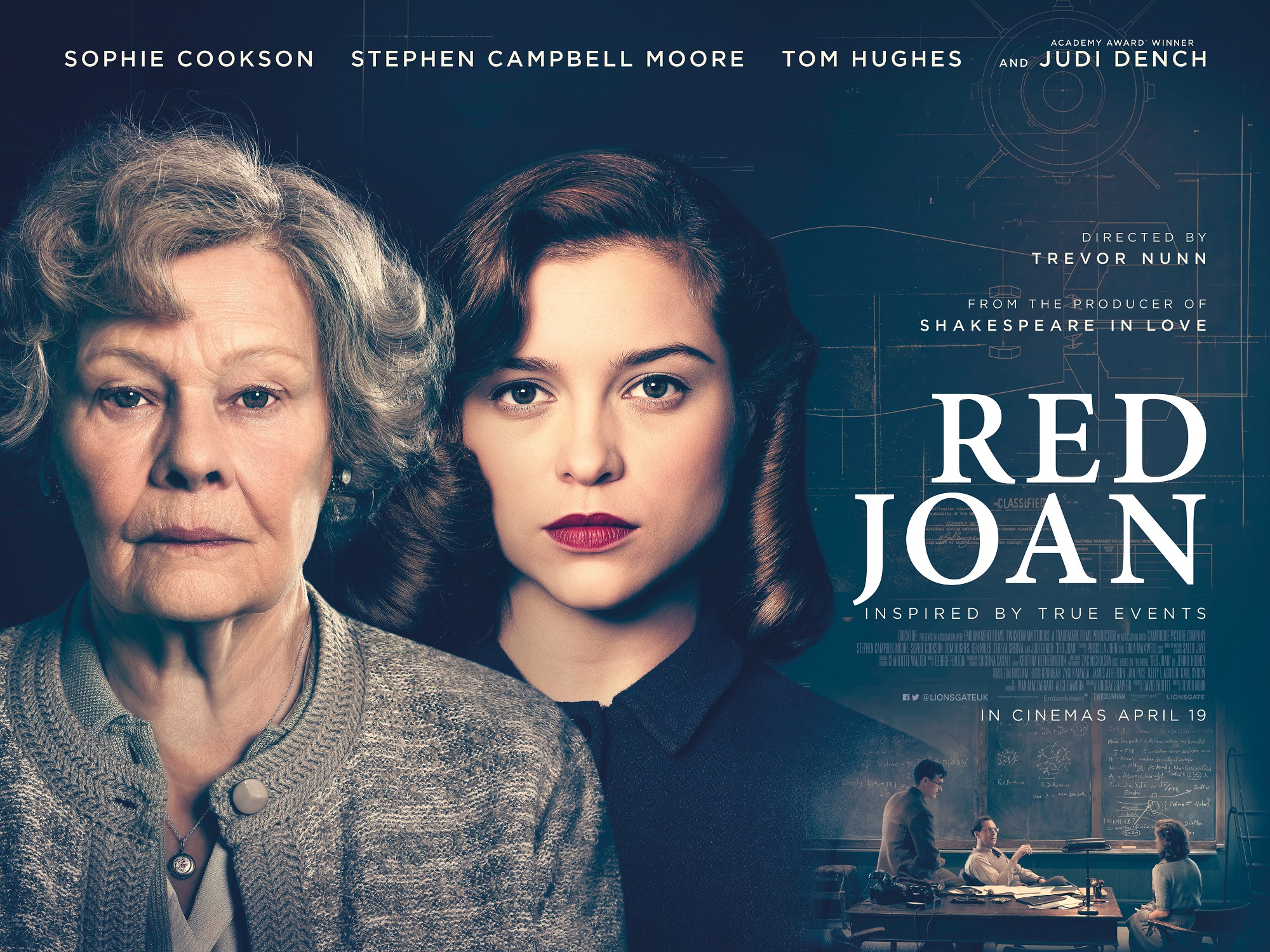
Red Joan, Britain 2018

Sun 2nd June 3.00 p.m., Wed 5th June 11.00am [BYOBaby] and 1.20pm

This is the story of a fictional character, Joan Stanley, who in the 1940s passed secret information to the Soviet Union. However, it and the novel from which it is adapted, are based on the life of a actual historical character, Melita Norwood. Norwood was exposed publicly in 1999 when information from an ex-Soviet agent and now-defector revealed her past activities.

The film version presents the story in a fairly conventional-style narrative [warning – plot spoilers]. The film opens with the arrest of Joan (Judi Dench) by Special Branch in 1999. Then we view a series of interrogations which are intercut with flashbacks by Joan to the 1930s and 1940s. The interrogations fill out the action in 1999 where information has led to the exposure of a senior Foreign Office official as well as Joan. The flashbacks presents Joan’s personal life and then her spy activities. At Cambridge ‘Young Joan’ (Sophie Cookson) meets glamorous European émigré Sonya Galich (Teresa Srbova) and cousin Leo Galich (Tom Hughes). Both are communist activists.

Continue reading

Join The Committee

We’re looking for more members to join our committee so we can better represent the diversity of the membership and all visitors to the cinema.

You can find out more about the committee in our handbook or come along to the AGM on Sunday 16th June at 1pm and talk to us.  If you wish to be included in the elections along with the current committee members at the AGM we need to receive a completed nomination form by this Sunday 2nd June however the committee will consider new members at any time.


Review: Madeline’s Madeline

Madeline's Madeline

“What you are experiencing is just a metaphor”

Madeline’s Madeline is the third feature film from experimental filmmaker Josephine Decker, which follows teen actress Madeline (Helena Howard) as she attempts to bring to life the artistic vision of immersive theatre director Evangeline (Molly Parker) and negotiate her fraught relationship with her mother Regina (Miranda July) along the way.

Lovers of Terrence Malick’s unique brand of film-philosophy are likely to find a second home in Decker’s artistic approach to themes of mental health, race and the conflation of life with art. The above quote, spoken by an unidentified nurse bathed in a halo of light, feels like an appropriate opening to a film which continually challenges its audience to decipher a complex web of perspectives, dream sequences and relationships presented in frenetic and, at times, frustrating ways.

Madeline is a biracial teenager whom we learn is recovering from a psychotic episode which prompted a stay in a psychiatric ward, perhaps the reason for the dreamlike opening to the film – a POV shot of a nurse looking down and seemingly speaking to a patient whilst bathed in a halo of light. Her interactions with people her own age are sparse, and her mother (Regina) alludes to her being bullied at school.

Regina is a nervous, seemingly introverted woman with a propensity to dissolve into emotional outbursts. She has clear difficulty in connecting with and deciphering the behaviour of her daughter, often interpreting Madeline’s exuberant behaviour through the lens of her mental illness.

As a result, Madeline is drawn to the confidence of theatre group director Evangeline, who not only praises and encourages her artistic tendencies but also wades into morally murky territory; after Madeline admits to a having a dream in which she harms her mother, Evangeline reveals she dreamt Madeline was her daughter.

As the narrative develops, Evangeline places Madeline at the centre of the theatre groups project, weaving her problematic relationship with her mother into the performance, seemingly oblivious to the insensitivity of a wealthy white woman using a biracial teenager with mental health issues as the base for her own artistic aspirations.

The above might sound like a relatively middle-of-the-road drama, but it brings its subjects to life through incredibly distinct formal treatment. Characters are captured with a roaming handheld camera, which ducks and dives around sets, tilting on its axis and occasionally getting distracted and panning up to focus on the branch of a tree or swirling clouds in the sky above.

Shots open in deep focus before shifting to shallow focus, denying the audience an omniscient viewing experience whilst also feeling deeply present in the character’s interactions. This happens in reverse too, where shots open open in an unfocused state and gradually shift back to clarity. Extreme close-ups of mouths, hands, eyes and sometimes the backs of heads break bodies up into their constituent parts.

These stylistic choices occasionally feel infuriating, but in their totality they hang together with a certain beauty. Are we experiencing the world through the mind of Madeline? The perspective is never truly clear, and Decker seems at pains to offer no judgements on the behaviours of her characters who are all, at times, manipulative, angry, loving and deeply in tune with one another. Perhaps the fractured formal quality of this film seeks to do away with the tropes of ‘good’ and ‘bad’ people in film making and to simply present life as it often is – chaotic.

Evangeline captures this notion by quoting Carl Jung:

“In all chaos there is a cosmos, in all disorder a secret order, that the pendulum of the mind swings between sense and nonsense, not between right and wrong.”

Two Fine Art Movies

Screening daily from Friday May 17th till Thursday May 23rd.

This Friday the new film directed by Claire Denis, High Life (2018), opens at the Picture House. Claire Denis is undoubtedly one of the really talented and interesting film-makers working in contemporary cinema. In this title she has presented her first film in an English language form; thankfully she has done a better job than a number of her fellow European film-makers. This is a science fiction story that opens on an odd box-like space ship heading far away towards a black hole. Inside we find Monte (Robert Pattinson) whose only companion is a very young child. A series of flashbacks fill in the events prior to this; Monte’s companions have fallen foul of the internal conflicts among the crew. We learn how the baby came to be on the space ship and the unusual social rules that produced the situation. Stylistically the film recalls the Soviet director Andrei Tarkovsky, especially his films Solaris (1971) and Stalker (1979). The plot at times appears to be lifted from the pages of J. G. Ballard and is both violent and a little disturbing: the BBFC have given it an 18 Certificate. The cast, which includes Juliet Binoche, is good. The production, including special effects, is well done. And once more Denis shows her ability to explore social and personal contradictions. The June issue of Sight & Sound has an interview with Claire Denis.

Screening on Saturday, Sunday and Wednesday afternoon this coming week

An equally fine film-maker, Zhangke Jia, has directed Ash Is Purest White / Jiang hu er nü (2018). The film covers several decades in the life of Qiao (Tao Zhao). Much of the film is set in Shanxi province in the north of China but at one point Qiao travels south to the Three Gorges in Hubei province [seen in earlier Jia films]. Qiao is involved with a “jianghu” gangster (Fan Liao). The effects of this relationship and the mob violence affect her life but throughout she remains cool and self-possessed. Tao Zhao is impressive as Qiao. She acts a muse for Zhangke Jia, having appeared in his earlier films including the very fine Mountains May Depart / Shan he gu ren (2015). This film has the same epic quality and it happily screens in Leeds, a city that missed out on the earlier title. The production values in all departments are excellent and both the action and the settings fully engage. The language in this title is Mandarin with English sub-titles.

The movie comments on recent and contemporary China; I thought one point referred back to the coup by capitalist-roaders following the death of Mao Zedong. Tony Rayns has an article in the May issue of Sight & Sound which includes comments by the director and explains some of the distinctive Chinese aspects, including the title rendered in English as ‘Sons and Daughters of the Jiangsu, a word appropriated by the underworld and originally referring to “the parallel world in which martial arts fictions is set.”