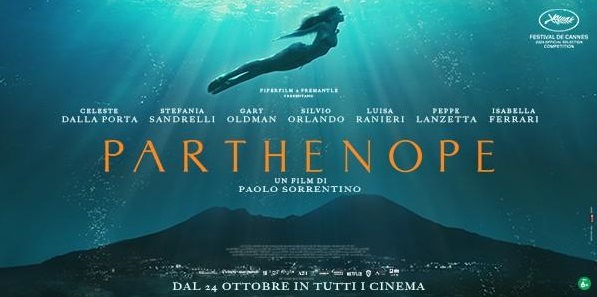
Parthenope, Italy / France 2024.

This new film from Paolo Sorrentino is screening at the Picture House over the coming days. His earlier films have been really impressive with great style but also a heart at the centre. I found this film a little disappointing because it did seem to lack heart to a degree. However, the visual and aural quality is very fine and Sorrentino is clearly working with a very talented group of craft people.

Parthe [for short] is the central character and at her birth in 1950, in the wealthy suburb of Naples, she is christened after a mythical Greek siren. Legend has it that the original Parthenope drowned in the waters off Naples and gave her name to an early settlement there. So Parthe is a reflection of the city, birthplace of the director.

From her birth the movie cuts to 1968 when Parthe is eighteen and is part of a triangle of her older brother Raimondo and the son of the family housekeeper, Sandrino. As in The Great Beauty events in this period mark both Parthe and her family for years to come.

The movie follows Parthe’s career as a student of anthropology and then as an academic who specialises in the study of miracles. She briefly toys with becoming an actor but settles for University life. She also has a number of relationships and affairs. The theme of miracles in reflected in several episodes.

She leaves Naples in later life but this is covered by an ellipsis in the narrative and the movie ends back in Naples. The narrative is absorbing, the characters and setting are finely presented, as are the sets and costumes. It is a visual feast and the soundtrack of sound and music is also excellent. The cast are very good though the script does not develop all the characters sufficiently; Gary Oldman is wasted in a cameo. I found some scenes and/or dialogue humorous and witty.

The title is in colour, with black and white, and 2.39:1; with the dialogue, Italian, Neapolitan and English, translated in subtitles. It runs 147 minutes but did not seem overlong. The production was made on digital formats and mastered at 4K. The DCP is also in 4K which does proper justice to the cinematography and music. The screening on May 25th at the Picture House is in auditorium one and the laser projector there will present the title to proper effect.

May’s First Thursday

Please join us on May 1st at 9pm onwards in the cinema bar to discuss all things film including but not exclusively Licorice Pizza which HPPH is screening as part of its Philosophy and Film strand that evening from 6pm.

Licorice Pizza has been selected by Dr. Colette Olive and will be followed by a short talk from Colette exploring the philosophical themes raised.

Tickets are already selling fast for this screening so we recommend booking if you want to join us.

‘First Thursday’ is our monthly meet up to give members and anyone interested in the Friends, or cinema in general, a chance to get together.

Please note: due to a licensing issue the screening will no longer be from 35mm and will be projected digitally.

April’s First Thursday

Please join us on April 3rd at 8pm onwards in the cinema bar to discuss all things film. Some of us will be watching The End at 5:10pm and if you already have your tickets there should be time to say hello before the 8:20pm screening of La Cocina. Both of these films are screening all week along with more chances to see I’m Still HereSantosh and Anora.

‘First Thursday’ is our monthly meet up to give members and anyone interested in the Friends, or cinema in general, a chance to get together.

The Japan Foundation Touring Film Programme 2025

Takemine Hideko in ‘Carmen Comes Home’

This is an annual event and the good news this year is that titles will be screening at the Hyde Park Picture House. In all the programme will be visiting 33 venues across Britain. There are 24 contemporary titles, released since 2018 and there are two ‘classics’ from the last century. The programme offers a variety of genres and themes whilst the title,

Am I Right? Justice, Justification and Judgement in Japanese Cinema

suggests a strong social element. The Programme web pages provide links to all the participating venues, with lists of the titles screening there and links to individual title pages.

The Hyde Park is screening four titles from mid-February to early March. One of these is a ‘classic’, though unlike in earlier years, we will not enjoy a 35mm print.

Carmen Comes Home / Karumen kokyô ni kaeru, (1951) is a comedy starring Takemine Hideko. Okin has left her rural home town in Nagano prefecture to work in Tokyo as a stripper, stage name Lily Carmen. She returns to the town with a friend where the local people are both fascinated and scandalised by this entertainer from the capital. Takemine Hideko was one of the major stars of Japanese cinema in a long career from late silent period (1929) until the 1970s. She worked with many of Japan’s most celebrated film-makers. This film was directed by Kinoshita Keisuke, whose very fine Snow Flurry / Kazabana (1959) was the classic film in the 2024 programme. Carmen was the first film to be made in colour in Japan, in Fujicolor and academy ratio. It was produced at the Shochiku Studio and the digital restoration was completed in 2012.

‘Ghost Cat Ansu’

The other titles at the Picture House are all recent. Ghost Cat Anzu / Bakeneko Anzu-chan is a colour animation released in 2024. Anzu of the title is a Ghost Cat or Bakeneko; a supernatural entity found in a number of Japanese folk tales. In this quirky drama Anzu takes eleven-year-old Karin on a magical journey. In the Wake / Mamorarenakatta mono-tachi e (2021) is a social thriller with serial killings but set in the city of Sendai (on the east coast of central Japan), struck in 2011 by the earthquake and subsequent tsunami, raising the wider problems of life there. Sakura / Kuchinai Sakura (2024) is another type of policier, here an investigation delves into the murky world of police and the national intelligence agency.

Oddly, it appears that none of the titles will be screening in Bradford at the Media Museum. But York’s City Screen and the Sheffield Showroom are screening some of the other titles, seven not in the Picture House programme. The Showroom will include the other classic in the Foundation programme, The Inugami Family / Inugami-ke no ichizoku (1976). The film was directed by Ichikawa Kon, a prolific film-maker whose best known works in the west are The Burmese Harp / Biruma no tategoto (1956, and remade in 1985) and An Actor’s Revenge / Yukinojô henge (1963). This film is reckoned to be an example of Japanese noir. The titular family come together for the will of the rich deceased family patriarch. The beneficiaries of the will and its surprising requirements lead to family dissensions. Then a murder occurs and a detective has to come in and solve the crime. Surprises abound right through the movie. It runs over two hours in colour and an unusual widescreen format.

‘The Inugami Family’

In past years the programmes have offered a rich and varied menu from one of the world’s most interesting and rewarding cinemas; so these screenings promise to be a cinephiles’ treat.

A Complete Unknown

Timothée Chalamet as Bob Dylan

After a successful Festive Screening of Perfect Days in December our next ‘First Thursday’ Film Club meet up is on February 6th after the 5:00pm screening of A Complete Unknown. Come along and watch the film with us, or see it anytime from the 31st January, and then join us in the bar around 7.45pm on the 6th to discuss it.

“Even a skeptic can be swept away by its heady mix of laidback assessment and genuine awe.” – Richard Lawson, Vanity Fair

“The wonder of A Complete Unknown isn’t just that it manages to be good anyway but that it finds an angle on Dylan as unexpectedly electric as that amplified Newport set.” – Alison Willmore, New York Magazine/Vulture

Revisiting 2024

The Picture House staff have produced a list of their top 50 films of the last year. There is a top ten on which regulars and friends can vote for a film to be re-screened in the coming days. However the film I would most like re-screened is in the top fifty but not the top ten. I suspect some readers may face the same issue. So I thought it was worth posting on my choice. It will be interesting to see if any other readers share this choice or indeed if they have other choices from the list.

Mine is Nuri Bilge Ceylan’s About Dry Grasses / Kuru Otlar Üstüne, (2023), listed at 14. As with most of his features this is scripted by Nuri with his partner Ebru. The feature runs for 197 minutes, in wide screen and colour; shot using digital formats. Set in the Turkish region of Anatolia, like most of Ceylan’s dramas, it focuses on a young teacher working in a remote village.

Ceylan’s movies are always worth watching; he is one of the finest film-maker working today. And in widescreen and colour it deserves to be seen in a cinematic forum, preferably on the laser projector in screen one.

There were [as I remember] several screenings at the Picture House but I was away and missed them. And there has not been an opportunity since to catch the title at a cinema.

Films of 2024

As the Picture House staff and volunteers have announced their films of 2024 we thought it would be interesting to see what our members thought of 2024. Have they missed anything? Do you agree? What were your cinematic highlights of the year. Let us know in the comments below or use the contact us form to send us a message.

Number 4 in their list and one of our favourites is Perfect Days which is why we’ve decided to have it as our ‘Christmas’ Screening this year. We hope some of you can join us on Sunday 29th December for the 4pm screening and a chance to chat about the film, 2024 and what else you are looking forward to in 2025.

 All We Imagine As Light

A group of people dressed in blue sit in a theatre, attentively watching something.

Our next ‘First Thursday’ Film Club meet up is on December 5th after the 5:50pm screening of All We Imagine As Light. Come along and watch the film with us or see it anytime from the 29th November and then join us in the bar around 8pm on the 5th to discuss it.

All We Imagine As Light was the first Indian film to be selected in the Official Competition at Cannes in three decades. Payal Kapadia also made history as the first female Indian filmmaker ever to have a film in this prestigious section of the festival. A worthy winner of the Grand Prix and one of the best films released this year.

Centring on three co-workers and friends, Payal Kapadia’s film alights on moments of connection and heartache, disappointment and hope. Prabha, her husband from an arranged marriage living in faraway Germany, is courted by a doctor at her hospital; Anu carries on a romance with a Muslim man, which she must keep a secret from her strict Hindu family; Parvaty finds herself dealing with a sudden eviction from her apartment.

Kapadia captures the delicate intricacies of their lives within the bustle of the soaked metropolis and open-air tranquility of a seaside village, with equal radiance, articulated by her superb actresses and a stunning naturalism, which employs a European aesthetic to further enhance the film’s emotional core.

“It is both dreamlike and like waking up from a dream. This is a glorious film.” – Peter Bradshaw, The Guardian

“The film is a reminder of the transcendent power of cinema, even, and perhaps especially, when not all that much is happening” – Lindsey Bahr Associated Press

All We Imagine As Light is showing daily from the 29th November and tickets can be booked now.

Wedding in Galilee / Urs al-Jalil, Palestine, France, Belgium 1987

This film is screening on Sunday at the Picture House as part of the Leeds Palestinian Film Festival. It was the first feature film shot by a Palestinian film-maker, Michel Khleifi, in occupied Palestine. Galilee is in what passes for the Israeli state and this drama is set before the 1967 war and the extension of the occupation to the Gaza, West Bank,and territory in Lebanon and Syria.

This a different world from that when the film was produced, just before the First Intifada; and very different from the Zionist campaign of genocide, ethnic cleansing and assaults on neighbouring peoples.

The wedding of the title is of the son of a village Mukhtar [head man]. His village is under martial law and he has to seek permission from the local Military Governor who agrees on condition that he and his aides can attend the ceremony.

Most of the film is taken up with the ceremony; a rich tapestry of Palestinian traditions, both Christian and Muslim. But the tensions caused by the presence of the occupiers exacerbates divisions within the Palestinian community. As the day progresses both personal and communal conflicts reach a climax.

This is a fine piece of film-making, actually shot in villages around Nazareth and the nearby West Bank. The complex narrative not only explores the contradictions of the occupation but also presents the import of the land to Palestinians and the important role that women play in resistance.

There is an excellent article on the film by Ella Shohat in the Middle East Information and Research Project from 1988. And two guests will be illuminating the film after the screening. The film is being projected from a 16mm print in colour, widescreen and with English sub-titles. There is also a review with much of the film’s plot discussed.

Review: Anora (2024)

Don’t forget you can join us in the bar after the 5pm screening to talk about Anora and other films at our First Thursday Film Club.

Writer-director Sean Baker has returned with his latest film, Anora. After winning the Palme d’Or at Cannes Film Festival earlier this year, alongside its initial reception, Anora has easily become one of the most anticipated films of 2024. After waiting for its release for what seemed like forever, I was more than ready to attend the first showing at the Picture House.

Mikey Madison gives a phenomenal, standout performance in the titular role that lingers long after the film ends. The starry-eyed Anora, who prefers Ani, is a 23 year old sex worker who dances in a Manhattan strip club. It is here that she meets Ivan or Vanya (Mark Eydelshteyn), the unfledged son of a wealthy Russian oligarch. Vanya soon makes Ani a business proposal à la Pretty Woman to be his girlfriend for the week. Enticed by the payout and by his life of frivolous excess, she agrees. Ani begins to fall for Vanya and her character is initiated into his world through head-spinning, reeling romantic montage. After their impromptu marriage (set to an unexpectedly moving needledrop), Ani believes this to be her golden ticket out of the club for good. Hopeful, uplifted and disarmed, we are enticed into the fantasy alongside Ani – tantalised by the prospect of a better life.

Once Vanya’s parents hear the news of the pair’s nuptials in Russia and of Ani’s profession, they set out to annul the marriage with the help of their associate Toros, flawlessly portrayed by Baker’s long-time collaborator Karren Karagulian. The film descends further into chaos when events lead Ani to assist Toros, his brother Garnick (Vache Tovmasyan) and gentle henchman Igor (Yuriy Borisov) in a manhunt for Vanya. As the foursome embark on a voyage through the streets of Brooklyn, the night tailspins into a sobering series of events, emphasised by flash cuts and overlapping, clamorous New York accents – reminiscent of the Safdie brothers’ Good Time (2017) or Uncut Gems (2019).

Baker is no stranger to this kind of storytelling. As seen in preceding titles Starlet (2012) and Tangerine (2015), the stories of sex workers are often at the forefront of his work. Baker’s films are typically structured as comprehensive character studies, employing realism to authentically explore the human condition as it relates to poverty, class, and living on the margins of American society. Anora is no doubt a continuation of this style and these themes, however confronts wealth and apathy in a way not before seen in these earlier titles.

Anora deconstructs the rags to riches trope with brutal honesty. The film is a tragicomedy akin to life itself, finding glints of light in its darkest moments. Amidst the calamity, the cast preserve a tactful, comedic tone that cuts through the bleakness. Ani, beneath her glittering exterior and professional persona, is a gritty, wilful and fierce character, able to hold her own in otherwise distressing circumstances. Her determination to escape a life of poverty propels the narrative forward. As though it were a survival instinct, she remains unrelenting in her own self-assurance and preservation, refusing to loosen the grip on her American dream until the bitter end.

Exhilarating, tender and utterly captivating, Anora is definitely one that you won’t want to miss on the big screen.

Sophie Laing

Now showing at the Picture House and as part of Leeds International Film Festival and the Friend’s First Thursday Meetup will be taking place after the 5pm screening on the 7th November