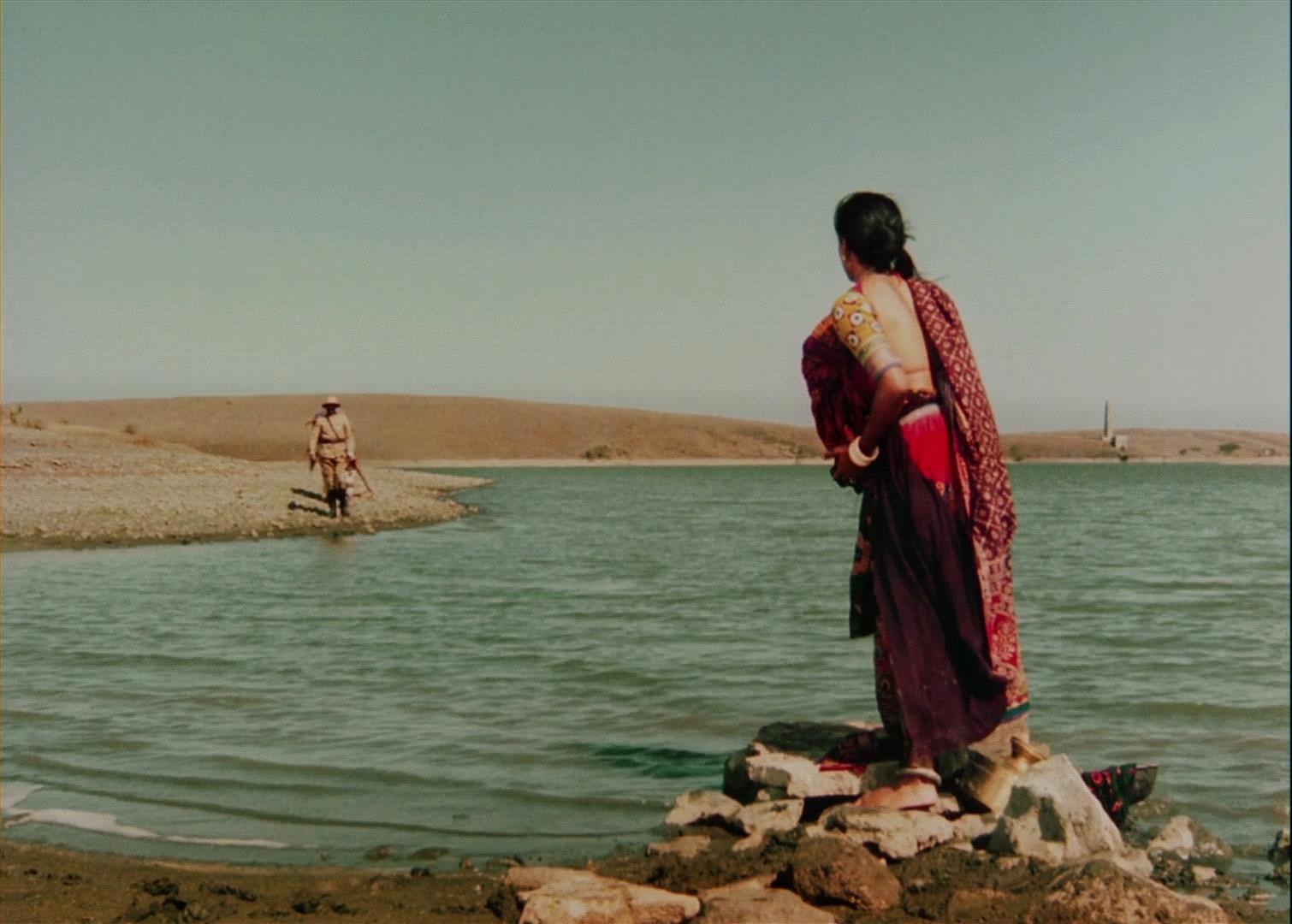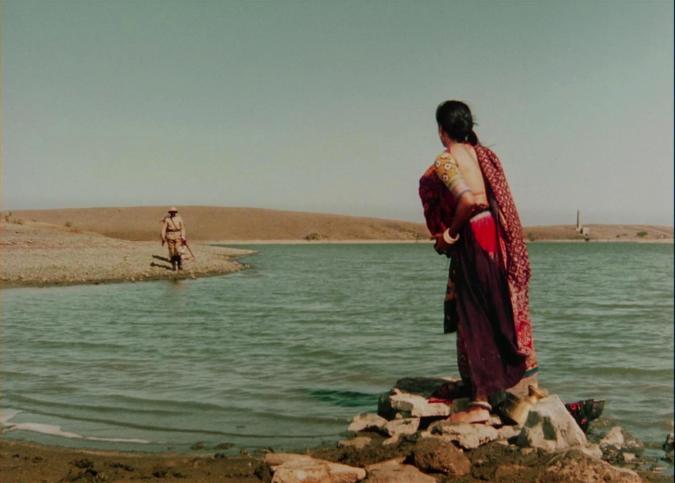
Mirch Masala, India 1987

This title is part of a retrospective of films featuring Smita Patil. She was an important and successful actress in the sub-continent from the mid 1970s until the late 1980s; she died only aged 31 in 1987.

Many of her best films were part of India’s parallel cinema; a counter cinema to the mainstream cinemas of which the Mumbai / ‘Bollywood’ is the best known. These films were closer to art cinema, often consciously critical and even revolutionary and eschewing the melodrama, songs and dances that epitomize the dominant film mode. Patil worked with a number of major parallel cinema directors, including the best-known Shyam Benegal and Mrinal Sen.

This movie was directed by Ketan Mehta and co-written with Chunilal Madia, adapted from one of his Gujarat short stories. The story is set in a small village in 1930s British colonial India. It is not clear if this is an area directly ruled by the British or is a part of one of the supposedly independent kingdom’s or principalities.

The village is visited by a Subedar [tax collector] with his accompanying troop of armed horsemen.

Such tax collectors were noted not just for the brutal way they enforced collection but in addition taking village valuables, resources and even women for their own use. In this case the visiting Subedar (Naseeruddin Shah) is taken with Sonbai (Smita Patil), the wife of Shankar who leaves the village to work on the Railway, that iconic network in the subcontinent and Indian Cinema. The village is divided by caste and the village Mukhi (leader – Suresh Oberoi) seems to have exploited and stolen the land of the poorer members through usury.

The women from poorer households work nearby sorting and processing red peppers, a site known as the factory. The title of the film translates as ‘Hot Spice’ and the peppers function as an actual and symbolic prop in the drama. Indeed the movie is saturated with the colour red. There is little sign of the men of the village involving in work and they clearly dominate and restrict the women.

Two sub-plots in the narrative involve the wife of the Mukhi, Saraswati (Deepti Naval) attempting to enrol her daughter Munni in the local school. The school master (Benjamin Gilani) is a lone follower of Gandhi in the village. Meanwhile the Mukhi’s younger brother (Mohan Gokhale) wants to elope with Radhu (Supriya Pathak) but her lower caste stands in their way.

The Subedar threatens the village men with reprisals if he cannot lay hands on Sonbai. The only resistance is by the school master: Abu, the watchman at the factory: and some of the fellow women of Sonbai in the village.

This is a powerful drama which dramatises both the sexist structure of the society and the repressive weight of the colonial occupation; though we never see or hear the British colonial authority. Patil is excellent as are her fellow actresses as the village women. The players of the male characters have minor roles, except for Om Puri as Abu and with the Subedar larger than anyone or even life. The film follows the style associated with the spaghetti western, which was very influential in Indian film in the 1970s and 1980s: as with the star vehicles of Amitabh Bachchan like Sholay (1975).

This was a screening of a digital transfer; there do not seem to be any 35mm prints, either in this programme of in the Festival itself. The quality was good and the important colours looked fine. It was shot in 1.66:1, in Hindi and has English sub-titles. The running time was given as 128 minutes, but I thought it was more like 120 minutes: Movie Database gives 121 minutes.

Unfortunately this is the only title of the five in the retrospective screening at the Picture House. Indeed, the number of Festival titles here seems down on 2023 and that year was lower than the pre-pandemic era. Given that the Festival originally started at the cinema, along with the development of the Friends, I find this disappointing.
First Thursday Film Club: Anora

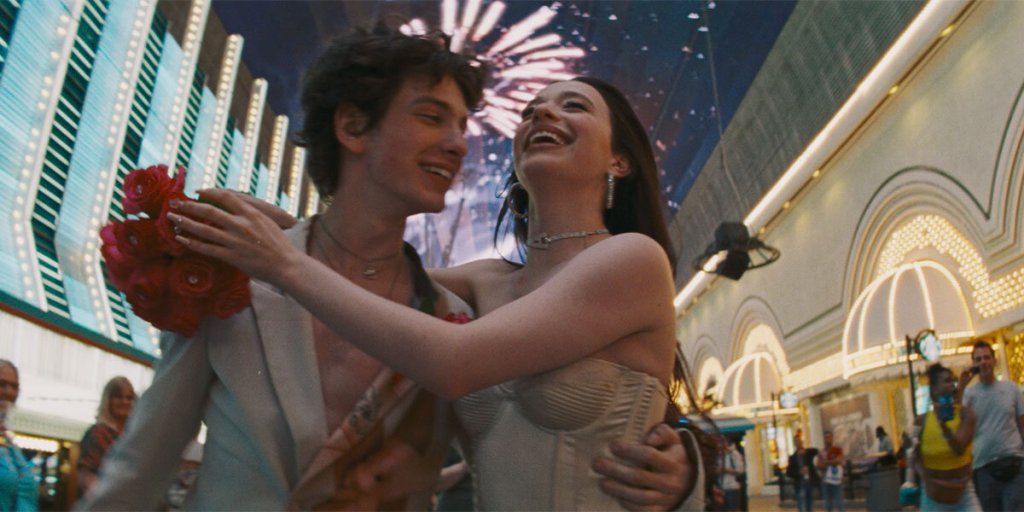
For November’s ‘First Thursday’ Film Club on the 7th November we’ll be meeting in the bar after the 5pm showing of Anora in screen 2. Anora is the latest film from Sean Baker (TangerineThe Florida Project) and won the Palme d’Or at Cannes Film Festival. It’s screening at the Picture House from Friday 1st November and is also one of the many films showing at the Leeds International Film Festival. If you can’t make the screening on the 7th and want to see the film some other time you’d still be welcome to join us around 7:30pm. Meeting at the end of the first week of the Festival should also mean we have plenty of other great films to talk about.

“Watching Anora is like riding shotgun alongside a reckless driver. Sean Baker is one of the brightest and most original filmmakers of his generation. He is one of a kind, and so is Anora.” – Leonard Maltin

“A wildly entertaining, modern-day screwball comedy set in 2018 that barrels through New York and Las Vegas. Mikey Madison is a revelation.” – Wendy Ide, Screen International

The film is showing every day from Friday so we hope you will get chance to see it and then join us on Thursday to talk about it.

Book Tickets

Strange Darling (2024)

Strange Darling completely shatters every expectation you might have of what initially seems to be a fairly cut and dry serial killer film: every chapter completely rips the carpet out from under what you think is going on between Willa Fitzgerald (The Lady) and Kyle Gallner (The Demon). Is it a one night stand gone horribly wrong? Is it some kinky game gone astray? 2024 has brought us some of the blandest films imaginable, so it’s refreshing to see a film from a director who is in full command of his craft and can play with the audience like a puppet-master.

The film marks both the debut of long-time actor Giovanni Ribisi as a cameraman, and the most exciting new voice in American independent cinema with JT Mollner. This is Mollner’s second film after the western Outlaws and Angels, which premiered at Sundance in 2016.

Non-linear structures can be a crutch to mask a filmmaker’s failings, but with Strange Darling it’s all about the twists and turns, which are carefully calculated with each reveal during the film’s six chapters. It’s a really impressive movie. Both of the leads have been a round for a while. Fitzgerald is mainly known for her TV work in the Scream TV series and Netflix’s Fall of the House of Usher. Gallner already has a bit of a cult following, starting with Jennifer’s Body but more recently the Scream sequel/reboot, Smile and Dinner In America. Both give star making performances and if there was any justice in the world Fitzgerald would be a nominated for a Oscar…. she won’t. 

Mollner had to fight like hell to get final cut on the film after Miramax recut it (and this is the post-Weinstein Miramax!)—but after Tiffany Haddish advocated on Mollner’s behalf with Miramax CEO Bill Block and a contractually obligated test screening of Mollner’s cut, Miramax relented and Block actually personally apologised to Moller for his trouble. When you see the film, the idea that somebody could think a linear version would possibly work will baffle you.

There hasn’t been a film yet with this kind of strong depiction of the state of Oregon since Gus van Sant’s early films, even though films are shot there all the time like the Twilight films for example. The Mt. Hood territory where the film is set is prime Sasquatch country (Mt. Hood is the hotspot for sightings). It’s home to two eccentric hippie doomsday preppers—although Ed Begley’s character wants it to be known he was a biker not a hippie—with whom The Lady seeks refugee, so of course he asks her if she is sure it’s not the ‘Squatches after her. The film depicts the strange and vast Oregon woodlands, a place full of ‘Squatches, hippies, preppers, white supremacists and yes, even serial killers (Ted Bundy and the Green River Killer both operated in Oregon). It’s not hard to believe that Sasquatches and serial killers can run rampant there. 

Also, in a world where there is much too much mediocrity shot digitally, it’s refreshing to Strange Darling proudly proclaiming that it was “shot entirely on 35MM” the moment the company credits end at the beginning of the film. Just don’t try the preppers choice of breakfast you might gag when you see the film. 

Ian Schultz

Strange Darling is showing on Saturday 19th and Wednesday 23rd October at 20:40

The Outrun (2024)

For October’s First Thursday Film Club we’ll be watching The Outrun at 5pm on Thursday 3rd and then gathering in the bar for a chat to share our feelings on the film, or about film in general, from around 7:30pm. First Thursdays are a new meet-up organised by the Friends of Hyde Park Picture House but open to everyone.

Starring and produced by Saoirse Ronan, and adapted from the bestselling memoir by Amy Liptrot, The Outrun is a life-affirming story about living on the edge, healing and what it means to return home.

“This is beautiful filmmaking. This is cinema where everything matters, where every little detail adds up to create something seriously exhilarating to experience in the theater.” – Alex Billington, FirstShowing.net

“The Outrun’s true tether, however, is Ronan, and here she works to all her greatest strengths. The film wraps entirely around her, yet she’s far too honest an actor to ever play up to the audience’s expectations of a woman in crisis.” – Clarisse Loughrey, Independent

The film is showing every day this week so we hope you will get chance to see it and then join us on Thursday to talk about it.

Book Tickets

Lee, Britain / USA / Norway / Australia / Ireland / Singapore – 2023.

This is a biopic of the photo-journalist Lee Miller, [full biography on Wikipedia]. In this feature she is played in a fine performance by Kate Winslet. Winslet is also the co-producer and worked closely with the writers and first-time-director Ellen Kuras, previously known for her work as a cinematographer. The movie enjoys a fine production with a strong supporting cast.

The film opens in the 1930s when Lee Miller was transitioning from a model to a photographer. She collaborated for a time with Man Ray and was also his lover. We see and hear some of the surrealist circle though who is who is unclear, [unless you watch the captioned version]. Lee Miller was a ‘free spirit’ but this and her relationships are only partly presented.

The movie concentrates on the World War II period when Lee worked for the British edition of Vogue. She usually worked with a Rolleiflex camera, a larger format and less compact than the Leica camera many other photographer used: one of these being the U.S. Dick Scherman (Andy Sandberg). After distinctive work on the British home front Lee was able to accompany U.S. Forces in the campaign in Europe after D-Day. As with the British her gender restricted her access but she firmly resisted this. Her most famous works were the photographs she took of the camps and victims of the Third Reich’s holocaust. These were censured in Britain but finally appeared in the U.S. edition of Vogue. The form of the narrative is an interview where particular and famous photographs by Lee provide references for a series of flashbacks. The interview and the use of photographs works well.

However, the writers have also attempted to make the interview a quest, not just for Lee’s career, but also her character and motivation and I found this aspect a little unsatisfactory.

Still it is a fine and powerful study. The production design, cinematography and editing are all excellent. The features is in colour and 1.85.1, running just under two hours. The dialogue is in English and French with appropriate sub-titles. This is definitely worth seeing and Lee’s biography is an fascinating study of a pioneering women and a period.

Review: Not A Rock-Doc

 
“If you can remember the 70s, you weren’t there!” A quote very freely adapted from Timothy Leary, or was it Pete Townsend, or maybe even Robin Williams, when commenting on the 60s …  to be honest I’m actually not sure who said it. Anyway they were two tremendously creative decades in rock history. We still have the recordings, some films of concerts, and some ageing rockers are still touring. But what was life really like for a band like Sharks on the edge of the big-time? They made good music and were signed to Island Records. They even had a shark-shaped car. What could possibly go wrong? 

Fortunately their frontman Steve (Snips) Parsons is also a filmmaker. Despite a very limited budget Steve, along with Anke Trojan, made Not a Rock-Doc to share his experience of the ups and downs of being in a working band. As the film title says this is not a traditional documentary. What we have here is a series of impressions of people, places and sounds, some fleeting, drawn from hours of film footage. We meet other band members, in particular accomplished guitarist Chris Spedding. The film touches on the formation of Sharks in 1972, the people, the glamour, the top musicians, the American tour, the albums, the rise of Sharks, their decline, their resurgence in the 21st century, and their subsequent collapse. We join band members in the dubious joys of playing a gig in Scarborough, answering questions from punk icon Jordan Mooney, and declining an audition for the Rolling Stones.

This film does for rock documentaries what Almost Famous (2000) does for rock journalism. It gets behind the glamour while recognising the talent and hard work of the music industry. And it also shows the big egos, personal problems and pettiness surrounding the mythical band Stillwater. Of course Almost Famous had a much bigger budget than Not a Rock-Doc. But Not a Rock-Doc may well follow Almost Famous as another cult classic. 

Not a Rock-Doc is fun. It’s also very human, silly, and sad, and a tribute to creative people struggling against the odds to bring their art to the public. Screen 2 of The Hyde Park Picture House was ideal for a screening of Not a Rock-Doc, followed by Q&A with director Steve Parsons, moderated by Alice Miller. An intimate auditorium. Up close and personal. Snips is refreshingly open in responding to audience questions. He is now using his energy to promote the film to wider audiences and to get funding to get the film on to DVD.  

In short another great Picture House event to celebrate our cultural lives.

Bill Walton

‘First Thursday’ Meetup – Kneecap

Our new ‘First Thursday’ meet ups start on September 5th when a group of Friends plan to see the early evening film and meet in the bar afterwards to chat.

You may have had a trial run at this if you attended our successful Yorkshire Day screening on the first Thursday in August and shared your feelings about Lad, A Yorkshire Story on an exit post it. 

For September we’ve decided to focus on Kneecap, the “mostly true story” about the controversial Belfast hip-hop group of the same name, but there’ll be chance to talk about anything else you’ve seen.

We’ll be at the 6pm screening of Kneecap in Screen 2 on Thursday 5th September. The film is also screening every day at the Picture House so there are plenty of opportunities to see it before the 5th if you would just like to join us for the meetup, which will be around 8pm. 

The band have also just performed at the Reading and Leeds Festival and a 30 minute set is available to watch on iPlayer.

Come along, enjoy the cinema, meet other Friends and chat about films. 

Review: Longlegs

Maika Monroe as FBI Agent Lee Harker standing against a blood splattered wall

It would seem like there’s a new horror film out every week but for that genre quantity doesn’t equal quality. However, being made on low budgets allows for creative freedom which can reach a large audience and provide an opportunity for exciting voices to shine through. Longlegs is one of those films.

Longlegs combines the serial killer thriller with the occult to disquieting effect. Over the past 30 years, there have been a series of whole family murders which would appear disconnected aside from the fact they have all been penned by a serial killer who goes by Longlegs. FBI Agent Lee Parker, who has semi-psychic abilities, is assigned to finally solving this puzzling case, which alarmingly seems to connect with her own life.

Having such a demanding job requires looking at tragedy and the darkest sides of humanity through a cold and objective lens and therefore acting desensitised to the worst sides of humanity. Lee is a very reserved and calm character, confident and determined to tackle this mystery but the growing revelation of how it links to her past makes it personal and so brings out the emotion in her, as we see through Maika Monroe’s incredible performance as our human guide through this descent into madness.

This is sharply contrasted with Nicolas Cage’s terrifying performance as Longlegs portraying him as a satanical Joker and going extreme Nicolas Cage. With alarmingly pale skin paint, he looks the part for a monster and his disjointed, crazed manner of speaking as he recites his religion makes for something so unsettling whenever he’s on screen.

The cinematography is astonishing where its major theme became clear to me through its clever use of tracking shots where it initially follows Lee from behind as she approaches a scene but after a particular incident it instead follows her from in front as the impersonal becomes personal. It also depicts bleak environments and makes them feel so cinematic both in its ultra-wide shots and its 4:3 claustrophobic flashbacks.  It’s minimalist sets with stark lights add to the atmosphere. Alongside startingly and unnerving sound design, it all creates such a creepy atmosphere dripping with dread.

Longlegs is an absolute must see. While it does have some jump scares, it’s far more built off tension, dread and sheer momentum as its mystery unfolds and reveals dark and unexpected revelations. Even knowing the answers, with this being my second watch, it left me spellbound and breathless- a sign of not just a great horror movie but a great piece of cinema that’s grip only tightens and further disturbs the more it progresses.

Harry Denton

Longlegs is still showing this Sunday to Wednesday

A Yorkshire Day Celebration

Thank to all our members who took part in the recent vote for our Yorkshire Day screening. The winning film was Lad: A Yorkshire Story.

Two people, an older man and a young boy, are sitting and standing near a stone fence in a green rural field, conversing, both are holding mugs.


Eleven years on from its first release Lad has continued to defy expectations and reach new audiences around the world with its charming and heartfelt story of friendship and the landscape.

Documenting the story of a teenage boy, Tom, as he grapples with the heartache of grief until an unlikely friendship with a park ranger in the Yorkshire Dales offers an opportunity for healing.

Book your tickets now and join us in Screen 2 on Thursday 1st August at 6pm. If you come along early from 5:30pm there will be free hot drinks and some popcorn. Afterwards there will be an opportunity to share your feelings about Yorkshire and the film!


If you’re unable to attend this screening you may be able to meet up on future ‘First Thursdays’ starting on September 5th when a group of Friends plan to see the early evening film and meet in the bar afterwards.

Review: Crossing

Screening until 28th July.

For those on the pulse of recent indies, defiant and hopeful films about trans people as well as films set in Turkey are on the rise. “Crossing” crosses both of those together.

The narrative is set in motion when Lia, a retired teacher, embarks to Istanbul to find her long lost transgender niece- Tekla- when her neighbour Achi speaks of where she could be. Achi joins Lia on this search as an interpreter- after all they don’t speak Georgian in Turkey. Lia hopes to bring back this missing piece of her family whereas Achi, who’s only in his twenties, seeks to kick-start his life there. In Istanbul, they meet Ervin, a trans lawyer and activist. A pair of impoverished children who hustle to make some money are also a frequent presence.

In the journey of finding lost family, found family emerges along the way as Lia learns to connect with the people around her. I mention all these characters as they all struggle to make ends meet and, more importantly, all are haunted by the absence of a family member. This is a celebration of breaking down barriers and being empathetic towards other people, even if they aren’t family.

It would be easy to focus on the difficulties and discrimination faced on being trans in Georgia and Turkey but with the inclusion of Ervin, it gives hope and demonstrates that a lot more is possible than sex work for trans runaways like Tekla.

Levan Atkin previously made an acclaimed film titled “And Then We Danced” (which is admittedly all I know about that but that should soon change). I love a film with a great dance scene, and this has three which provide opportunity to bask in the roaring culture in Istanbul and also to provide emotional release for both the characters and the audience.

The performances are excellent all around but the one which particularly impressed me was Mzia Arabuli. Lia is a stoic character- one in a state of guilt, obligation and fatigue as she searches for her niece. This near-mourning attitude is signified by the black coat she always wears. She is quite a cold presence, at least at first, but we see her emotion through subtle but effective facial expressions where we can tell how she fees deep down. It’s a quiet performance so layered that it helps immerse you in the character of Lia.

It’s a beautiful film to look at, capturing Istanbul’s grand scale and also capturing the subtle intricacies of its characters. The score is also great, especially when it comes to the dancing.

In summary, “Crossing” treats its dark subject matter of estranged and missing families and societal and financial struggles sadly more so for the marginalised with significant empathy and ultimately hope in a vibrant and compelling drama deserving to be seen.

Harry Denton