Bombshell: The Hedy Lamarr Story, USA 2017

Tuesday March 27th at 6.30 p.m.

Hedy Lamarr was born Hedwig Eva Maria Kiesler in 1914 in Vienna, then part of the Austria-Hungary Empire which collapsed at the end of World War 1. She worked in Max Reinhardt theatrical company as a stage actress but then moved into the German film industry. Her most famous role was in Ekstase (1933), a Czech/Austrian production in German directed by Gustav Machaty. The film featured erotic scenes and a nude bathing sequence which ensured that it achieved notoriety. The film was screened at the a Leeds International Film Festival along with an earlier silent tile by Machaty, Erotikon (1929),

A failing marriage with a military munitions business man [experience she utilised later] and her Jewish status led Lamarr to leave Germany. She was recruited in Paris by Louis B. Mayer to the M-G-M studio. In Hollywood Lamar became a famed on-screen beauty. However, her roles tended to be based on her physical attributes and tended towards exotic characters. She rarely was cast in roles with strong acting potential.

Hedy Lamarr was with M-G-M from 1939 until 1943. Titles there included White Cargo (1942) in which she played Tondelayo, a black siren who seduces white colonial administrators (Richard Carlson). The story, which also had an earlier British version in 1929, suffered from racist caricature. H.M. Pulham, Esq (1941), adapted from John P Marquand’s novel, was of higher quality and was directed by King Vidor. Lamarr’s Marvin Myles was cast opposite Robert Young’s Harry Pulham.

For several years she worked free-lance, including with Warner Brothers, more titles for M-G-M, two minor Hollywood studios and at RKO. The last was Experiment Perilous (1944), directed by Jacques Torneur, which had her playing Allida Bederaux opposite George Brent and Paul Lukas in a Gothic melodrama.

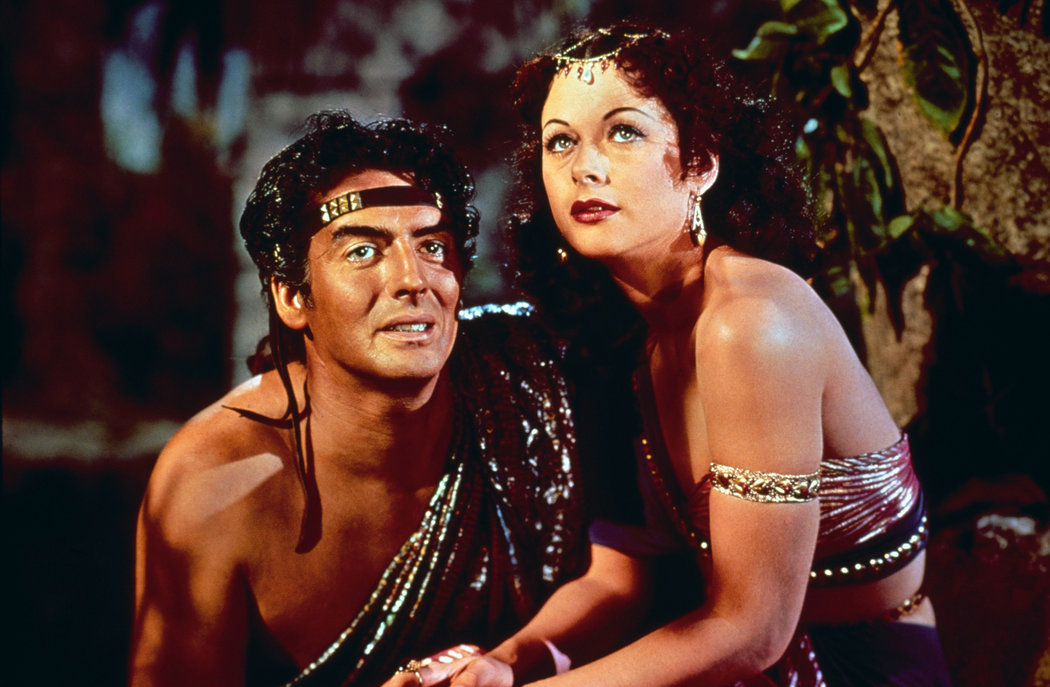
Then she was at Paramount from 1949 until 1951. Here she played one of her most famous roles as Delilah in Cecil B de Mille’s Sampson and Delilah (1949), opposite Victor Mature playing the Jewish prophet and hairy heavy.
Lamarr’s film career ran out in the 1950s. However, aside from acting her ‘hobbies’ involving inventions give her story a distinctive turn. Hedy Lamarr had picked up some military science know-how from her first husband. During World War II, with support from the mogul Howard Hughes, she helped to develop a ‘radio-hopping’ device which has been utilised in more recent technologies.

Alexandra Dean’s documentary presents both aspects of her story, combining film clips and interviews, including audio tapes of Hedy Lamarr. It should provide a fascinating representation of both the film industry and the unseen other life of a Hollywood star. Hedy Lamarr was one of a select group of female stars described as the ‘world’s most beautiful woman’. More accurately the publicists could have described her as both the ‘most beautiful’ and ‘the smartest’.

Cinephiles’ Health Warning:

The title has archive footage in academy ratio reframed to 1.78:1 [television’s 16:9]. Oddly some television footage [4 by 3] and some 16mm footage [academy] are both in their original ratio.

Aliens: Ripley’s Back Believe It or Not

sigourney-weaver-as-ripley-in-james-camerons-aliens
Released in 1986, the xenomorph returned to the silver screen under the vision of budding Canadian Director James Cameron, who got his start with Piranha II: The Spawning (seriously look it up).

Cameron’s incarnation of the Alien universe is different to the atmospheric space horror that Ridley Scott brought to life, bursting through some poor souls chest and into our collective consciousness. Cameron made Alien into an action-movie. That’s not a bad thing.

We return to Ripley (played by the wonderful Sigourney Weaver), who has been floating around in statis for 57 years. She’s rescued and unfortunately, no one really believes her stories of aliens and blowing up ships for legitimate reasons. The audience can really join in with the Socratic irony of the this, the enraging knowledge that THERE’S ALIENS and no one really believes her. Oh how wrong they were.

Ripley, along with a rag-tag group of marines, is sent to investigate a colony that has gone erily silent. This is where elements of Cameron’s Aliens take hold, where horror shifts gracefully (or not so) into action. Ships, guns and plenty of flame throwers make this ride into the Aliens universe intense in a whole other way, and the ending….oh boy.

Cameron isn’t just explosions and one-liners, he continues to explore the themes set out by Scott in the previous film. Ripley’s distrust of androids and the uncanny valley that comes with that territory is explored further with her interactions with Bishop (Lance Henriksen), a staple of science fiction, with good reason.

The extent of mega corporations power in the future, the ineptitude of those in power, survival and the horrors of things we do not know. Aliens is favourite amongst science fiction fans, because it explores these themes, and at the same time…it’s an adventure.

Ellen Ripley, is the real star of this, not the xenomorph (sorry Giger). Ripley is possibly the start of a long line of amazon-heroines. Sarah Connor, Xena, Buffy…the list goes on. But Ripley was at the forefront, and Weaver’s performance in this well rounded/written character cements her as an icon. This stock character is a firm favourite of mine, and Ellen’s true grit ensures no acid-spitting alien is going to take her down.

Please watch this film. It’s essential.

Stand out performance: Carrie Henn as Newt.

If you like this you should also watch;

  • Starship Troopers
  • Piranha II: The Spawning
  • Event Horizon

Henry Stocks-Fryer

The Creature From the Black Lagoon: A Fishman Out of Water Story

Creatures of the Night: Saturday 24th February 10.30 PM

blacklag

The Creature From the Black Lagoon, the title is typical of the science fiction films of the  1950s, especially, Jack Arnold, director of this motion picture. The title does exactly what it says on the tin. Same with Jack Arnold’s other films (which I encourage our readers to see), The Incredible Shrinking Man (one of his best), Tarantula and It Came From Outer Space.

Originally filmed in 3D (a fad which went away eventually…), Arnold takes the audience on a trip deep into the Amazon. The suspense of the piece is carried on masterfully by the director, the constant looming presence of the creature is felt, Jaws before Jaws.

The exploration of evolution, and of the future is a theme in this film. Constant references to the world of tomorrow, and how science can help humanity advance, its pro-science leading man and woman, help cement it as a film ahead of its time. Gil-Man, the creature, is not the only star player in this piece, Richard Carlson alongside the beautiful Julie Adams, bring a classic Hollywood charm to the film.  Carlson’s character (David) is a forward thinking sort, at conflict with his less noble intentioned coworkers. Julie Adams performance as Kay as one to watch out for, playing the girlfriend and coworker of David. A character in her own right (instead of the atypical damsel in distress), bringing a refreshing change to the two dimensional female leads of B-movies. Of course it is not all about scientific discovery, as we see Gil-Man become infatuated with Kay, and his various attempts to carry her off to his lagoon lair bring further drama to this tense film.

We can see that Jack Arnold wanted to portray David and Kay as the future, of what society and people should be striving towards. They are still imperfect, but they are getting there).

Future meets ancient past as the intrepid science team stumbles into the black lagoon, disturbing the Gil-Man, and prompting him into action against these intruders. There are no true bad guys in this film, which makes it all the more well rounded. There’s no cartoonish villain twirling a comic moustache. Gil-Man might be a tragic monster, more akin to Frankenstein’s Monster than Dracula. Although he is not a monster of human creation, merely left behind by evolution….

This is one of my favourite monster-horror films, and was the start of the 50’s sci fi film binge (recommended list below). The atmosphere, the well rounded characters, the action and of course, the design of the monster it(him?)self all come together to create an iconic piece of cinema.

Come join us at the Hyde Park Picture House, Saturday 24th February 10.30pm. Popcorn is essential.

Further viewing, if classic sci-fi is your thing, check out the following;

  • The Incredible Shrinking Man
  • Forbidden Planet
  • The Day the Earth Stood Still.
  • Attack of the 50 foot Woman. (so bad it’s good)

Henry Stocks-Fryer

The Post, USA 2017

From today and on Sunday January 28th at 5.00 p.m. with a Q&A

You can see the Academy Award nominated film and be involved with a Question and Answer session with Granville Williams at this special screening. Granville is an experienced writer on the Newspaper and Media Industries and is the Editor of ‘FreePress’ from the Campaign for Press and Broadcasting Freedom.  He writes;

The Post in an honourable addition to Hollywood films (All The Presidents Men (1976), Good Night, and Good Luck (2005), Spotlight (2015)) which portray journalists and journalism in a positive way, as opposed to grubby hacks chasing squalid, sensational headlines .

When I see films like these I wonder why UK film directors haven’t tackled such subjects. Couldn’t the dogged work of Guardian journalist, Nick Davies, as he probed and finally exposed the industrial scale of phone-hacking at Murdoch’s ‘News of the World’, be a suitable subject?

The credits for The Post say it is ‘based on a true story’ and whilst I can quibble with the way the film modifies some of the facts about the way the Washington Post’s publisher, Katharine Graham, finally came to back publication of the Pentagon Papers, I think the film captures perfectly how enmeshed she was in the Washington elite and the political and commercial pressures on her to take an easier route, and not publish the papers.

I will talk more about this in the Q&A session following the 5.00pm showing of the film on Sunday 28 January at the Hyde Park Picture House. Here I just want to develop a couple of points about two aspects of the film.

One is the way that Spielberg focuses on the old hot metal printing press scenes and the workings of the Linotype machines assembling the lines of type for the stories. It’s very evocative.

In 1975 after Watergate there was a ferocious strike by printers which set her and the newspaper on a conservative course. Graham devoted dozens of pages in her autobiography ‘Personal History’ to vilifying Post press operators who went on strike in 1975. She stressed the damage done to printing equipment as the walkout began and “the unforgivable acts of violence throughout the strike.”

John Hanrahan, a Newspaper Guild member at the Post, wouldn’t cross the picket lines and never went back. He pointed out,

“The Washington Post under Katharine Graham pioneered the union-busting ‘replacement worker’ strategy that Ronald Reagan subsequently used against the air-traffic controllers and that corporate America — in the Caterpillar, Bridgestone/Firestone and other strikes — used to throw thousands of workers out of their jobs in the 1980s and the ’90s.”

The other point is on the role of Ben Bagdikian in the film – he’s the journalist who gets access to Daniel Ellsberg and persuades him to hand over 4000 pages for the Post to use. He was national editor on the Post, a man who the editor, Ben Bradlee, in his autobiography, ‘A Good Life’, describes as ‘thorny’. Bagdikian had a big influence on me, and others interested in media reform. He wrote a key book ‘The Media Monopoly’  (1983) which warned about the chilling effects of corporate ownership and mass advertising on US media. Fifty corporations owned most of the US media when he wrote the first edition. By the time he wrote ‘The New Media Monopoly’ (2004) it had dwindled to five.

NB A couple of friends who have already seen the film thought it helps if one is clear about ‘The Pentagon Papers’. You can check this out on Wikipedia.


Three Billboards Outside Ebbing, Missouri

Showing multiple times daily from Friday 12th January

Three Billboards Outside Ebbing, Misouri

Let’s face it. 2017 was a crap year for most of us. So many outrages, and “the authorities” so slow to act. But wait! Three Billboards gives us a champion. Watch irrepressible Mildred Hayes (Frances McDormand) use her visceral rage to shame “them” into action. “Them” is the local police or anyone else who gets in her way. Woody Harrelson, Sam Rockwell and the rest of this superb cast had better watch out!
The issue is that Mildred’s daughter, Angela, was raped and murdered seven months ago. Have the police got any leads? Have they Hell! Maybe a few billboard messages will get them off their fat butts.
Mildred Hayes: What’s the law on what ya can and can’t say on a billboard? I assume it’s ya can’t say nothing defamatory, and ya can’t say, ‘Fuck’ ‘Piss’ or ‘Cunt’. That right?
Red Welby (Caleb Landry Jones): Or… Anus.
Mildred Hayes:  Well I think I’ll be alright then.
This film deservedly won the Audience Award for new feature films at this year’s (2017) Leeds International Film Festival. It’s another triumph for In Bruges (2008) director Martin McDonagh. Ebbing, Missouri is as complex a community as any other. We get to see not only the anger but also the humour, kindness, sadness and violence of small town life. And naturally Ebbing is not exempt from Midwestern prejudices.
Mildred Hayes: So how’s it all going in the nigger-torturing business, Dixon?
Officer Dixon (Sam Rockwell): It’s ‘Persons of color’-torturing business, these days, if you want to know. And I didn’t torture nobody.
And if Mildred Hayes doesn’t like this review, I’m keeping well out of her way …

Bill Walton

Our 2017 Highlights

We asked our blog contributors for their highlights of the year and this is what they came up with.

Bill

My highlights from the films shown at the Picture House are:

  • Elle, France 2016
  • I Am Not Your Negro, USA, 2016.
  • Lady Macbeth, UK, 2016
  • The HandmaidenSouth Korea, 2016
  • Lover For A Day, France
  • Kedi, Turkey, 2016
  • Thelma, Norway
  • Loving, USA, 2016
  • Detroit, USA
  • Human Flow, Germany

and from the film festival at different venues

  • Three Billboards Outside Ebbing, Missouri (Showing at Hyde Park from January 12th), USA
  • Mutafukaz, France/Japan
  • The Teacher, Slovakia/Czech Republic, 2016

On a different day I could have included Neruda, Loveless, 20th Century Women or Human Flow.

Jake

My top 10 of 2017, sticking to films that got a general cinema release this year:

  1. Certain Women (USA, dir. Kelly Reichardt)
  2. Le Parc (France, dir. Damien Manivel)
  3. Toni Erdmann (Germany, dir. Maren Ade)
  4. Machines (India, dir. Rahul Jain)
  5. Cameraperson (USA, dir. Kirsten Johnson)
  6. Moonlight (USA, dir. Barry Jenkins)
  7. By the Time it gets Dark (Thailand, dir. Anocha Suwichakornpong)
  8. The Untamed (Mexico, dir. Amat Escalante)
  9. Dina (USA, dir. Antonio Santini & Dan Sickles)
  10.  A Ghost Story (USA, dir. David Lowery)

Keith

The new films that impressed me this year, in the order of when I saw them, are

A special mention for Casey Affleck in

And of the classics from the past,

  • Cloud-Capped Star / Meghe Dhaka, India 1960, really impressed me.

Stephen

I restricted this list to things I saw for the first time at the Picture House, otherwise the list could also have included Paddington 2, The Last Jedi, Blade Runner 2049 and Dunkirk.

  • Manchester by the Sea, USA, 2016
  • A Monster Calls, UK, 2016
  • 20th Century Women, USA, 2016
  • mother!, USA
  • The Florida Project, USA
  • Good Time, USA
  • A Ghost Story, USA
  • My Life As A Courgette, Switzerland/France, 2016
  • JackieUSA, 2016
  • Bad Genius, Thailand

I’m a bit disappointed that my list is mostly English language films but a lot of the ‘foreign language films’ released this year such as A Man Called Ove, The Handmaiden and Toni Erdmann I saw at LIFF30 so haven’t included here.

Loving Vincent, UK / Poland 2017

                                                      There is one more screening on Saturday 23rd at 5.15 p.m.           with subtitles for the hard-of-hearing,


The last screening of this title was sold out, an uncommon feat at the cinema. It is the recipient of a number of Awards including Best Animated Feature Film Award at the 30th European Film Awards in Berlin. Comments have focused on the sheer visual beauty of the images.

This is an animated feature and it has used a set of distinctive techniques:

“Each of the film’s 65,000 frames is an oil painting on canvas, using the same technique as Van Gogh, created by a team of 115 painters.”

The film also uses live action sequences. These are mainly flashbacks within the narrative.

Van Gogh is one of the most prized [and expensive] painters in European Art and he has a presence in popular culture as well. His personal life and tragic demise have fed into this celebrity. The narrative in this production takes the form of an investigation. A young man, charged with delivering Van Gogh’s final letter, delves into the final days of the artist. Thus the film explores both the personal and the artistic.

The director is a Polish animator Dorota Kobiela with her first feature. Her co-director is Hugh Welchman, who normally works as producer,. The film relied on funding from the Polish Film Institute, an institution with a long and illustrious history.

The production was shot on a digital camera and is in colour and the academy ratio. [IMDB gives 1.33:1 but thus us usually masked to 1.37:1].  The film used a number of ac actors as ‘models’ for the paintings and they also appear in the ‘live action’ sequences. The British release has an English language soundtrack, dubbed by the credited actors and other voices. .

Van Gogh has enjoyed frequent representations on film. There is Lust for Life (USA 1956), directed by Vincente Minnelli with Kirk Douglas playing the artist. Some of the relationships in the film seem a little facile but the artist and his work are well presented. Then there is Vincent and Theo (France, Netherlands, UK, Germany, Italy) a film by Robert Altman with Tim Roth as Van Gogh. Roth makes excellent casting for the tortured artist. And there are several well made documentaries.

The Disaster Artist

The Disaster Artist showing daily until Thursday 14th
The Room screens tonight (8th December) at 9pm

15 Years after its first premiere, notorious bad film, The Room (2003), has continued success with regular screenings all over the world. This success is down to its growing cult fanbase, and in turn, The Disaster Artist, a film based on the making of The Room, is created by those fans.

In August 2010, journalist Tom Bissell wrote a brilliant piece for Harper’s magazine entitled ‘Cinema Crudité’, charting his growing obsession with The Room, which he describes as “…the movie an alien who has never seen a movie might make after having had movies thoroughly explained to him.” His deep dive culminates in an interview with the director/screenwriter/producer/star himself, Tommy Wiseau.

In his interview, Bissell eludes to an article by Clark Collis entitled The Crazy Cult of ‘The Room’, which charts the growing cult success of the film among Hollywood’s comedy elite, including Judd Apatow alumni Jonah Hill and Paul Rudd. Bissell asks Wiseau if he had been approached by any of his celebrity fans, to which he gives a typically left field and cryptic answer, a roundabout way of saying ‘no’. Funnily enough, it would be Bissell, and his book The Disaster Artist (written with Greg Sestero, Wiseau’s friend and co-star), that would finally connect Wiseau with his celebrity fanbase. It was the book that also introduced director/star James Franco to the film, which he is already envisioning as a film of sorts in his 2013 Vice article about it (“The book reads like the combination of two Paul Thomas Anderson film scripts…”).

The film version of The Disaster Artist begins with a prelude of talking heads, including Kristen Bell (who is interviewed in the original Clark Collis article), trying to articulate their complicated relationship with “the Citizen Kane of bad Movies”. The film itself is made up of high profile fans of the film, including all three hosts of the podcast ‘How did that get Made’, who interviewed Sestero before The Disaster Artist book was published (at that point with the working title of ‘Lost inside The Room’)

Richard Brody’s review of The Disaster Artist for The New Yorker, describes the acting style of Tommy Wiseau (played convincingly by Franco) as a “theatre of attention” which is most apparent in a scene played out in a cafe, where Wiseau and Sestero command the attention of bemused patrons. This was an inspiration for producer A24’s viral campaign, an award given to the best scene from The Room acted out in public. This in turn mirrors those early midnight screenings, as it was a staple, to dress up as characters from The Room and act out scenes, in the aisles and in front of the screen, which essentially provides the core of The Disaster Artist. Apparently around 25 minutes of the The Room was recreated shot-for-shot, evidenced in the films closing credits.

There’s a clip on youtube (below) of Tom Bissell before he went to his first midnight screening of the film, the one he wrote about in his piece. In the video he is asked about his favourite scene, one which he calls “incomprehensible”. At that point he had only seen clips online, recently he said he has seen it “More than 100 times”, I wonder if it makes any more sense to him now, or if the delight is still in the incomprehensibility of it all.

Blood Simple – Director’s Cut

Remastered Director’s Cut Showing Saturday 2nd December 8:40pm

Marty: “I got a job for you.”
Private Detective Visser: “Well, if the pay’s right, and it’s legal, I’ll do it.”
Marty: “It’s not strictly legal.”
Private Detective Visser: [Thinks for a second] “Well, if the pay’s right, I’ll do it.”

Definition of Blood Simple: What happens to someone psychologically once they have committed murder; craziness.  A phrase coined by novelist Dashiell Hammett.

Revenge is sweet. This could be the perfect crime. But who can you really trust? And might human fallibility bring unintended consequences? This tense Texas thriller will keep you guessing. Make sure you keep an eye on those little details … the gun, the cigarette lighter, the knife, the contents of the safe.

Blood Simple is the Coen Brothers’ first film and my personal favourite. They bring together a great script, cinematography and soundtrack. The director’s cut is just a few minutes shorter than the original. M Emmet Walsh (Private Detective Visser); John Getz (Ray); Dan Hedaya (Marty); Frances McDormand (Abby); and Samm-Art Williams (Meurice) bring their flawed characters to life. One damn things just leads to another …

The Four Tops record on the jukebox blares out:

You’re sweet as a honey bee
But like a honey bee stings
You’ve gone and left my heart in pain
All you left is our favourite song
The one we danced to all night long
It used to bring sweet memories
Of a tender love that used to be

It’s the same old song
But with a different meaning
Since you been gone
It’s the same old song

The screening will be the director’s’ cut of the film following a recent digital restoration from StudioCanal.


Bill Walton

Leeds Palestinian Film Festival 2017


The 2017 Festival launches during the Leeds International Film Festival with a new documentary Gaza Surf Club. The film has been directed by two young filmmakers with funding from German Public Broadcasting Company, Westdeutscher Rundfunk Köln. In Gaza there is a small band of enthusiasts who ride the surf in the coastal waters. The added dangers of the sport here are the Israeli blockade and maritime restrictions. It is in colour and with both English and Arabic.

The Occupation of the American Mind is a documentary produced by the Media Education Foundation. The writers and directors Loretta Alper, and Jeremy Earp have provided an exploration of that central movement attempting to protect Israel from scrutiny and justice in the USA. This ‘propaganda’ and pressure is replicated to a smaller extent in Britain as well. Filmed in colour and all in English. The film will be followed by a talk and discussion with former Reuters journalist Naomi Wimborne-Idrissi. Naomi is a leading campaigner for ‘Free Speech on Israel’.

Firefighters Under Occupation is a distintive documentary. Sponsored by the Fire Brigade Union it was filmed by a South Wales firefighter on a trip to the Occupied West Bank where indigenous firefighters operate the equipment donated by their comrades in Britain. The event also has a distintive venue, the converted Gipton Fire Station now an East Leeds Community venue.

The Time That Remains is the most recent feature by Elia Suleiman released in 2009, screening at the Hyde Park Picture House. Suleiman is a pioneer of Palestinian cinema, his first films in the 1990s were produced before the present expanded cycle of films made in the occupied territories emerged. Dramatising his own life and that of his father Fuad Suleiman produces a complex narrative setting out both the Israeli domination of Palestinians and their resistance. The film treats the subject with a degree of irony.

The Idol from the 2016 Festival at a new venue. This title dramatises the story of Muhammad Assaf, the Gazan wedding singer who won the prestigious Television Contest ‘Arab idol’. The film had some fine sequences set in Gaza in his childhood and returns there at the end with actual footage of the celebrations on his success.

Also returning from 2016 is Balls, Barriers & Bulldozers, a documentary following a British tour of the West Bank playing against  Palestinian women football teams. The film is about the sport and about the experience of visiting the Occupied Territories.

‘Existence is Resistance’ is an evening with short films and an exhibition of photographs. The theme is ‘Sumud’, that is ‘steadfast’. The short films are Sumud: Everyday Resistance; Journey of a Sofa; and Shireen of al-Walaja the portrait of a popular resistance leader.

Finally we have ‘Film Maker as Activist – an afternoon of short films and discussion with Jon Pullman’. The Forgotten addresses the condition of the millions of Palestinian refugees who still wait for the liberation of their homeland. The filmmaker will also talk about his planned film, The Lynching, which will deal with the current ‘anti-semiotic’ witch-hunt in the British Labour Party.

The Festival offers a varied selection of films in both theatrical and community settings. Now well established the Festival brings a political edge to film viewing in West Yorkshire.

Festival Webpages: http://www.leedspff.org.uk/