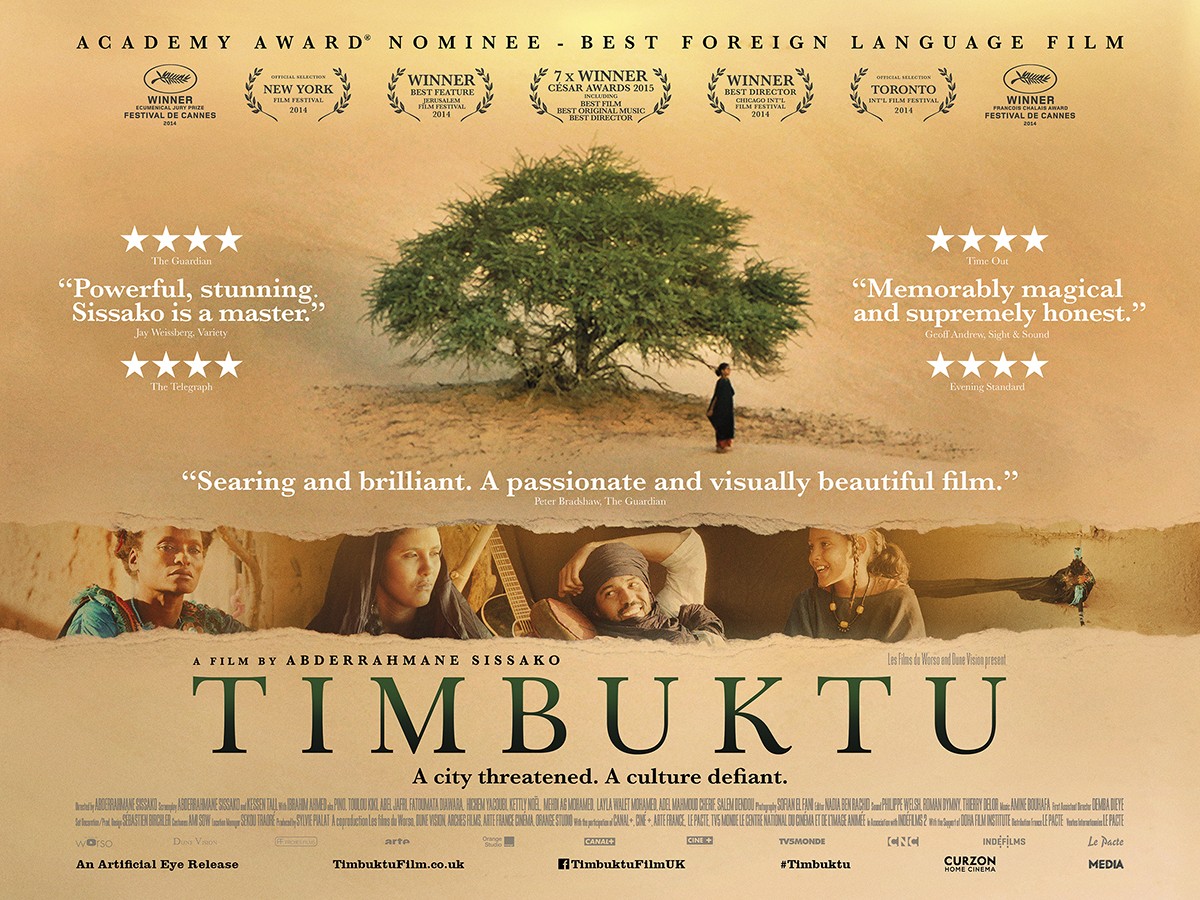
Timbuktu

Directed by Abderrahmane Sissako, Mauritania, 2014.

Screening from Saturday 13th June

timbuktu_ver3_xlg

This film is set in Mali and depicts the occupation of the titular ancient city by Jihadists. The director, Abderrahmane Sissako [Bamako, 2006] avoids the crude representation found in many Western films and its media. This is a subtle and complex portrait of both the local people and the rather disparate army of religious warriors. In an interview reprinted in Sight & Sound (June 2015) Sissako explains:

“Generally, when the world speaks about my country, or indeed Africa in general, it does so in a tone which is, quite frankly, condescending, as if there’s one continent which is simply wretched and others which are rich. The world may speak about Ebola on a daily basis, but it hardly ever mentions that the African is also beautiful, strong and moving forward.”

Continue reading

Federico Fellini’s Otto e Mezzo / , Italy 1963.

Klat_otto_e_mezzo

I am afraid if you’ve just noticed this then you missed seeing this great film – it was screened on Thursday June 4th. There was a fairly good audience, 70 or more I reckoned. And they were clearly divided about the film. A couple passed me as the end credits rolled by – he hated it, she thought it was great. In the foyer a group of four were debating the merits or demerits of the film. Outside there were trios and pairs, one couple considering their responses. I was surprised so many people were seeing the film for the first time: I have had the pleasure of being familiar with the film for years. But it is reassuring that a film can stimulate so much intense discussion.

The HPPH Brochure notes that the film was selected in the Top Ten in the 2012 S&S Critics Poll: at number 10. Mote notably, it was number 4 in the parallel Director’s Poll and Federico Fellini was top director.

The film has so many virtues, fine cinematography by Gianni Di Venanzo; a great score by Nino Rota; and superb editing by Leo Catozzo. And the cast! – at times it felt as if Fellini was throwing a party for all the wonderful actors who had graced his films. This screening was sourced from a DCP. I thought the transfer was good, but the digital version did not do full justice to sparkling contrast tween black and white, especially in the long shots. But the sound was great.

And despair not. I last saw this film two or three years ago – so it will come round again. And it is worth waiting to see it ‘real’, on the big screen.


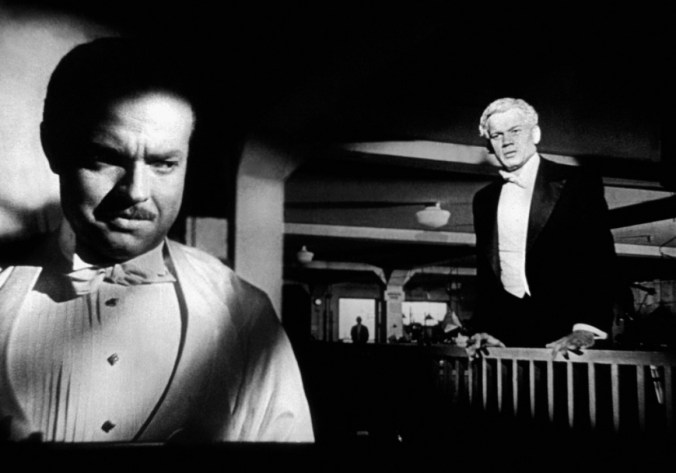
Citizen Kane, USA 1941

Screening on Monday May 25th at 3 p.m.
citizenkane1

The film is screening in a 35mm print, the original format, though unfortunately it is not possible to use a nitrate print. The characteristics of this format will do proper justice to one of the classics of cinema. It managed for fifty years to come top of the  Sight & Sound critics’ polls, held every decade. It turns up again and again, to the delight of those familiar with the film, and as a treat for those who have never seen it before, at least on the large screen and in the darkened auditorium. This occasion follows on from the centenary of Orson Welles, the director, on May 6th.

The script by Herman J. Mankiewicz [with Orson Welles] is at once witty and complex, with a distinctive structure. The cinematography by Gregg Toland makes exceptional use of both deep staging and deep focus, and has passages of beautiful chiaroscuro. And there are impressive special effects by a Hollywood veteran, Vernon J. Walker. The art direction by Van Nest Polglase offers range of fabulous settings from Xanadu to the great opera House in Chicago. Whilst the costumes cover the late C19th up until the present of the film. The cast are terrific, a fine actress like Agnes Moorehead has only a short scene on screen. She, like many of the cast including Joseph Cotten, had worked with Welles in the New York Theatre and radio. The editing by Robert Wise and Mark Robson [both to later become directors in their own right] is finely done: watch the sequence of breakfast scenes between Kane and his first wife Emily. The film is a key innovator in the use of sound, recorded by Bailey Fesler and James G. Stewart, but also benefitting from Welles own experience on radio. And this enjoys the first score in the career of Bernard Herrmann, one of the greatest of Hollywood composers.

All this is orchestrated by Welles, himself appearing as Kane. Both are characters with immense talent and giant egos. Welles claimed that on the night of the premiere he shared a lift in his hotel with William Randolph Hearst, the basis for the film’s fictional press baron. Welles offered Hearst a ticket to see the film, which was declined. Welles remarked:

“Kane would have accepted”.

Hearst got his revenge with a virulent press campaign, aided on the quiet by Hoover’s FBI. So the only Academy Award for the film was Best Screenplay. It did though win the New York Film Critics’ Award for Best Picture. And since then the film has enjoyed success after success. Moreover viewers and critics alike still discuss and argue over the film’s portrait and the famous single word in the opening scene.

A favourite term of praise for me is ‘panache’:

style – swagger – dashing manner

magnificence – brilliance – brazen exhibitionism

Welles had it by the bucketful, as does his most memorable film.
 

New release – Phoenix

Directed by Christian Petzold, Germany 2014.

Screening from Friday May 15th till Thursday May 21st, every evening.
A Leeds Movie Fans Meetup is happening at the 6pm screening on Monday 18th

Phoenix

Friends will probably be familiar with the director Christian Petzold and star Nina Hoss from their excellent earlier films Yella (2008) and Barbara (2012). Phoenix offers the same absorbing and entertaining play on a familiar genre, the world of noir, here set in post-war Berlin. The Guardian review was rather lukewarm including the suggestion that the plot was implausible. This misses the point of Petzold’s films: they appear naturalistic but they are not primarily realist. Thus, Yella is a ghost story: Barbara is set in East Germany, but it is the DDR from film dramas.

Shortly after the end of the war and the liberation of the concentration camps Nelly returns to Berlin to seek out her previous life and her friends and family. Nina Hoss plays Nelly with real verve and is ably supported by Ronald Zehrfeld (also in Barbara) as Johnny and Nina Kuzendorf as Lena.

The Phoenix in the title is a night-club for troops of the allied occupation. One of the pleasures of the film is its use of the ‘lieder’ from Berlin’s popular musical culture. There is a particular skilful play with songs by Kurt Weill.

The film builds to a gripping and likely unexpected climax. Endings are often a let-down in many contemporary films: Phoenix and its cast deliver with superb aplomb.


Au Revoir Les Enfants

Directed by Louis Malle, France, 1987
Screening on Sunday 17th May at 3.30p.m as part of the Friends AGM.
Poster-of-Au-revoir-les-enfants_non-dated_equad

This is in many ways the most personal film of the distinguished French filmmaker Louis Malle. The basic story is taken from experiences in his early years during World War II.

What happened in January 1944 was instrumental in my decision to become a filmmaker. It’s hard to explain, but it was such a shock that it took me several years to get over it, to try and understand it – and, of course, there was no way I could understand it. What happened was so appalling and so fundamentally opposed to the values that we were being taught that I concluded that there was something wrong with the world, and I started becoming very rebellious.

The film is set in a boarding school in occupied France, rather like the one that Malle actually attended. The film develops a narrative depicting a tragic chain of events, but as he recalls, one that was traumatic for the participants as well as the victims.

Malle started out in filmmaking in the 1950s. Even for a noted European director he has worked in unusually wide variety of industries and settings: in France, but also in the UK, in North America and on documentaries made in Asia. Malle comments that he had three great passions: Music, Literature and Film. The role of music in his work is exemplified by the marvellous score improvised by Miles Davis for his first feature, Lift to the Scaffold (Ascenseur pour l’echafaud, 1957). A good example of the contribution of literature is in the very fine Vanya on 42nd Street (1994) with its exploration of and homage to Anton Chekhov. Film itself crops up regularly: in today’s feature there is a sequence when the school students watch old movies:

…it was in the following years that they showed films in the school on Sundays, that’s when I saw the first Chaplin shorts. They were projected in this strange format that was rather popular in the late 1930s and 1940w, the 9.5 mm, which had a perforation in the centre – a terrible invention. Chaplin was forbidden during the war by the Germans, not only because he was Jewish but also because he’d made The Great Dictator. But his films, I was told, were still being shown, very discreetly, in schools and cine clubs. It was one of the great memories of my childhood, those Sunday evening, we’d darken the room, there’d be a white sheet, and everyone would sit and watch those films. I chose The Immigrant because, first, it was one of the great ones, and second, it was an evocation of freedom for those Jewish children when they see the Statue of Liberty, America being the Promised Land.

Continue reading

Fruit of Paradise

(Ovoce stromu rajských jime), Czechoslovakia/Belgium, 1970.
Thursday 30th April 7:00pm at The Hyde Park Picture House

Fruit Paradise

This avant-garde classic comes courtesy of the Czech National Film Archive and the Czech Centre in London where film buffs have enjoyed a major retrospective of the work of Vera Chytilová. She was one of the outstanding filmmakers in the Czech New Wave and, whilst she rejected the label of feminist, an important female director in times when they were even rarer than at the present.

The Czech New Wave was notable for its observational approach to cinema: an important influence on our own Ken Loach. And the filmmakers were also drawn to unconventional techniques and forbidden topics. The later led to regular attempts to ban or censor films, something that afflicted Fruit of Paradise. Following on from this film Chytilová became a ‘non-film person’ for six years.

But there has also always been a strong surrealist strand in Czech art and film. Since the 1930s Prague has been an important centre for this movement, tying in to a longer tradition of mannerism. Jan Švankmajer is certainly the most important surrealist filmmaker in the contemporary world.

Continue reading