Our #LIFF2017 Highlights

The film festival may be over but with arguably one of their best programmes, there’s still plenty to talk about. We asked our contributors for their highlights from LIFF2017 and it would be great to see yours in the comments:

Bill

  • Thelma
  • Félicité
  • The Wages of Fear
  • Loveless
  • Lover for a Day
  • The Teacher
  • Three Billboards Outside Ebbing, Missouri
  • Gaza Surf Club
  • Investigation of a Citizen Above Suspicion

Jake

  • The Rider
  • Western
  • Untitled
  • Félicité
  • Happy End

Keith

  • Happy End
  • Félicité
  • Taste of Cherry / Ta’m e guilass

And the best film not screened at the Festival, Oktyabr / October 1917 (Ten Days that Shook the World, 1928), co-written and directed by Sergei Eisenstein.

Stephen

  • Amélie
  • Three Billboards Outside Ebbing, Missouri
  • Journeyman
  • The Florida Project
  • Good Time
  • Bad Genius
  • You Were Never Really Here
  • Jane
  • The Breadwinner
  • The Rider


LIFF’s 35mm Films

‘Orphée ‘ – a Festival highlight.

This year’s Festival includes eight screening sourced from 35mm prints, [baring accidents]. I make this one more than in 2016, progress. All the films will be projected at the Hyde Park Picture House as the only other venue in Leeds with 35mm projector, The Cottage Road Cinema, is not participating in the Festival: shame. In another example of progress all the titles are listed in the printed ‘Free Guide’ and are noted on the Festival Webpages.

Stephen has already mentioned the ‘breakfast’ screening of Amelie (France 2001).

The Deputy / El diputado is a Spanish thriller from 1978, filmed in colour and standard widescreen. The plot involves a left-wing politician, the police and security services, black mail and even treason. The treatment makes all of this both complex and fascinating, widening the story with sexual orientation.

The Lives of Others / Das Leben der Anderen (Germany, 2006) was a popular success on its initial release. It studies the situation of an artist under the Stasi in the German Democratic Republic in the 1980s. What makes the story dramatic is a borrowing from Victor Hugo’s great novel ‘Les Misérables’.

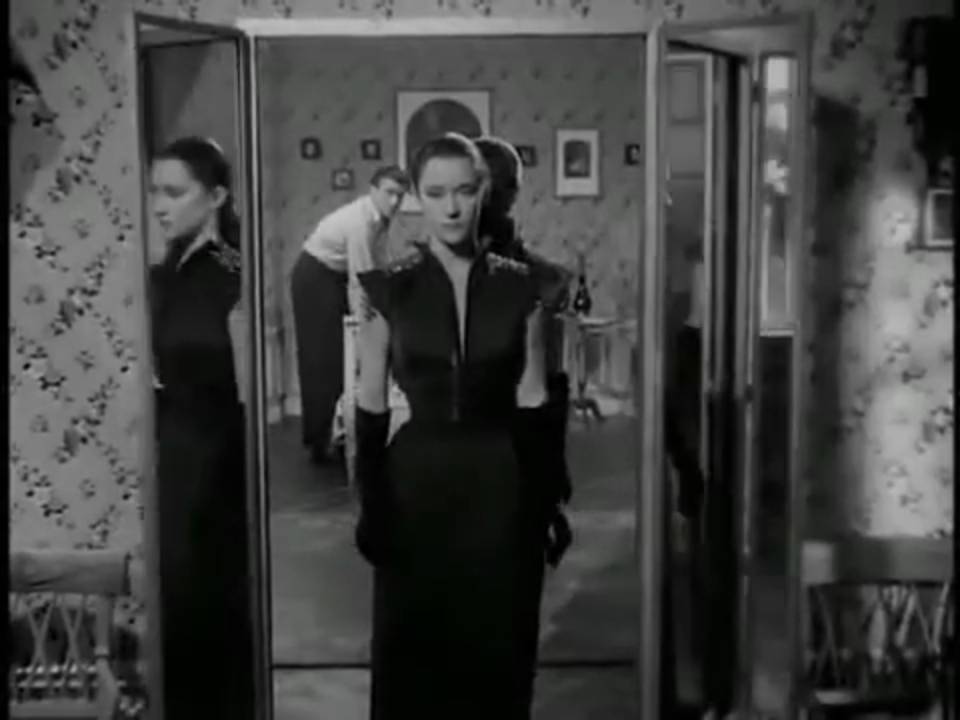
Orphée (France 1950) is a film version of the famous myth by poet and artist Jean Cocteau. The film has a dreamlike quality and is full of actions and settings beloved of the Surrealists. The black and white cinematography really does deserve to be seen on film.

The Party and the Guests / O slavnosti a hostech (A Report on the Party and the Guests, Czechoslovakia, 1966) was part of the 1960s ‘new wave’ and was banned for many years. The film only appeared in Britain in 2008. Shot in academy and black and white, the film is an absurdist drama, at times reminiscent of Samuel Beckett.

Seven Days in January / 7 días de enero (Spain, 1979) is a thriller based on actual events. Aftert the welcome death of General Franco and Spain’s transition to a more democratic society elements from the fascist past attempted to undermine the process.

Taste of Cherry / Ta’m e guilass (Iran, 1997) is one of the fine films from this country’s art/independent sector. The director Abbas Kiarostami is noted for his minimalist approach. Here, in another Iranian film set mainly in an automobile, we spend a few hours with a man debating a fundamental question.

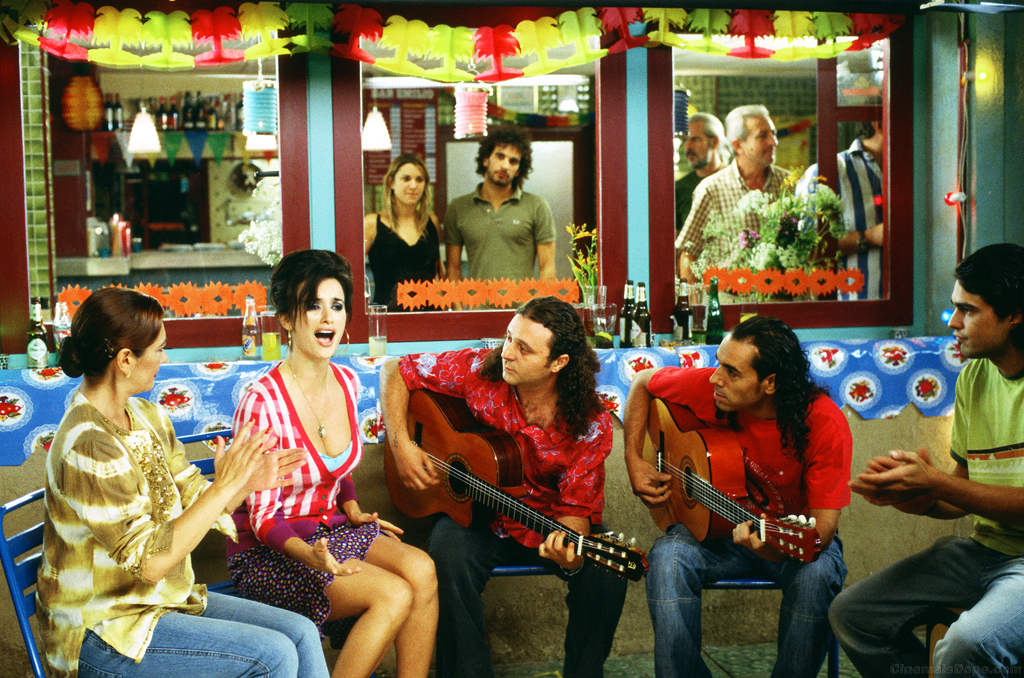
Volver (Spain, 2006) is another excellent drama from Pedro Almodóvar. This is a film centred on women and the fine cast, as a collective, were awarded the Best Actress Award at the Cannes Film Festivals. This is mainly a dramatic comedy but with many of the issues that always fill Almodovar’s films and titillate audiences.

Classic Almodóvar at the Festival.

Surprisingly several other films in the retrospective section are on digital even though I am pretty sure that 35mm prints exist. These include Satyajit Ray’s memorable Aparajito (India, 1956) and the more recent and compelling The Headless Woman / La mujer sin Cabeza (Argentina, 2008) directed by Lucretia Martell.

But the most serious lacunae in the programme is the complete absence of Soviet titles. The Centenary of the Great October Revolution [in the new style calendar] falls within the Festival. If this is not recognised as the most significant event of the C20th then surely the cinema it inspired, Soviet Montage, should be. It was the most challenging but also the most influential film movement in C20th World Cinema. It seems that we need a seminar on film history for the Festival office.


Our LIFF30 Highlights

The film festival is over for another year and once again has provided Leeds with a fantastic selection of films. Below we share five of our highlights from the festival and would love to see yours in the comments:

Bill

Bill's Top 5There are so many films being made around the world!  The Leeds Film Festival programme is just a small sample, and the thirty or so films I saw are just a small sample of what the Festival had to offer. Here are 5 films that I enjoyed, in no particular order:

  • Sieranevada  – a beautifully directed and acted glimpse of a Romanian
    family’s memorial commemoration, which also says something about wider
    Eastern European society.
  • Chi-raq – Spike Lee’s theatrical exploration of the issues around Black
    Lives Matter, made with the involvement of people living in Chicago’s
    Southside.
  • Lonesome – a love story, with live organ accompaniment, mostly set in
    Coney Island, and made at a time when silent films were giving way to
    the new ‘talkies’
  • The Handmaiden – an exciting and beautiful Korean/Japanese story, with
    different perspectives challenging us to work out what is really going
    on
  • Fukushima, Mon Amour – the aftermath of the earthquake, tsunami, and
    nuclear reactor meltdown, is the setting for this film about the lives
    of people 5 years later, as seen through the eyes of a German woman who
    wants to bring some pleasure to their lives

I could have added another 5 quite easily.

Keith

Keith's Top 5

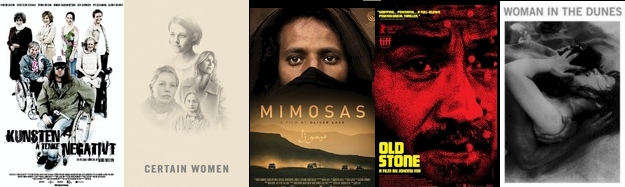
  • The Art of Negative Thinking – Scandinavian filmmakers excel at combining disability and humour.
  • Certain Women –Three well crafted stories, four excellent performances.
  • Mimosas – Very fine visually but the story requires careful thought and study.
  • Old Stone – A good Samaritan suffers under Chinese capitalism.
  • Woman of the Dunes – A black and white classic in a good 35mm print.

Stephen

Stephen's Top 5

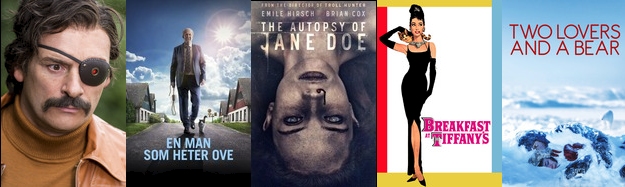
  • Mindhorn – The funniest film since What We Do In The Shadows. I’d forgotten how fantastic it is to see an incredibly funny film in a packed cinema. We laughed so hard we probably missed half the jokes. Followed by a brilliant surreal Q&A.
  • A Man Called Ove – Perfectly combining humour and humanity, everything comes together to remind you there is some good in the world.
  • The Autopsy of Jane Doe – The best horror film I’ve seen in some time. Delivers intelligent thrills and never outstays it’s welcome by becoming too silly.
  • Breakfast at Tiffany’s – Seeing this projected (from 35mm) gave me a new appreciation and managed to completely charm me where I’d previously been underwhelmed.
  • Two Lovers and a Bear – A complete surprise, I knew nothing about this film and found it all completely delightful.

This was the strongest festival I remember and I’d recommend nearly all the films I saw. My next 5 films were Pet, The Birth of A Nation,  The First, The Last, Life Animated and Paterson.

Jake

Jake's Top 5

  • Certain Women – Kelly Reichardt’s most fully realised film to date. Maile Meloy’s short stories perfectly compliment each other, providing a perfect counterpart to Reichardt’s earlier adaptations of Jon Raymond. Great performances from the central cast, especially Laura Dern and relative newcomer, Lily Gladstone.
  • Mister Universo – Tizza Covi and Rainer Frimmel’s simple fiction played out by real life members of the Italian circus community. A beautiful intersection between fact and fiction, that functions as both a road movie and an affectionate family portrait.
  • The Woman of the Dunes – Teshigahara/Abe’s Sisyphusian nightmare. A classic. So glad I got to see this on a big screen on 35mm.
  • Graduation – Doting father, Romeo, walks moral tightropes in this austere drama from Cristian Mungiu. Shades of Haneke’s Hidden in it’s creeping sense of dread.
  • Mimosas – Ecstatic fiction, quasi-western with the Atlas mountains as a backdrop. Shakib Ben Omar is a wild, charismatic lead. A natural heir to Ninetto Davoli.

A Fanomenon Selection

LIFF30 Fanomenon

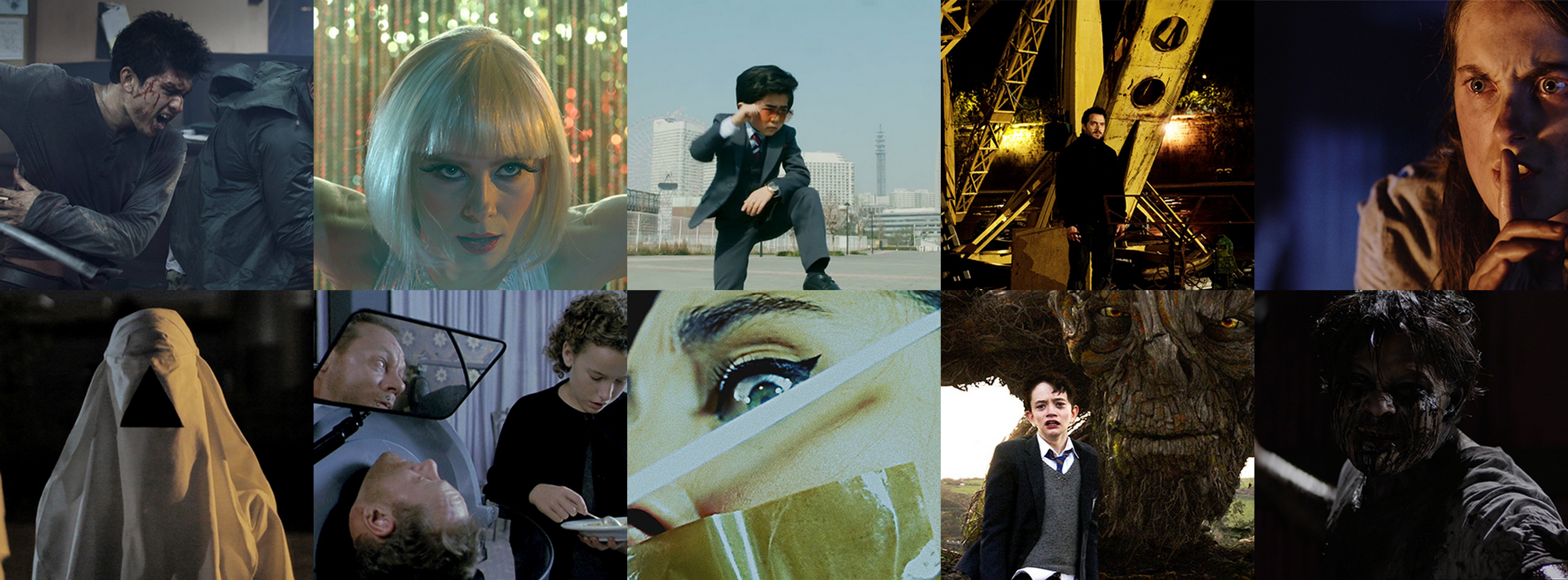
As LIFF enters its 30th year, here is a selection of some of the Fanomenon strand of weird and wonderful films playing at the Hyde Park Picture House:

Francesca (2015)

Francesca is a beautiful and bloody love letter to the Italian giallos of the 70s. A psychopath in a red coat and leather gloves is stalking the city, clearing it of ‘impure and damned souls’. The crimes seem linked to an unsolved case from many years ago.

A Monster Calls (2016)

Based on the acclaimed novel by Patrick Ness, this dark compelling from J A Bayona (The Orphanage) tells the story of a young boy visited by an enormous, tree-shaped monster – voiced, obviously, by Liam Neeson!

Kids Police (2013)

From one of Japan’s wildest comic film creators Yuichi Fukada comes this delightful spoof of procedural cop dramas. Chief Onuma and his Special Investigative Division are transformed back into their child selves by terrorists. Can Onuma and his mini squad stop the terrorists taking over Japan? A big story about very little heroes!

Continue reading

Happy #LIFF30 Day

cwue3ilw8aaetpy

As you probably know the 30th Leeds International Film Festival starts tonight with a screening of Jim Jarmusch’s Paterson at the Town Hall (it’s also showing at the Picture House on Saturday 5th at 8:30pm).

We were hoping to post more about the festival but it’s going to be busy few weeks so that might be difficult but don’t forget about our Twitter and Facebook pages. You can find all of our #LIFF30 posts here including a fascinating look at how the Friends started the festival 30 years ago. On Friday we’ll be highlighting some of the films in the Fanomenon strand showing at the Picture House. The Leeds Movie Fans Meetup Group also have a number of meetings planned during the festival, check out their webpages for more details.

There are nearly 150 films on offer over the next few weeks so there’s bound to be something for everyone. If you’re still planning what to see you might find this clashfinder useful. There really seems to be a lot of great films this year. I’m planning on seeing 45 films over the next two weeks (you can follow my progress on Letterboxd and Twitter) and I still feel like I’m missing out. Here’s a list of ten films I really wanted to see but couldn’t fit in (and that doesn’t include any of the classic films in the soundtrack retrospective which I’d love to have seen again!)

  1. A Divorce Before Marriage
  2. Dougal And The Blue Cat
  3. As I Open My Eyes
  4. Cameraperson
  5. Greetings From Fukushima
  6. Graduation
  7. Lady Macbeth
  8. November
  9. Napoleon
  10. A Silent Voice

We hope you enjoy the festival and would love to hear your thoughts about any of the films in the comments (or contact us if you’d like to write a longer post for the blog).

A History of Leeds Film Festival

LIFF30

It is the 30th edition of the Leeds International Film Festival this November. From its instigation in 1987 by members of the Friends of Hyde Park Picture House the festival has consistently presented a wide-ranging programme of films and film based events annually, across a shifting landscape of city venues.

Laura Ager, a volunteer at the Hyde Park Picture House who has worked with the film festival in various roles over the last 10 years, recalls how she first became interested in the history of the festival and, in the course of her research, has tracked down some of its former directors and supporters to ask them what the festival meant to them.

Two typed documents, discovered by chance in the office of the Leeds International Film Festival at Leeds Town Hall, announced the coming of The Leeds International Film Festival.

In November 1987, the Leisure Services department at Leeds City Council proclaimed that in 1988:

Leeds, the birthplace of the film industry, will celebrate the centenary of the moving image by holding a major international film festival.[1]

This film festival would celebrate 100 years since Louis le Prince filmed the people and traffic in ‘Leeds Bridge Scene’ at a spot now marked with a Leeds Civic Trust blue plaque.

The Leeds International Film Festival took place from 13th – 29th October 1988. On the first day, the famous traffic scene was reconstructed on Leeds Bridge at 2pm, later on that day a ‘black & white ball’ was held in the Town Hall. The film programme addressed eight themes that year: comedy, horror, war, music in films, images of England, animation, women and film and documentary[2]. Continue reading

LIFF30

It was great to have the launch of the 30th Leeds International Film Festival at the Picture House last week. There was a wonderful atmosphere and sense of anticipation as 50ish trailers and clips were shown. I left wanting to see more of everything that had been showcased.

If you haven’t picked up a guide yet, it’s now also available in digital form.

There’s a new layout for the guide this year including a more compact pull out calendar which may be prove to be useful during the festival but for lots of people has made planning a little harder. If you are struggling to see the overlaps you may find this Clashfinder website useful. It shows everything in a grid format so you can plan your dashes between venues. You can also highlight films to create your own itinerary and this allows us to see what’s popular, earlier today the top 20 was as follows:

  1. LIFF30 Opening Gala: Paterson + Timecode
  2. The Handmaiden
  3. Jurassic Park
  4. Schneider vs. Bax
  5. A Monster Calls
  6. Train to Busan
  7. Hacksaw Ridge
  8. I Am Not a Serial Killer
  9. Under the Shadow
  10. Jaws
  11. The Wailing
  12. The Master Cleanse
  13. Toni Erdmann
  14. Belladonna of Sadness
  15. Kids Police
  16. The First, the Last
  17. Psychonauts, the Forgotten Children
  18. Elling
  19. The Red Turtle + Father and Daughter
  20. Ambulance

Over the next few weeks we’re hoping to preview some of the festival films and it would be great to hear your plans and what you are looking forward to seeing in the comments (or get in touch if you’d like to write a full post for the blog).

Changing the World One Film at a Time

Friends committee member Bill Walton picks out some highlights from the first week of the 29th Leeds International Film Festival.

What I really like about the Leeds International Film Festival is the sheer variety of  subjects, styles, genres, formats, and cultures. Thus the Festival gives me a glimpse of the world seen through other eyes.

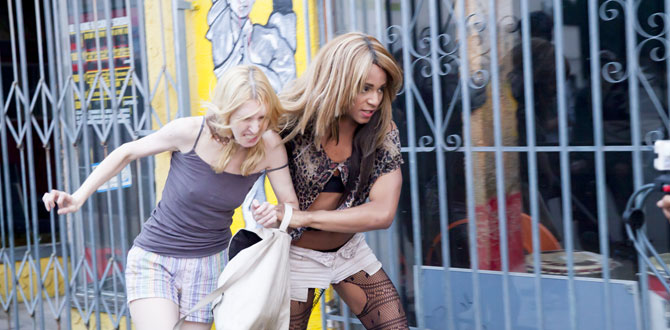
A few examples of films that were both entertaining and thought-provoking are Tangerine (2015): a lively, low budget film set in Los Angeles, which gives food for thought about sexual identity.

Tangerine

Continue reading

LIFF preview – Pyaasa, India 1957.

LIFF screening Saturday November 7th 1400.

A memorable film from the 1950s Hindi Cinema. “Producer and director Guru Dutt’s intensely original film [The Thirsty One] is widely considered one of India’s unquestionable classics, striking a chord with its  vision of the romantic artist in conflict with an unfeeling materialistic world.” (Cinema Ritrovato Catalogue, 2014).

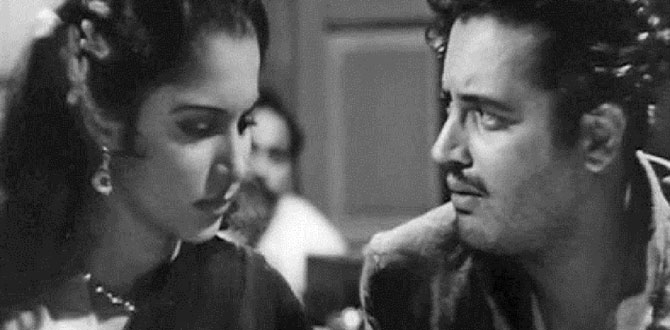
Gulab and Vijay

Gulab and Vijay

Guru Dutt also appears in the film as the poet Vijay, opposite Mala Sinha as Meena and Waheeda Rehman as Gulab. The film has a distinctive use of music and songs and exemplary black and white cinematography with fine use of crane shots. The music is by Y. G. Chawhan and the cinematography by V. K. Murthy. Dutt’s collaboration with these two artists and with the cast and production team offers a control of sound and image that stands out in the period.

Pyaasa is among a number of films from The Golden Age of Indian cinema, [late 1940s and 1950s] which have been restored and made available in either 35mm or digital versions by the recently established Film Heritage Foundation. The films offer the pleasures of the distinctive Indian musical film form. They combine melodrama and emotion with great dance and musical sequences. Pyaasa is in Academy ratio and runs 143 minutes. So this is a rare opportunity to see not just an Indian classic but an outstanding film of World Cinema.

London and Leeds Film Festivals

Jake Baldwinson reports back from the London Film Festival and looks forward to Leeds annual film festival next month.

London Film Festival

Last Friday saw the launch of the Leeds International Film Festival programme. Now, I would normally spend the following weekend poring over the free guide, working out a schedule for my filmgoing highlight of the year. This time around, however, I was attending part of  the BFI London Film Festival. I ended up packing in 7 films over a hectic couple of days, including two that have been selected for the Leeds Film Festival this year.

What I find exciting about attending a film festival, even if just for a day or two, is experiencing a melting pot of different narrative voices in a short period of time. On my Saturday in London, I went to 4 screenings; beginning with a fiction feature set in Mexico, shot in an eye-catching circular frame using innovative techniques by the filmmakers. I then finished with a documentary about a culture under threat in Thailand and Burma, filmed in a collage-style using several different formats underwater and on land. These are the complementary screenings (or ones that intriguingly clash) that you would only find at a film fest. The former, entitled Lucifer, is screening a total of three times in Leeds as part of the festival in November, and I would really recommend it. Another from LIFF’s Official Selection that I caught in London was Jafar Panahi’s extremely enjoyable, Taxi, also showing three times (including once at The Hyde Park Picture House.)

Continue reading