May’s First Thursday

Please join us on May 1st at 9pm onwards in the cinema bar to discuss all things film including but not exclusively Licorice Pizza which HPPH is screening as part of its Philosophy and Film strand that evening from 6pm.

Licorice Pizza has been selected by Dr. Colette Olive and will be followed by a short talk from Colette exploring the philosophical themes raised.

Tickets are already selling fast for this screening so we recommend booking if you want to join us.

‘First Thursday’ is our monthly meet up to give members and anyone interested in the Friends, or cinema in general, a chance to get together.

Please note: due to a licensing issue the screening will no longer be from 35mm and will be projected digitally.

The Afterlight (UK 2021)

This is a compilation film of film fragments on a 35mm black and white and academy ratio print. There are hundreds of brief sequences: some repeated: some silent: some with sound: in fourteen or so different languages: mostly with English subtitles: and featuring stars and actors from nearly all the substantive cinemas. It runs 82 minutes. This is the only 35mm print, so it will gradually acquire the scars of projection; there are no other prints or alternative versions.

This is the idea of Charlie Shackleton, who researched, produced, directed and edited the film. His earlier titles include Beyond Clueless (2014) which features over 200 extracts from ‘teen movies’ and the extremely unusual Paint Drying (2023), a ten hour salvo at the BBFC. Robbie Ryan contributed on cinematography and Jeremy Warmsley provided a musical accompaniment. To date there have been 44 screenings. Nitrate and safety film stock have a shelf life of over a hundred years; far longer than more recent moving image formats. But the screenings have taken place in numerous and different venues. So the screening may have acquired some of the familiar features of older 35mm prints, such as scratches and other marks. But the print will retain the characteristics of the original format of the films featured.

The extracts in the film range across nearly all the territories of world cinema. They include familiar faces and rather rarer characters. All the extracts are from earlier than 1960, so all the visible participants are dead. The extracts are arranged by genres, themes and tropes.

Viewing the film is rather like a visit to a museum, perhaps a set of ghostly encounters, or an elegiac journey through cinema. Many of the extracts are recognisable but some will likely only be recognised by cinephiles with a extensive range of international film viewing. One can puzzle over the extracts, their order and their sources. One can watch the changing palettes with some extracts in pretty good condition and some showing the wear and tear of long screening journeys.

Whichever response this is a welcome and impressive selection. It is constantly of interest and pleasure and occasional mystery. Since the print will gradually  succumb to age and running through various projectors it is worth seeing at the earliest opportunity. Happily it screens at the Hyde Park Picture House on May 12th, with the director present.

The Bill Douglas Trilogy

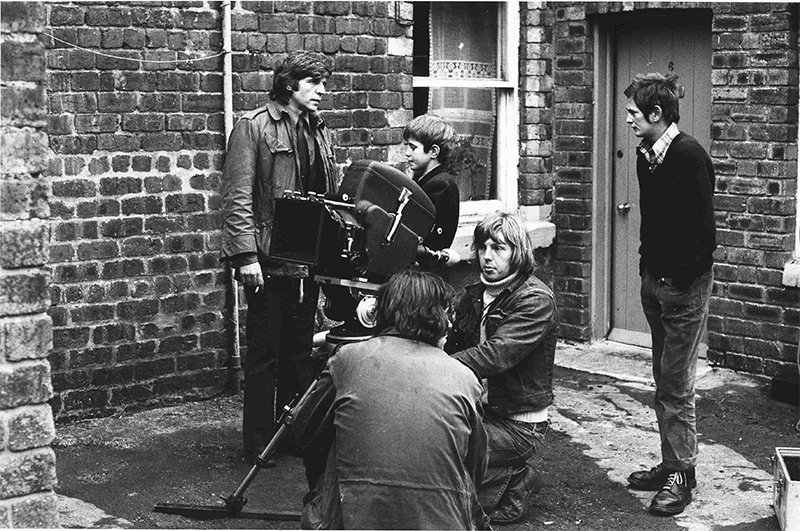
Douglas and crew filming a scene

This first part of this film trilogy was screened for members following the Friends’ Annual General Meeting. This was in the new Screen 2 of the redeveloped Picture House and was screened from a good quality 16mm print.

Scottish film-maker Bill Douglas was born in a small mining village close to Edinburgh in 1934. He was, sadly, lost to British film having only made, [apart from student films], the trilogy and a one feature film. Douglas came late to film; it was only in 1969 that he enrolled at the London School of Film Technique. This is actually the oldest school for film-making study in Britain, founded in 1956 and sited now in the Convent Garden area. Douglas made four short films while a student. However, on completing his studies he faced the usual barriers for independent film-makers.

Finally in 1972 he secured support from the British Film Institute’s production fund for three interrelated films. The first, at time with the title of ‘Jamie’, had been turned down by Films of Scotland because of the bleak view it provides of war-time Scotland. The film is based on experiences of Douglas’s own upbringing in the 1930s and 1940s. It became My Childhood, shot in black and white, academy and running 46 minutes.

The film is set in 1945, as World War II draws to a close. Jamie (Stephen Archibald) and Tommy (Hughie Restorick) live with their grandmother (Jean Taylor Smith). Their housing, diet and clothing all show the deprivation given the poverty of the family. The boys have pets which suffer from their situation. Jamie’s one outside relationship is with a German prisoner of war working locally on the land; Helmuth (Karl Fieseler). We see a celebratory bonfire at the end of the war and then Helmuth returns to Germany. There are also times when the boys (and the audience) see their father, who co-habits nearby, (Bernard McKenna). His mother is confined on some sort of mental institution. The bleakness of their lives is almost unparalleled in British film. It does have a moment of change; with a long shot of a departing figure on a train. The latter a familiar trope in films concerning children and rites of passage.

The cinematography was by Mick Campbell: the editing by Brad Thumin: and there were additional craft people on sound and a second unit. The imagery is stark but effective: the sound track is sparse, especially the dialogue, but it contributes to the overall impact: and the exteriors provide both a comparison and contrast to the central setting. The craft team, like the writer and director, seem to have a small number of credits. The quality should have led to a far greater output.

The second film of the trilogy is My Ain Folk (1973). This film picks up where My Childhood finished. The characters are the same, with the addition of other family members, as Jamie goes to live with them. Tommy is taken into welfare so this film concentrates on the experiences of Jamie. This is as harsh as his earlier life but with greater isolation. There is a brief moment of colour earlier in the film. It is in black and white and academy, running for fifty five minutes.

The final Part of the trilogy, My Way Home (1978) is also in black and white and academy but runs for 79 minutes. The film takes Jamie’s story into adulthood, entering work and then National Service. Jamie is again played by Stephen Archibald. The film takes the narrative outside of Scotland and Britain for the first time. It also presents a full and continuing friendship that leads to a change in Jamie’s life.

The National Film Archive has 35mm prints of both the second and third parts of the trilogy. It would be good if the Friends could cooperate with the Picture House to arrange screenings so that members and the public can see the rest of this outstanding work. The Archive also has a 35mm print of Douglas’ final film, Comrades (1987). The presents the story of The Tolpuddle Martyrs, agricultural labourers in the early C19th criminalised and then transported for daring to form a Trade Union. This is an important film on working class history in Britain and a fine representation in colour and widescreen which makes interesting use of early picture technologies.

2019 in retrospect.

So, I found 2019 not a great year for new releases; lots of popular films but not that many outstanding ones. Those that stood out for me both in terms of craft and subject were:

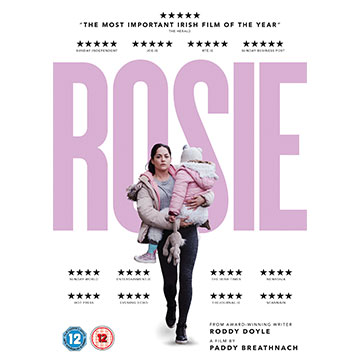
Rosie, Eire. This was a drama about homelessness in Dublin. Very well done and the cast were impressive. It was distributed independently so I am afraid many people may have missed it.

Happy as lazzaro / Lazzaro Felice, Italy. A compelling drama, both of exploitation and the problems of migrants. One of the most imaginative stories I have seen for a  long time.

A Season in France, France. A drama about an African migrant family. This was a bleak tale but finely done.

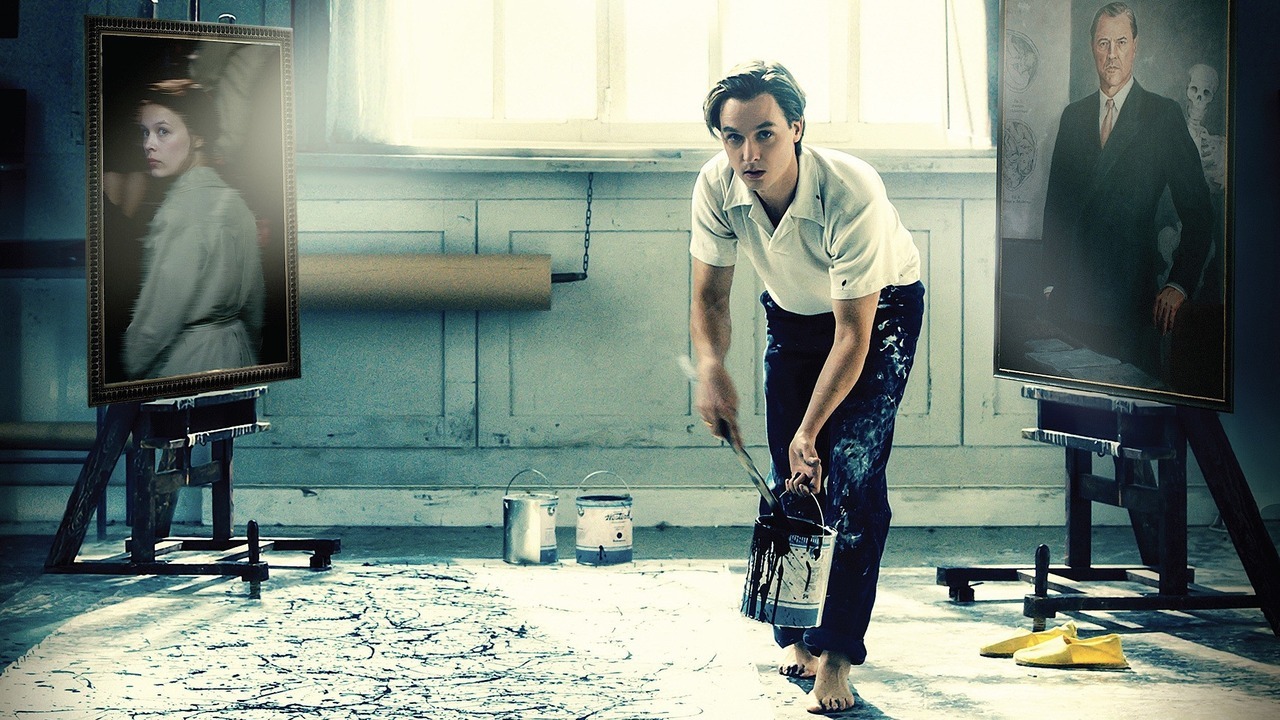
Never Look Away, Germany. An artist travels from East Germany to the West and from Socialist Realism to the avant-garde. Fascinating.

Pain and Glory, Spain.  An exploration of sexual orientation and of cinema and of art; beautifully put together.

Bait, Britain. This title only qualified on 35mm. The digital version did not handle the distinctive techniques on the film well.

So Long, My son, China. One of several epic dramas from the territory presenting a canvas that was large in terms of time and space; a study of  the contradictions of family relationships.

We also enjoyed several screenings of classics in their original format of 35mm.         Sans Soleil / Sunless, France 1983 was part of a weekend of screenings curated by the Pavilion of the  Artist Moving Image Network. This is a classic documentary, visually stunning and with a complex tapestry of themes. Among the other gems of the weekend was Colloque de chiens, France 1977; a sardonic 20 minute film on 35mm and in colour. The canine characters were a metaphor.

Bait, Britain 2019

Fri 6th December at 8.50 pm, Sun 8th December at 8.30 pm and  Wed 11th December at 1.30pm and 6.30 pm

This new independent British film returns to the Picture House in a 35mm print. It was shot on a 16mm Bolex and the director, Mark Jenkin, processed the film himself. It seems that he wanted to make the film look like older titles that originated on ‘reel’ film and in the processing added some of the signs of age and usage with scratches and the like. It first circulated on a digital transfer and, to be  honest, the effects that Jenkin aimed at did not translate to that format; they looked artificial. On 35mm the 16mm original should look as intended; so this is a film worth revisiting if you have already seen it.

It is a powerful drama set in a Cornish village. The film, through the use of camera techniques such as large close-ups and a non-linear narrative develops a intense feel  and effect. The village in this film is an old fishing port which has now become a summer venue for holiday-makers. The conflicts generated by these two separate worlds are personalised in two leading characters, brothers born and raised in the village.

The form and the style of the film is at times challenging but always absorbing. It is definitely a stand out film drama from this year’s selection of British film. And, like the earlier and equally fine  Gods Own Country  (2017), finds drama and compelling characters away from the urban settings that are more common in film stories.

LIFF 2019 Preview: Retrospective

Verna Fields

The Festival Retrospective this year offers a distinctive programme:                              ‘Mother Cutter Women Who Shaped Film’.

The women shaping film in this case are the editors, an important aspect of film-making which women have often dominated and which for much of the industry history has been one of the few areas where women had similar opportunities to men; another interestingly is scriptwriting.

The retrospective title is that of the nickname of Verna Fields, a long-standing editor in Hollywood. Her work included such disparate titles as Medium Cool {1969) and Jaws (1975). The former, a classic of the counter-culture, is the title screening in the Retrospective.The programme screenings are split between The Victoria at the Town Hall and the Hyde Park Picture House. Note, some titles are screening twice, some only once; so check the Brochure and calendar.

With the exception of the most recent ‘Mad Max’ release all of the titles were produced using photo-chemical film with the appropriate techniques. This means that the editing not only involves viewing, selecting, and arranging the complex tapestry of film shots and sequences in relation to sound tracks; it was physical manipulation,  cutting and splicing reel film, nearly always 35mm. So it is a little disappointing that only four of the titles in the programme are being presented in this format. All screen at the Hyde Park Picture House.

‘Beau travail’

Beau travail (1999.) [Wednesday 13th and Friday 15th November].

This is an adaptation of Herman Melville’s story ‘Billy Budd,Sailor’ by the director Claire Denis with Jean-Pol Fargeau. There have been other film versions of the Melville story but this is the most ambitious, with the narrative moved from a ship-o’-war to a Foreign Legion outpost in North Africa. Two important collaborators on the film were cinematographer Agnès Godard and film editor Nelly Quettier. Both have worked on other important films. Agnès Godard was cinematographer on a fine Italian film Golden Door / Nuovomondo (2006). Nelly Quettier worked on the equally fine and more recent Italian film Happy as Lazzaro / Lazzaro felice (2018).

‘Dancer in the dark’

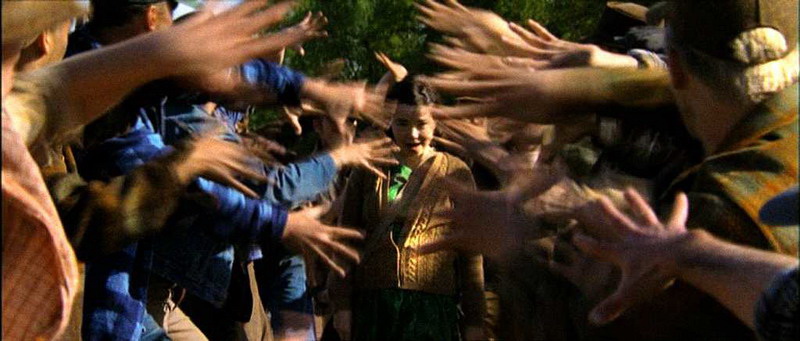
Dancer in the Dark (Denmark and thirteen other territories, 2000)                                    [Monday 18th and Tuesday 19th November].

This is a post-Dogmé film from Lars von Trier. As you might expect it moves to a harrowing climax. Before that a young immigrant single mother [played by singer Björk) is living in rural USA in 1964. Her world of escape presents musical sequences set in her factory workplace. The film was edited by Molly Malene Stensgaard who had to manipulate DVcam video before its transfer to 35mm film. She has worked on a number of Lars von Trier titles, including the outstanding Melancholia (2011). This film won the prestigious Cannes Palme d’Or.

‘Movern Callar’

Movern Callar (Britain, Canada 2002).                                                                                                        [Tuesday 19th and Wednesday 20th November].

This was the second feature directed by Lynne Ramsay. This, and the earlier Ratcatcher (199),.seem to me better than her later films with US participation. Samantha Morton in the title role plays a grieving young woman who goes on a journey and an odyssey to Spain. The film was edited by Lucia Zucchetti. She also edited Ratcatcher, and, a little later, the highly successful The Queen (2006).

‘The Tempest’

The Tempest (Britain 1979). [Monday 11th and Wednesday 13th November].

The talented and subversive Derek Jarman adapts William Shakespeare: later he added Christopher Marlowe Edward II (1992). ‘Such stuff as dreams are made of …’ in a completely distinctive treatment. The editor Lesley walker, in only her second feature, provided an editing style that matched the unconventional style of Jarman. Her later work includes popular hits like Mama Mia (2013) but also other unconventional titles like Fear and Loathing in Las Vegas (1998). The film originated on 16mm.

Esfir Shubb

The Fall of the Romanov Dynasty / Padenie dinastii Romanovykh (USSR 1927),        [Monday 11th November].

This title, originally on 35mm, is screening from a 16mm print; the format used in film societies and by Kino in 1930s, when Soviet films were almost impossible to see in Britain. Directed and edited by Esfir Shubb, this is a pioneer compilation documentary. Shubb worked through thousands of metres of stock footage, short films and newsreels to produce 1500 metres that traced the the developments in Russia from 1913 to the revolutionary year of 1917 and the final dissolution of the Russian ruling class. Shubb could be called the ‘mother cutter’ of Soviet cinema. Many of the famous talents learned from her tutelage, including the young Sergei Eisenstein. The film has no sound track but uses title cards and will have live musical accompaniment by Jonathan Best at the piano.

These five films are the only photo-chemical prints in the Festival. The number seems to go down year by year; so apart from the quality of the films these screenings are also an opportunity to enjoy a’ vanishing prairie’ of reel film.

************************************************************************

Note: a bonus.

Green for Danger  (Black and White, 1946) by Lauder and Gilliat is also a 35mm print, the second screening is on Thursday a,m. This is a murder mystery with a fine performance from Alastair Sim. Edited by Thelma Myers [later Connell]. She learned her craft on films like The Life and Death of Colonel Blimp (1943) and worked on many more titles including the fine black and white drama The Hill (1965).

I can also happily report that the 35mm prints of The Tempest and Green for Danger  were both good and that for Beau Travail was excellent.


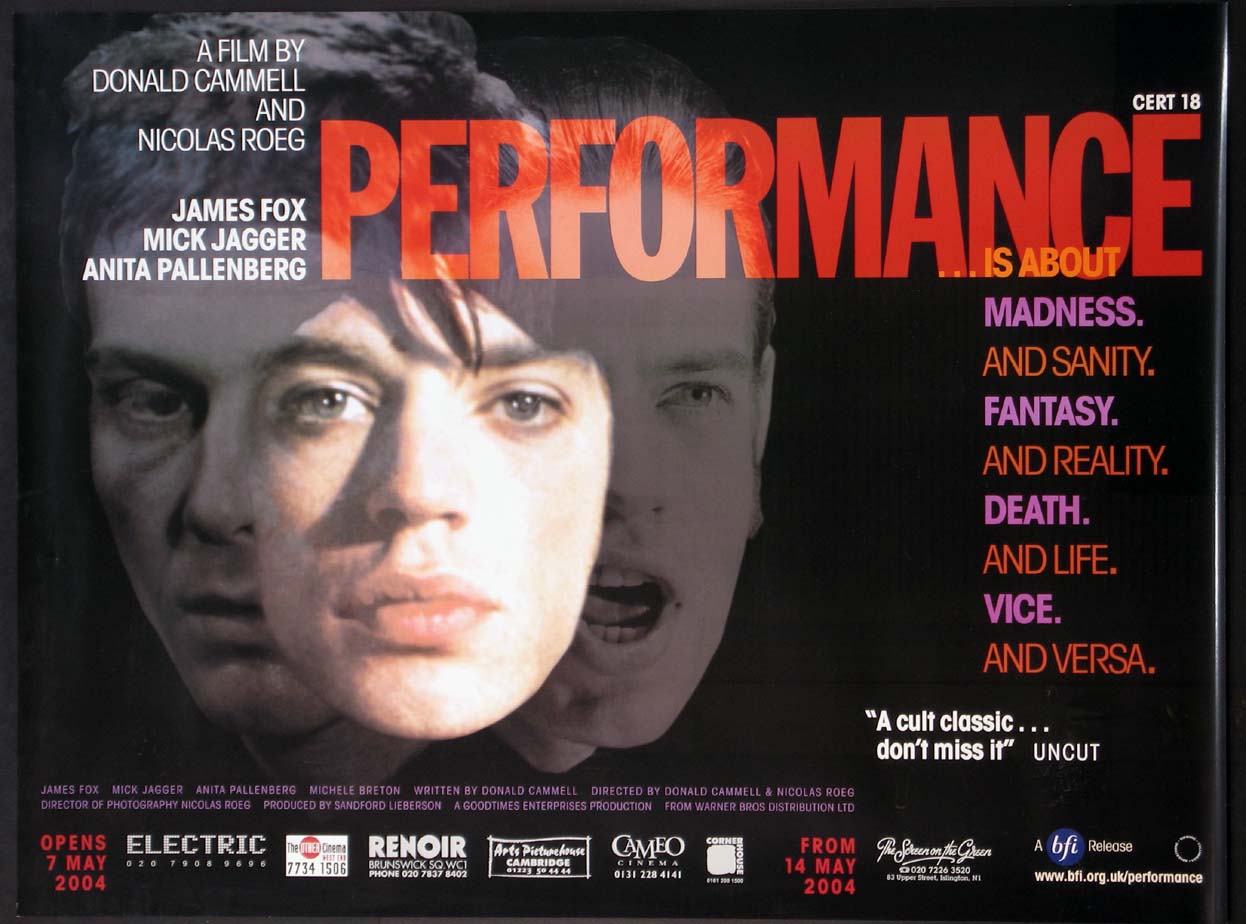
Performance (UK 1970)

Saturday July 27th 5.30 p.m.

This is both a cult movie and a seminal British film. Chas, (James Fox) is an East End gang member who collects protection money. When his methods result in a killing he goes on the run and hides out in Notting Hill Gate basement, where, upstairs there is a ménage à trois. Chas becomes involved in the hedonistic activities at the house and, in particular with an ex-rock musician Turner (Mick Jagger).

The film became infamous for its melee of explicit violence, sex and drug-taking. The 1970s also became infamous for the clash between adventurous film-making and conservative values, embodied in another British film The Devils (1971) and the campaign against it by an organisation called ‘The Festival of Light’.

This film was produced by Warner Brothers, who also were involved in the equally controversial A Clockwork Orange (1971). The studio executives did not know how to manage the film and enforced cuts in the finished property. The British Board of Film Censorship [as it then was] made more cuts. On release it received an ‘X certificate’ whilst in the USA it received an ‘R’ rating. It received similar certificates in other territories and often additional cuts. The USA release suffered the further indignity of having some cockney dialogue being dubbed [re-voiced]; a fate also experienced by the radically different Kes (1969).

Two people received director credits. Donald Cammell, a bona fide maverick, who wrote the screenplay and was also associate producer. He was born in Edinburgh in the ‘Outlook Tower’ later home for a ‘Camera Obscura’; how apt. Cammell started out as a painter, took up script-writing and then Performance. This is his most famous and successful film; later works have a similar combination of the exotic and the erotic, but not the acclaim.

His fellow director was Nicolas Roeg. He was born in London; and also appropriately nearly opposite the old Marylebone Film Studio, used at one point by Hammer Films. He started out as a cinematographer and indeed shot this film. He went onto direct several successful and highly praised films, including Don’t Look Now (1973), screened in a digital version here last week. He had an unconventional style of film photography. One critic, Steve Rose, remarked that his films

“shatter reality into a thousand pieces” .

His film work, as in this title, is always memorable.

The film runs 105 minutes in colour and black and white, and in the European widescreen ratio. This screening presents the restoration by the BFI from 2004 in 35mm.

The background to the film and its handling by the industry and censors will be illuminated in the Q&A that follows with Sanford Lieberson, the producer on the film. His other work includes a number of documentaries including the very fine ‘Brother Can You Spare a Dime (1975). He will be accompanied by Jay Glennie who has produced a book; ‘Performance: 50th Anniversary Book’.

Sunset / Napszállta (Hungary. France, 2018)

Sunday July 14th at 2.30 p.m.

This is the new film from director László Nemes. His previous film was Son of Saul / Saul fia (Hungary, 2015). This new film also enjoys the fine production work of many of the same team from the earlier film: music László Melis, cinematography Mátyás Erdély, Film Editing Matthieu Taponier and production design by László Rajk. And once again the film is screening at the Picture House in its original format of 35mm.

Son of Saul was a very subjective style narrative and the new film takes a similar approach. But is seems that there are even more ambiguities in the plotting this time. The film opens in Budapest in 1913 when a young woman comes to the city and encounters mysterious and threatening situations. The pre-World War I Austro-Hungarian empire offers a rich palette for such a story; witness the earlier Sunshine (1999) directed by István Szabó.

The film runs for 142 minutes in colour, widescreen with Hungarian and German dialogue with English subtitles. It promises to be less downbeat than the earlier film but likely will need close attention as the story unfolds. The effort should be repaid by the visual pleasure in the screening. The 35mm cinematography relies on random  silver halide grains in the stock that reflect the light and give excellent contrast. Digital copies of 35mm film transfer this to uniform pixels and only rarely reproduce the particular characteristics of film stock. So, the illustrative still at the top of this post does not really give a sense of what we should enjoy viewing.

Sans Soleil/Sunless, France 1983

Friday July 5th at 6.15 p.m.

This film was written, directed and edited by Chris Marker, who also provided the music. If you have not seen a Chris Marker film before it might help to write that two of his friends and cinematic collaborators were Alain Resnais and Agnes Varda. Associated with the nouvelle vague they were actually part of a distinct group of film-maker known as the ‘left-bank group’. Their films were more experimental, more political and more distinctive than the  famous ‘new wave’ films. Marker himself is known for works described as ‘essay films’ and this title is a good example of that approach. Not exactly documentary but addressing the actual world.  Wikipedia defines [informal] written essays as characterised by:

“the personal element (self-revelation, individual tastes and experiences, confidential manner), humour, graceful style, rambling structure, unconventionality or novelty of theme,”

Much of this will be found in the Marker film. As well as his personal involvement in so much of the production of the film Marker also appears in slightly fictionalised versions of himself.

The film’s written component is a series of letters both partly read with comments by a female character. The letters are from a cameraman visiting a variety of places: Japan, Guinea-Bissau, Cape Verde, Iceland, Paris, and San Francisco. The last includes locations used in Alfred Hitchcock’s highly regarded Vertigo (1958), a film that has pre-occupied Marker for years. I actually did the same homage to the film with a French guide and Marker fan.

The original French version of Sans Soleil opens with the following quotation by Jean Racine

“L’éloignement des pays répare en quelque sorte la trop grande proximité des temps.”

(The distance between the countries compensates somewhat for the excessive closeness of the times.)

The English version of the film opens with lines by T. S. Eliot:

“Because I know that time is always time

And place is always and only place”…

The screening today is of the English Language version. Marker shot the film on a 16mm camera in colour and standard European widescreen. There are film footage and stills in colour and black and white academy and some special effects. The film-makers quoted are given in the end credits as is the English language narrator, Alexandra Stewart. Marker recorded the soundtrack in asynchronous manner, thus the sound does not always match the imagery. So this is ‘montage’ in the full sense of the word. The film has been copied onto 35mm so we will enjoy a ‘reel’ film.

Sans Soleil is preceded by a short five minute film, also on 35mm and an introduction. The short film is Black by Anouk De Clercq (2015, Belgium). The double bill is the opening event in a weekend of screenings organised by the Pavilion, ‘Artists’ Moving Image Network Screening Weekend’. There are a series of screenings by artists working on film and moving images, including digital and 16mm projections. There are more events at the Hyde Park Picture House but also at a venue in New Briggate, number 42, sited between the entrances to the Grand Theatre and the Assembly Rooms [pre-booking is advised].

The artists include those based in Yorkshire and from farther afield; Alain Resnais has a title screening. This is an ambitious project which promises to be varied, fascinating and rewarding.

***************************************************************

Postscript: I apologise; like Rick I was misinformed. Last night we enjoyed the original French language version of Sans Soleil with the letters and comments read by Florence Delay.

Black turned out to be a cinematic meditation on Marker’s use of black leader early in his film. And this 35mm print is a unique artefact, so we were fortunate to see it.

Rabbit-Proof Fence, Australia 2002

On Sunday 24th September – 1.30 PM

The screening jointly presented by the Picture House and Amnesty International. This was a relatively successful release in 2002 given that it is [in part] a foreign-langue film, in Aboriginal and English. The British distribution and exhibition scene does not do very well by such films. So it is good to see it returning to the Picture House for an opportunity to see or re-see a fine and moving drama.

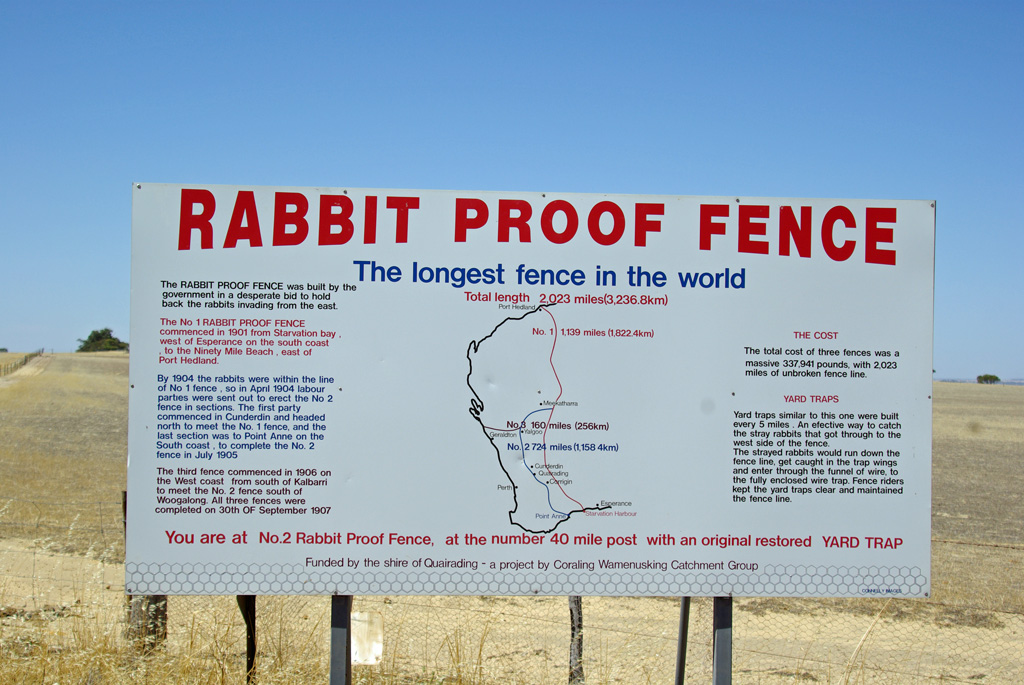
The film is partly based on actual characters and events. In 1931, as part of the oppressive treatment of Aborigines, three young girls are taken from the families and placed in a ‘re-education’ camp. The film follows their epic journey home, following the fence that cuts across the continent. The fact that the fence was a built to control the imported rabbits population is a potent metaphor for the colonial policy in Australia.

The three young performers – two sisters, Evelyn Sampi as 14-year-old Molly and Tianna Sansbury as 8-year-old Daisy, with Laura Monaghan as their 10-year-old cousin Gracie are excellent. Kenneth Branagh plays the Protector of Western Australian Aborigines, A. O. Neville: the actor frequently embodies the British Empire, in this case known by Aborigines as ‘Mr Devil’. And there is David Gulpilil as Moodoo the Tracker, the Aboriginal actor whose career started with Walkabout in 1971.

The film is helmed by Phillip Noyce, the Australian director whose tally of films goes back to the 1970s including the fine Australian Film Commission production Newsfront (1978). The cinematography is the work of Chris Doyle. He is especially noted for his work with the Hong King filmmaker Wong Kar-Wai and he has won prizes at the Cannes and Venice Film Festivals. Here he reveals the sweep and epic nature of the outback landscape.

Fortunately the film, shot on Super 35 and in colour, is screening in 35mm, which will do proper justice to the visuals. And the soundtrack enjoys music by the British composer Peter Gabriel.

When released the film attracted criticism and controversy regarding the representation of the treatment of Aboriginal children. The source for the film is a personal autobiography. The film probably takes liberties in dramatising historical events. But there is plenty of evidence of the inhumane treatment of Aboriginals by the colonial government and the Australian government: from the 1978 The Chant of Jimmy Blacksmith there are a number of fine film treatments of the issue,. The recent excellent documentary Al Jazeera on the ‘White Australia’ policy provides evidence on another aspect of the policies in this period.