Favourites from 2016

arrival-movie-still

So we enter the Award season and the moment when we reflect back on the previous year. I thought a good year, but not a great year for film: but there were some great movies. Of the new releases that I watched at the HPPH I was especially impressed with:

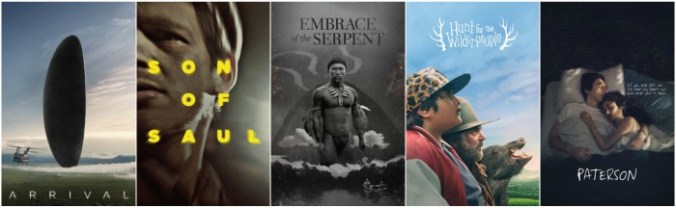
Arrival (USA but also Canada 2016). Denis Villeneuve has directed the most interesting sci-fi in years and Amy Adams offers a sterling performance.

The Pearl Button / El botón de nácar *France, Spain, Chile, Switzerland 2015). Patricio Guzmán provided a documentary that was moving, analytical and both looked and sounded great.

Son of Saul / Saul fia (Hungary 2015). László Nemes produced an intense and revelatory treatment of an often overworked subject.

Taxi / Taxi Teheran (Iran 2015). I prefer film to video but Jafar Panahi can make an impressive film with any sort of cinematic technology.

Our Little Sister / Umimachi Diary (Japan 2016). The latest film by Hirokazu Koreeda is a simple tale of four sisters: and goes into my list of the top films of the century so far.

still-ourlittlesister2

We also enjoyed a lot of classics from times gone by. The best in a competitive field for me was:

Eternity and a Day / Mia aioniotita kai mia mera (France, Italy, Greece, Germany 1998). Theo Angelopoulos’ rich and complex film was screened in a good quality 35mm print.

2017, 100 years on …

soviet-directors

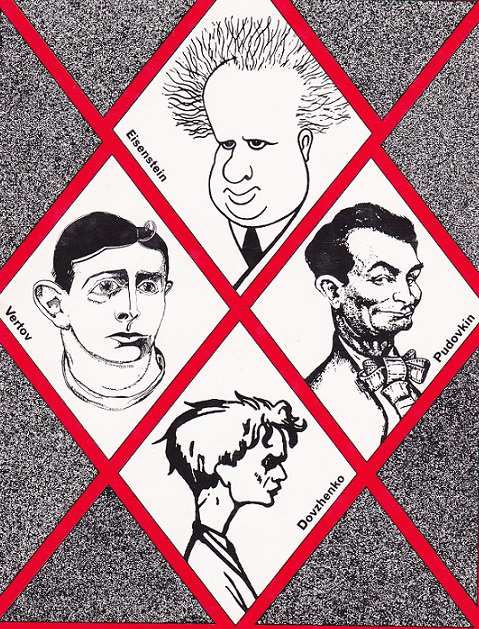
So welcome to the year in which we celebrate the centenary of the Great October Revolution. One enjoyable form of celebration will be to watch some of the masterworks of Soviet Montage Cinema. One obvious candidate is Sergei Eisenstein’s film of the historic event, Oktyabr (Ten Days That Shook the World, 1928).

Other key films that we may hopefully see this year on 35mm [four with live music) would be:

The New Babylon (Novyy Vavilon, 1929) directed by Grigori Kozintsev and  Leonid Trauberg. A powerful dramatisation of the historic Paris Commune of 1871: a forerunner for the October revolution.

Mother (Mat, 1926)  directed by Vsevolod Pudovkin. Set during the Russian Revolution of 1905 and based on the 1906 novel ‘The Mother’ by Maxim Gorky.

The Girl with a Hatbox (Devushka s korobkoy, 1927) directed by Boris Barnet and starring Anna Sten. The film satirises the ‘Nepmen’, entrepreneurs who were allowed to conduct commercial business during the New Economic Policy of the 1920s.

Earth (Zemlya, 1930) directed by Alexander Dovzhenko and dealing with the process of collectivization and the hostility exhibited by the Kulak landowners.

Enthusiasm (Entuziazm / Simfoniya Donbassa, 1931) directed by Dziga Vertov. A film celebrating Socialist Construction in the Don Valley of the Ukraine. Needs to be seen with its original soundtrack rather than with live music.

Arrival, USA 2016

Tuesday December 27th at 3.00 p.m.

arrival-21

A chance to catch one of the best English-language films of the year. The film tends towards what is called ‘hard science fiction’, that is concern with the theoretical and scientific aspects of the future. That is part of its entertainment value, though it is also well produced and enjoys a fine central performance from Amy Adams. She is a linguist recruited by the military to attempt to communicate with visiting aliens. The design of the aliens is as innovative as I have seen in years. A central theme is time: the resolution of the film unlocks the complexities this involves.

The director is Canadian filmmaker Denis Villeneuve who was responsible for the very fine drama Incendies (2010). His two other films have been Prisoners (2013) and Sicario (2015), demonstrating a varied approach to genre. Whilst the film bears the US tag it was filmed in Canada. The screenplay by Eric Heisserer has been adapted from a short story by Ted Chiang. He seems to specialise in shorter fiction writing and has a high reputation in science fiction circles. This tale has an interesting treatment of language as well as of time.

If you have time and are feeling a little frustrated by the  few quality films around over the festive season you can wait a little while and catch a classic: In the Heat of the Night (1967) with award winning performances by Sidney Poitier and Rod Steiger.

in-the-heat-of-the-night-film

The Unknown Girl / La fille inconnue, Belgium / France / Italy 2016.

Opens Friday December 16th at 6.00 p.m.

theunknowngirl4-1600x900-c-default

This is the most promising title in December, not a great month for new releases. It is the latest film from Jean-Pierre and Luc Dardenne. Their track record over the years offers series of very fine films. Their work is best described as social realism. They started their career with documentaries and there is still a touch of the documentarily style about their films. But there screenwriting also offers drams that are intense as well as socially relevant.

They won the Cannes Festival Palme d’Or in 1999 with Rosetta, which followed the efforts of a teenage girl to free herself from a dysfunctional family situation. The Son (Le Fils) was nominated for the same prize in 2002. This tale studied a young man and a relationship with a surrogate father. The Child (L’enfant) was again the winner in 2005. This was an intense drama about parents living on welfare and their newly born child. Lorna’s Silence (Le Silence de Lorna) received a another nomination for a study of a young woman who undertakers an arranged marriage. Once again in 2011 the brothers were nominated for The Kid with a Bike (Le Gamin au vélo), a more upbeat tale about a young boy and an effective surrogate mother. Two Days, One Night (Deux jours, une nuit) also received a similar nomination in 2014. This film parcelled both the British I, Daniel Blake and the French La loi du marché in the tale of a young female factory worker.

Now this year The Unknown Girl received the Dardenne Brothers seventh nomination for this prestigious award. Clearly Cannes juries like these filmmakers: deservedly so. The films are simply yet beautifully composed. They work with their cast with real skill. And the stories they present are intriguing and powerfully relevant. Their latest film follows an investigation into the death of an unidentified young woman. It sounds like familiar Dardenne territory and whilst is has received mixed reviews it remains a promising film to watch.

The Dardenne’s have explored the world of the young, exploited oppressed and disenfranchised youth in many of their films. It is remarkable that they do so with such skill since they are both now in their fifties. And in that time they have produced a series of films that are equal to the work of other leading European filmmakers.

Note the film opens today with the only early screening. The following ones on Sunday, Monday and Tuesday all run up to or pass 11 p.m.

Christmas in Connecticut

For our Friends’ Christmas special this year we are pleased to present Christmas in Connecticut (1945) this Wednesday 14th December.

14856056_1455304677813865_2632509456940092219_o

Members are invited to join us from 5.45pm for a mince pie and a glass of sherry and to meet and speak with other members of the Friends then the film will screening shortly after 6.30pm.

This showing is free to members of the Friends but everybody is welcome and normal ticket prices apply to non members.

The film follows a sharp writer who, despite never setting foot in a kitchen, writes a cooking column for a women’s magazine. In order to trick her publisher, she poses as a happy homemaker, complete with husband, baby and country estate. Her goose is cooked when the publisher arranges for her to host a sailor over the Christmas holidays. The journalist has to marry her boyfriend, find a home and prepare a spectacular meal for a huge magazine spread. Things grow even more complicated when she starts to fall for her guest.

Andrzej Wajda 1926 to 2016

wajda-andrzej-03-g

World Cinema lost one of it luminaries in October this year when the iconic career of this filmmaker came to an end. Wajda was one of the celebrated graduates of the Łódź Film School, This training ground for film actors as well as crafts people had a deservedly outstanding reputation.

Wajda first drew attention with his trilogy A Generation (Pokolenie, 1954), Kanał (1956) and Ashes and Diamonds (Popiół i diament 1958). These were founding works in what developed into the European art cinema. I saw them, as did many at the time, in a Film Society in 16 mm prints. I have since been able to revisit them again in 35mm prints. All remaining outstanding but the key film is Ashes and Diamonds with the character of Maciek played by the young iconic Polish actor Zbigniew Cybulski. There is a terrific sequence with fireworks lighting up the sky and a sequence which I have seen copied a number of times with sheets billowing from a clothesline.

Wajda turned out fine films decade after decade, and I still have to see a number of them. One that stood out was Landscape After the Battle (Krajobraz po bitwie, 1970), a film that deals with a Holocaust survivor and which includes some stunning landscape sequences. Two films that stood out in addressing the repressive regime that ran Poland in the period are Man of Marble (Człowiek z marmuru, 1977) and Man of Iron (Człowiek z żelaza, 1981). I saw at least one of them at the Academy Cinema in London, a fine and now lost venue for quality film.

More recently Katyń (2007), dealing with the Soviet massacre of Polish Officers in 1941, was extremely well done. And we can look forward to his final film Afterimage ( Powidoki, 2016), yet to enjoy a UK release. There are a variety of fine films that would grace a screening tribute to this great filmmaker. My own choice would be The Promised Land (Ziemia obiecana), 1975) which chronicles the development of the C19th capitalist textile firms in Łódź. The film is a fascinating chronicle and has some terrific sequences including a factory fire. The film came round last year in the programme ‘Martin Scorsese Presents: Masterpieces of Polish Cinema’. It was screened at the Sheffield Showroom in a good quality 35mm print. However, I do not think it made in to West Yorkshire. Hopefully the print is still available in the UK.

promised-land-10

Review: Eternity and a Day

Friends member Rob Baker reviews Eternity and a Day which screened recently as part of a small season of films in conjunction with Amnesty International Leeds.

1-eternity-and-a-day

After Arrival (2016) we have another film playing with concepts of time. Eternity and a Day (1998) is the second of three screenings at the Picture House organised by the local Amnesty group’s Refugee and Asylum Seeker Sub-Group.

Alexander (Bruno Ganz) is an aging Greek poet who believes he is facing his last day on earth. An unnamed medical intervention is planned for the next day, and he does not expect to recover – we almost get an impression of voluntary euthanasia. He starts the day trying to find a home for the dog he knows he must leave behind.

Alexander time-shifts through the day, re-living encounters with his parents (only his ailing mother now survives), his young wife (deceased), and his daughter both as a child and grown up (bringing us to current time).  With the exception of a couple of scenes showing him as a child, playing on the beach with other children, with his Mother off-screen calling him to come in for dinner, Alexander appears in most of these scenes as his current late middle-aged self. We are even taken back to the mid 19th century with the appearance aboard a Thessaloniki night-bus of a long dead poet, whose key unfinished work  Alexander  has set himself the task of finishing, though of course he hasn’t – “Nothing is finished” he laments.

Powerful symbols of “passing on” intrude on the scene, with buses and ships, even a trio of cyclists in yellow oilskins, hoving into view behind the protagonists. The constant leitmotif of the film is the Aegean shoreline where nearly all the family encounters of the past and present play out. The sea, the final frontier for us all to cross, sparkles in the sunshine.

Continue reading

Fidel Castro, 1926 to 2016

Fidel Castro, Prime Minister of Cuba, smokes a cigar during his meeting with two U.S. senators, the first to visit Castro's Cuba, in Havana, Cuba, Sept. 29, 1974. (AP Photo)

Fidel Castro, Prime Minister of Cuba, smokes a cigar during his meeting with two U.S. senators, the first to visit Castro’s Cuba, in Havana, Cuba, Sept. 29, 1974. (AP Photo)

Apart from reactionaries in the USA most people will mourn the passing of this revolutionary leader. So a good way to celebrate his achievements and contributions would be to screen one of the  outstanding films that were produced by ICAIC. My preferred title would be Memories of Underdevelopment (Memorias del subdesarrollo, 1968) directed by Tomás Gutiérrez Alea which has been restored by the World Cinema Foundation. And Alea’s later The Last Supper (La última cena 1976) is likely to be available on 35mm . Another would be Lucía (1968) directed by Humberto Solás which should also still be available in a 35mm print.

Since either would now be in a 2017 programme this would also provide a harbinger for celebrations of the centenary of the 1917 Revolution as ICAIC were among the important heirs of Soviet Silent Montage.


Paterson France, Germany, USA 2016

Daily from Friday 25th November

paterson-quad

This new film from Jim Jarmusch was the opening film at the Leeds International Film Festival. Jarmusch also scripted the film and the Festival Catalogue quotes him:

“I love variation and repetition in poetry, in music and in art. Whether it’s in Bach or Andy Warhol. In the film I wanted to make this little structure to be a metaphor for life, that every day is a variation on the day before or the day coming up.”

What we get in the film is the slight variations in the life of Paterson (Adam Driver) who lives and works in the city of Paterson. The city is famous for the Great Falls situated on the Passaic River and as the subject an epic poem by William Carlos Williams, a member of the US modernist poetry movement.

Paterson is an amateur poet who works as a local bus driver. The variations in his life and work take place over seven days. We see him frequently writing poetry in his notebook. and there are occasional encounters including with a much younger would-be poet.

Mornings, evening and night-times are spent at his house which he shares with Laura (Golshifteh Farahani) and her dog Marvin (Nellie, playing in a cross-gender role). Laura seems mainly involved in domestic labour. Marvin, a ‘British Bulldog’, clearly is jealous of Paterson. But Paterson take shim for his regular evening walk when he visits a local bar where we see the more local inhabitants and some of the drama in their lives.

The film offers low-key humour. The observation of Paterson and his environs is absorbing. However, he is a slightly fey character and Laura is even more so. I did think that Farahani’s part was seriously underwritten. I thought that Marvin was more developed in character. It would seem though that this will be Nellie’s only film role as an end title is dedicated to her memory. She won the 2016 Palm Dog posthumously.

The production of the film is well done. The cinematography by Frederick Elmes is clear, direct and makes good use of settings like the Falls. And the editing, by Alfonso Gonçalves, works well and makes some of the humour in its cuts. The composer Carter Logan, who worked on Jarmusch’s last film Only Lovers Left Alive (2013), adds to the irony with judicious music.

I should note that the Sight & Sound review by Henry K. Miller thought this the best work by Jarmusch since Ghost Dog (1999). If your taste is in Jarmusch movies then you will likely enjoy this.

Our LIFF30 Highlights

The film festival is over for another year and once again has provided Leeds with a fantastic selection of films. Below we share five of our highlights from the festival and would love to see yours in the comments:

Bill

Bill's Top 5There are so many films being made around the world!  The Leeds Film Festival programme is just a small sample, and the thirty or so films I saw are just a small sample of what the Festival had to offer. Here are 5 films that I enjoyed, in no particular order:

  • Sieranevada  – a beautifully directed and acted glimpse of a Romanian
    family’s memorial commemoration, which also says something about wider
    Eastern European society.
  • Chi-raq – Spike Lee’s theatrical exploration of the issues around Black
    Lives Matter, made with the involvement of people living in Chicago’s
    Southside.
  • Lonesome – a love story, with live organ accompaniment, mostly set in
    Coney Island, and made at a time when silent films were giving way to
    the new ‘talkies’
  • The Handmaiden – an exciting and beautiful Korean/Japanese story, with
    different perspectives challenging us to work out what is really going
    on
  • Fukushima, Mon Amour – the aftermath of the earthquake, tsunami, and
    nuclear reactor meltdown, is the setting for this film about the lives
    of people 5 years later, as seen through the eyes of a German woman who
    wants to bring some pleasure to their lives

I could have added another 5 quite easily.

Keith

Keith's Top 5

  • The Art of Negative Thinking – Scandinavian filmmakers excel at combining disability and humour.
  • Certain Women –Three well crafted stories, four excellent performances.
  • Mimosas – Very fine visually but the story requires careful thought and study.
  • Old Stone – A good Samaritan suffers under Chinese capitalism.
  • Woman of the Dunes – A black and white classic in a good 35mm print.

Stephen

Stephen's Top 5

  • Mindhorn – The funniest film since What We Do In The Shadows. I’d forgotten how fantastic it is to see an incredibly funny film in a packed cinema. We laughed so hard we probably missed half the jokes. Followed by a brilliant surreal Q&A.
  • A Man Called Ove – Perfectly combining humour and humanity, everything comes together to remind you there is some good in the world.
  • The Autopsy of Jane Doe – The best horror film I’ve seen in some time. Delivers intelligent thrills and never outstays it’s welcome by becoming too silly.
  • Breakfast at Tiffany’s – Seeing this projected (from 35mm) gave me a new appreciation and managed to completely charm me where I’d previously been underwhelmed.
  • Two Lovers and a Bear – A complete surprise, I knew nothing about this film and found it all completely delightful.

This was the strongest festival I remember and I’d recommend nearly all the films I saw. My next 5 films were Pet, The Birth of A Nation,  The First, The Last, Life Animated and Paterson.

Jake

Jake's Top 5

  • Certain Women – Kelly Reichardt’s most fully realised film to date. Maile Meloy’s short stories perfectly compliment each other, providing a perfect counterpart to Reichardt’s earlier adaptations of Jon Raymond. Great performances from the central cast, especially Laura Dern and relative newcomer, Lily Gladstone.
  • Mister Universo – Tizza Covi and Rainer Frimmel’s simple fiction played out by real life members of the Italian circus community. A beautiful intersection between fact and fiction, that functions as both a road movie and an affectionate family portrait.
  • The Woman of the Dunes – Teshigahara/Abe’s Sisyphusian nightmare. A classic. So glad I got to see this on a big screen on 35mm.
  • Graduation – Doting father, Romeo, walks moral tightropes in this austere drama from Cristian Mungiu. Shades of Haneke’s Hidden in it’s creeping sense of dread.
  • Mimosas – Ecstatic fiction, quasi-western with the Atlas mountains as a backdrop. Shakib Ben Omar is a wild, charismatic lead. A natural heir to Ninetto Davoli.