Johnny Guitar USA 1954

Sunday 29th May at 1 p.m.

85Johnny_Guitar_Johnny_Guitar_1954_Nicholas_Ray_ingl

This classic western has been re-released in a digital format by the BFI. You can read about it in the May edition of Sight and Sound under ‘The Psychological Western’ and ‘Westward the Women’. Both suggest why this film is now a cult classic, but there are other good reasons as well.

The director Nicholas Ray is a celebrated ‘auteur’ from the last stages of classic Hollywood, [i.e. the studio system]. His films are full of interest and he has a particular facility with colour: the best example being Rebel Without a Cause (1955). The screenplay is by Philip Jordan, whose other work includes Anthony Mann’s fine western The Man From Laramie (1955). The cinematography is by Harry Stradling who won two Academy Awards and received another 12 nominations. And the music is by Victor Young, who also won an Oscar and received another eleven nominations. Charlton Heston always maintained the nominations were what really counted as they were from one’s own peers in the Academy.

The film also has a stellar cast. Joan Crawford, in one of her outstanding roles, is saloon owner Vienna. She is the central character in the film despite being listed third in some publicity. Her support in the film is Sterling Hayden as drifting Johnny ‘Guitar’ Logan. Hayden’s laconic persona, with ample gravitas, led to Bernardo Bertolucci casting him in his epic 1900 (Novecento, 1976).  The opposition is led by Mercedes McCambridge as Emma Small; she almost liberally spits fire in the film. And the ever dependable Ward Bond is her sidekick John McIvers.

The film takes one of the central themes of the western genre – revenge – and treats it in an entirely unconventional manner. The film crosses over with the small-town melodrama, a genre that Ray used in his Bigger than Life (1956). This is a film that especially reflects on the social and film industry ‘witch-hunts’ of the period. The HUAC ‘witch-hunt’ is featured in two recent releases, Trumbo (2015) and Hail, Caesar (2016). Even if you are not a fan of westerns I would reckon this is a 110 minutes of completely engaging drama. The film was produced in the early days of modern widescreen formats and is in the 1.66:1 aspect ratio and was filmed in Trucolor for Republic Pictures.


Review: Arabian Nights Trilogy

Arabian Nights Trilogy

Filipino director, Lav Diaz, once said of his epic, sometime 10+ hr films, is that he likes the idea that audiences could leave the cinema, go to work, then return and carry on watching. That his films just breathe, exist, like we do. Parts of Miguel Gomes’ 6.5 hour Arabian Nights felt like that to me; These ambling, slice of life portraits of modern day Portugal, structured in a style inspired by One Thousand and One Nights, as told by Scheherazade. They show a Portugal in the shadow of austerity, yet plugging on. Breathing, Existing.

For example, the final 90 or so minutes, entitled “The Inebriating Chorus of the Chaffinches”, is about a group of disparate men, some of whom we’ve met already, who engage in the hobby of trapping and training chaffinches for singing competitions. The section, much like the rest of the trilogy, is at once sublime and ridiculous; weaving together their everyday existences, with Scheherazade’s anecdotal, at times bizarre narration, shedding light on their insular world whilst birds tweet and trill constantly in the background.

I hope plenty of people, like the audience at the Picture House today, get to watch the Arabian Nights films as a whole. I think they benefit from being in close proximity with each other, especially the final volume. I also hope audiences go home and watch Gomes’ previous films; The Face You Deserve (which is on Mubi until the 22nd ), the critically lauded Tabu (2012), and the (in my opinion) masterpiece, Our Beloved Month of August (2008), both of which screened at LIFF 26.

This Week At The Picture House

Hyde Park

Some weeks are dominated by one big release and others offer a variety of films. In the next seven days there are ten different films at the Picture House including the latest from directors Jeff Nichols, Jean-Marc Vallée, Miguel Gomes and Richard Linklater.

First up is Jeff Nichols’ long anticipated Midnight Special (Fri 6:20pm with a Meetup and Wed 8:50pm, also 11am BYOB), a science fiction mystery from the director of Mud (2012) and Take Shelter (2010) with a Spielbergian feel, even if that’s not what Nichols was planning.

On Sunday afternoon there’s a rare chance to see all three of Miguel Gomes’ Arabian Nights films (1pm special ticket price: £15 full, £13 conc, £12 members plus another MeetUp). “A glowing love song to Portugal performed by a man who has mastered a range of exotic instruments” says David Jenkins in Little White Lies and a “passionately investigative, floridly imaginative triptych” according to Richard Brody of The New Yorker.

Jean-Marc Vallée has received a lot of attention in the last few years for directing Dallas Buyers Club (2013) and The Wild (2014) but it was C.R.A.Z.Y (2005) that makes him a director to keep an eye on. Unfortunately his latest film Demolition (showing daily) is getting mixed reviews but it’s an interesting premise and a great cast so may be worth checking out.

Continue reading

Our Little Sister / Umimachi Diary Japan 2015

On 7th May – 5.40 PM / On 11th May – 3.40 PM

our_little_sister_edit_xlarge

This film was screened in the 29th Leeds International Film Festival and I thought it the pick of a strong programme. The film is adapted from a popular manga title by Koreeda Hirokazu, who also edited the film. It is the most recent in a line of family dramas in the tradition of the Japanese film genre, shomin-geki [shōshimin-eiga, the lives of ordinary working people]. These include Like Father / Soshite chichi ni naru (2013) involving parentage and children: I Wish / Kiseki (2011) about separated siblings: and Still Walking / Aruitemo aruitemo (2008) about adults and their ageing parents. Our Little Sister combines aspects of the earlier films with its main focus on four sisters. Three of these are the adult Koda sisters, Ayase Haruka as Sachi, Nagasawa Masami as Yoshino and Kaho as Chika. The ‘little sister’ has Hirose Suzu as Asano Suzu, their step-sister. They and the supporting cast are very fine.

The film is set in Kamakura on the Yokohama peninsula; not that far away from Tokyo. But this is a small coastal town. The settings include the family home, urban and rural sites and the seashore. Koreeda and his team, notably cinematographer Takimoto Mikiya, offer fairly slow and detailed observation. Critics have made comparisons with the films of the great Ozu Yasijurō, but thematically this film is closer to the equally fine work of Naruse Mikio. There is loss but also resilience and the importance of memory and tradition. The film is a delicate study with moments of humour and irony. As with the earlier films food and meals are an important aspect of the lives and their study.

If you have not seen Koreeda’s films before this would make an excellent start. If you have you will know just how rewarding are his studies of family life. If we see half-a dozen equally fine films this year then 2016 will be a classic.

Son Of Saul Hungary 2015

Screening daily from Friday 29th
Introduction and panel discussion Sunday 1st May 5pm

Son Of Saul

There have been countless essays written about cinematic representations of the Holocaust; are the Academy Award winning depictions by Steven Spielberg or Roberto Benigni truly important? or just trite exploitation? Is it ever OK to make a fiction film about the awful events that happened in places like Auschwitz-Birkenau and Treblinka?

Son of Saul director, Laszlo Nemes, himself a film school graduate, has made a film that places him into this ongoing conversation, and sees his debut as, among other things, a critique of established popular representations. In an interview with The New York Times, Nemes reveals his antithetical approach “Since the end of the Second World War I’ve seen very clearly that many people more or less consider the Holocaust as a mythical story and approached it probably from a defensive mechanism, as a way to get away from it through survival stories. I don’t think Auschwitz and the extermination of the European Jews was about survival. It was about death. And how Europe killed itself, committed suicide.”

But Son of Saul, now an Oscar winner itself (Best Foreign Language Film 88th Academy Awards) has been met with its own share of criticism. Manohla Dargis for The New York Times called the film “Intellectually repellent”, Michael Koresky in Reverse Shot described it as being “grotesque and exploitative” and Stefan Grissemann in Film Comment similarly sees it as exploitation; writing “In its pursuit of controversy, Son of Saul plumbs unforeseeably new depths of revulsion.”

The film does, however, have a surprising but powerful supporter in Claude Lanzmann, director of the revered holocaust documentary, Shoah (1985). Lanzmann has criticised other films for dramatising the horrors of death camps, yet has given Son of Saul his approval, praising it as an “anti-Schindler’s List”

Son of Saul first played at Hyde Park Picture House as part of the Leeds International Film Festival last November, where it didn’t quite manage to rank in the audience top 10. Yet looking at Twitter, it definitely had its fair share of supporters in the audiences, and although I’m undecided on how I feel about the suspense plotline, I have to recommend it for Géza Röhrig’s central performance, the impressive stark sound design and for the arresting shallow focus cinematography by Mátyás Erdély.

Son of Saul screens daily from Friday 29th of April. The Sunday screening at 5pm will include an introduction by Dr Dominic Williams (University of Leeds), co-author of a recent book about the Sonderkommando as well as a post-film panel discussion with Prof. Griselda Pollock (University of Leeds), Prof. Sue Vice (University of Sheffield) and Gary Spicer (Stockport College).

Philosophy and Film: Eternal Sunshine Of The Spotless Mind

Tuesday 26th April 6:15pm

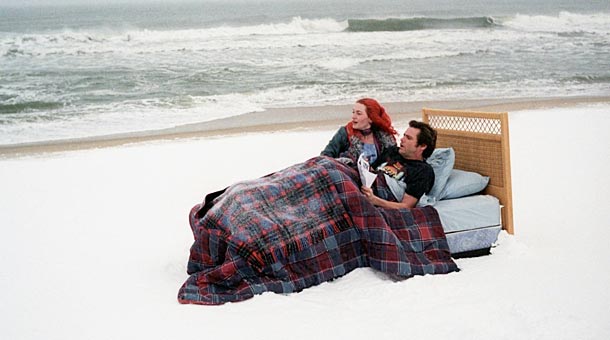
Eternal Sunshine Of The Spotless Mind

The second session of the Philosophy and Film series at the Hyde Park Picture House will show Eternal Sunshine of the Spotless Mind (2004), directed by Michel Gondry, with a screenplay by Charlie Kaufman.  Eternal Sunshine is about an unhappy estranged couple, Clementine (Kate Winslet) and Joel (Jim Carrey), who separately decide to have their tormented memories of their failed affair deleted by a professional service, Lacuna Inc. Then they accidentally meet again, not knowing who they are.

Here’s one idea. We’ve all had bad experiences, and bad memories of those experiences. They can make us feel defeated, depressed, even paralyzed. Wouldn’t we be better off without them? Here’s another idea. Our memories naturally decay. By and large, we don’t think this is a tragedy. It protects us against being entombed in the past, and leaves us free to live in the present, and to plan for the future. But if this forgetting doesn’t ruin us, and may even benefit us, then why would it be a bad idea, if we could, to take deliberate steps to erase these memories? And, if it turns out that it would be a bad idea to deliberately erase our memories, then should we try to fight against the natural processes of decay? The film obliquely explores ideas like these in a variety of ways, and from a variety of angles. Dr. Gerald Lang (University of Leeds) will be talking about them after the screening of the film.

Black Mountain Poets UK 2015

On 20th April – 11.00 AM [BYOB]On 20th April – 9.15 PM

BLACK_MOUNTAIN_POETS_6Strictly speaking this is a wry Welsh film comedy. It is uneven but engaging. If you have seen writer and director Jamie Adams’ early films [Benny & Jolene and Christmas Time, 2014)  you will know if it is your sort of comedy. The basic story is set on a weekend rural ‘Poet’s Poetry Society’ event. In fact there is only  a limited amount of poetry, with two complete poems, one in Welsh. The film is really interested in the characters. At the centre are sisters Lisa (Alice Lowe) and Claire (Dolly Wells). They are excellent, as are the supporting cast which includes another pair of sisters. The event and the attending poets are whimsical and slightly absurdist.

The film has an improvised quality, it was shot over five days. The continuity is not so much full of holes as coming and going as the whim takes the film. The editing has a fragmentary quality, it is as if the audience are listening in to the characters as they wander round. But there is a definite trajectory in the relationships over the four days. Bizarrely the poetry event includes camping on the Welsh hills. This provides innumerable settings for very fine widescreen cinematography by Ryan Owen Eddleston.

The film is unconventional and rarely formulaic. There is quite a lot of music on the soundtrack, sometimes unnecessarily so. But the film provides a warm and quietly humorous 85 minutes.

Meetup: Dheepan

Wednesday 13th April 5:50pm
Also showing daily until Thursday 14th

Dheepan

The Palme D’or winning Dheepan is showing every day this week but Wednesday’s screening is the latest Leeds Movie Meetup Group gathering. We asked Frankie, the group’s organiser to tell us a little more.

Since forming in September 2008 the Leeds Movie Meetup Group has grown to a substantial size (1700+) members, although a typical number of attendees for an actual movie meetup would be 6 or 7 and our record attendance remains 22 for the DiCaprio movie Inception (2010). The Hyde Park Picture House is very much our ‘home’ venue. To date we have attended over 500 movies at the cinema, with Dheepan being our next meetup. I was joking that the follow up film should be called Krispneven, and at least 1 person thought that was funny! It’s not the same when we go elsewhere, although if we do, we much prefer independent cinemas such as The Cottage Road in Far Headingley to the Vue experience – where the screens are way too big and it’s way too expensive. But the main reason we love going to HPPH is the type of movie that gets shown there. Dheepan is exactly the kind of movie that the group looks for. Sure we also like recent blockbuster films such as The Revenant, High Rise or Hail, Caesar! but it’s the award winning foreign movies that are the first to get scheduled. Palme D’or winners (such as Dheepan) are sure to get the group talking in the Royal Park backroom afterwards. It might be totally hat-stand, but The Lobster which was our Favourite Film Meetup for 2015.

It’s tricky to find the Meetup website’s discussion board on a mobile phone, but with a desktop version, then it’s easy. We nearly always put an informal review of the film (and meetup) on there, certainly this happens if it’s an event that I’ve hosted, so it’s a little weird to do a preview of Dheepan. My reasoning in stating that is that I like to go see a movie where I know as little about it as possible. Ideally someone who has similar taste in movies to me will recommend it; and then I don’t want to see any trailers or read any reviews in the media. Dheepan has an interesting premise where a Tamil soldier poses as the husband and father of two other refugees in order to escape Sri Lanka and attempts to start a new life in France, and I think I’d rather not know any more about it!! However, I’m not a fan of some of the director’s other movies, especially A Prophet (2009), which as prison dramas go, was easily the toughest stretch I’ve had to endure, and was far too long.

I want to finish by mentioning Victoria. This movie is coming to the HPPH soon (from April 15th), and our Group is going to see it. We saw it at the Leeds International Film Festival back in November. It subsequently won a Llama (Leeds Annual Meetup Awards) for the year’s best film, as voted for by the members of the Group. Now that is an amazing film. It’s a little slow to get going but when it does it grips!!

The Pearl Button / El botón de nácar Chile 2016

Wednesday 6th April at 4.00 p.m. and on Thursday 7th April at 6.15 p.m.

the-pearl-button

This is the new film by Patricio Guzman. His most famous work is The Battle of Chile. This epic documentary was made in exile in Cuba in three parts. These are La batalla de Chile: La lucha de un pueblo sin armas – Primera parte: La insurreción de la burguesía 1975: Segunda parte: El golpe de estado 1976: Tercera parte: El poder popular 1979. The last time it was shown locally was five or more years ago in one of the screenings ‘tween’ festivals and then I think only Part 1 and Part 2. There were 35mm prints in the UK [Metro Pictures], if they are still here it would be good to have a fresh opportunity to see what Time Out praised as “among the best documentaries ever made”.

Guzman’s new film is a companion piece to the earlier Nostalgia for Light / Nostalgia de la luz 2010. Both films combine a sort of poetic essay with a documentary treatment. The earlier film was mainly set in Chile’s northern and arid Atacama desert. In part it followed widows and family members of the ‘disappeared’ under the Military Junta looking for traces of their lost ones. The new film is set in the southern Patagonian region and initially addresses the genocidal treatment of the indigenous Indians but then draws parallels with victims of the Junta who perished in the same region. The button of the title is one of the links between these groups.

In both films Guzman uses a physiological and cosmological metaphor to bind the issues together. In this film it is water: bought to earth originally by comets and one of the major features of the Patagonian region: the others are mountains and glaciers. Both films are full of impressive visuals and enjoy distinctive sound designs. I thought the metaphoric aspects worked better in this film. It also has a freer form which allows/demands that the audience think through the interaction.

The film is in standard widescreen and colour with English subtitles. It also uses black and white archival stills and film. My only reservation was that the film follows that increasing and problematic habit of reframing early film: not exactly respectful for the predecessors of today’s’ filmmakers.

The film is showing on Wednesday and Thursday. The Wednesday screening will also offer one of the short films from The Artist Cinema 2016: El Helicóptero, which turns out to have an intriguing link with the feature, [Thursday’s may also screen this short film]. Thursday’s screening is followed by a recording of a Q&A with the film director.

This Week At The Picture House

underground_02

It’s quite an interesting week at the cinema (isn’t it always?). There are a few more chances to catch High-Rise and Anomalisa, two films which seem to be splitting audience opinions between love and hate. The Coen Brothers latest Hail, Caesar! gets its first run at the Picture House along with beautiful and haunting The Pearl Button. The screening of The Pearl Button on Thursday 7th April will be followed by a recorded Q&A with the film’s director, recorded last month at Home, Manchester.

On Saturday at 4pm there’s chance to see Harmonieband perform live their wonderful new score to Anthony Asquith classic  Underground (1928) which is sure to delight first time viewers and old fans alike.

On Monday there’s a rare chance to see this year’s Oscar nominees for Animated Short on the big screen. I’m sure all nine films are great but personally I’m looking forward to finally seeing World Of Tomorrow a film I’ve heard so many good things about.

Tuesday’s Wonder is This Is Exile (2015), an extraordinary, intimate portrait of child refugees forced to flee from the violence of Syria’s civil war to neighbouring Lebanon. The film will be followed by a panel discussion and the screening is a “pay as you feel” event to raise money for Amnesty International and Save The Children.