Oscar Micheaux: The Superhero of Black Filmmakers

This is a documentary screening on April 1st on Sky Arts at 2.40 a.m. This appears to be the only Sky channel available on Freeview, Channel 11. It offers a range of programmes on the arts including frequent studies of cinema, film and film-makers. The majority of these are rather lightweight; they tend to ‘talking heads’, which means the comments are spread across a series of interviewees and rarely have the space to develop complex comments. And the extracts from films tend to be short and not necessarily illustrative of the important points. Some, like the programmes on Buster Keaton or Josephine Baker, involve the European Media Company Arte and are more analytical. This documentary falls rather in the middle.

Oscar Micheaux was a pioneer film-maker in what was known in early C20th USA as ‘race cinema’. These were films produced specifically for black audiences and usually screened in segregated cinemas in the South and either in segregated auditorium or programming in the North. The earliest ‘race’ film dates from 1905 but the cinema took off around 1910 , mainly in Chicago. There were independent ‘race films’ production companies like The Lincoln Motion Picture Company [1916 to 1921] owned by black entrepreneurs. Most companies in this field were owned by white entrepreneurs. There were also black production crew and ‘stars’ like comedian Mantan Moreland, who actually appeared in a few mainstream Hollywood titles. The ‘race cinema’ died out at the end of the 1940s when Hollywood finally decided to attract the ‘black dollar’; and then the 1950s saw the appearance of black stars in Hollywood like Sidney Poitier.

Oscar Micheaux was possibly the most important producer and director in this field. His Micheaux Film Corporation was set up in Chicago in 1918 and he later also worked in New York. Between then and 1940 he made forty four movies; most, like much of the ‘race cinema’, are lost. But the surviving silent and sound films are key examples of that cinema and also are seminal film texts in the history of US film and black film-making. Continue reading

Knives Out, USA 2019

If you are still unable to enjoy theatrical screenings you can at least enjoy a very smart movie on terrestrial television. It offers comedy with drama; a clever pastiche [celebration rather than the spoof] of a popular genres. This highly praised title plays with the ‘murder mystery-cum-detective’ story; in particular the variant that made Agatha Christie so successful. A mysterious death occurs in a family mansion of the patriarch who made his money in writing the sort of stories presented in this movie. A famous private detective is paid anonymously to investigate the death and solve the mystery. The family members fight over the money and the mystery; one aspect of the title.

The writer and director Rian Johnson had already made a teen neo-noir: an action movie: and an episode of the Star Wars franchise. He clearly has watched innumerable examples of the genre and one can spend time spotting the influences. The plot is labyrinthine and perhaps at times too clever. There re a number of red herrings, even an occasional Hitchcock ‘macguffin’. I suspect that very few viewers will unravel the plot in advance of the conclusion; a major surprise.

The production values are good and the tempo of the film is slick. But I felt that it was the cast in particular who made the movie so effective. Christopher Plummer plays patriarch Harlan Thrombey with ease and skill that have graced so many performances. Daniel Graig as detective Benoit Blanc reveals characterisation skills that have not been much seen in his  earlier roles. And I really liked Ana de Arnas as Harlan’s nurse Maria. But all the actors are really fine in their roles. There are several canine characters; and two of them race in an important sequence.

The title was shot on a combination of 35mm and digital formats. It is screening on Channel 4 at 9 p.m. this Saturday. – 130 minutes in colour and standard wide-screen. On the HD channel it should look and sound fine. It did when screened at the Picture House.

The Man Who Invented Christmas (2017): A Friends Festive Screening

Sunday 12th December 3.30 pm at Leeds University.
Members can claim up to 2 free tickets for this special festival screening

Film poster featuring Dan Stevens, Christopher Plummer, Jonathan Pryce in The Man Who Invented Christmas. How Charles Dickens wrote A Christmas Carol and created a tradition

The man in question is, of course, Charles Dickens; and his invention is his novella ‘A Christmas Carol’ (1843). This must be the most famous contribution to the festive season in modern times. There are likely two dozen adaptations of the book on film plus others on television, radio and in the theatre. And its influence can be seen in many other tales rolled out every year; it has always seemed to me that It’s a Wonderful Life works by inverting the earlier story. The smart variation offered in this movie is the portrait of Dickens writing his masterwork in the last weeks of 1843.

It is a dramatisation and whilst much of it is accurate it also includes invention and embroidering; check out ‘History vs Hollywood’ which examines some of these issues. The six week time period of the film is accurate; in that year Dickens was seeking an elusive popular novel and also worrying over financial problems. Meanwhile the Victorian Christmas was emerging; the 25th became a Bank Holiday in 1834; whilst Boxing Day and Bob Cratchit had to wait until 1871. The source for the movie was US writer Les Standiford who produces historical non-fiction and had the bright idea of presenting both how Dickens produced his famous work but also its influence on the increasing importance of this festival.

The film depicts Dickens drawing on his own life experiences to dramatise a tale of ‘light’ and shadow’; incorporating already existing practices such as the large fowl for dinner and the succulent pudding. He also added family get togethers and carol singing. The film tends to emphasise the sentimentality that was part of Dickens’ writing. There is less emphasis on the darker aspects of Victorian Britain; aspects written about vividly in the same period by Frederick Engels (‘The Condition of the Working Class in England’, 1845).

In the course of the film we see Dickens (Dan Stevens) tussling with the  characters he develops, including Ebenezer Scrooge (Christopher Plummer); receiving inspiration from those about him including an invented Irish maid Tara (Anna Murphy): and revisiting his past and family, including his father John (Jonathan Pryce). He also has to tussle with publishers, printers and illustrators as the novel takes shape and prepares for publication.

Continue reading

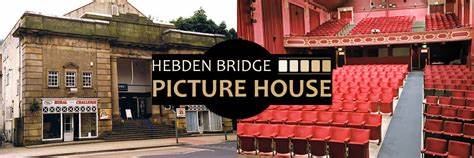
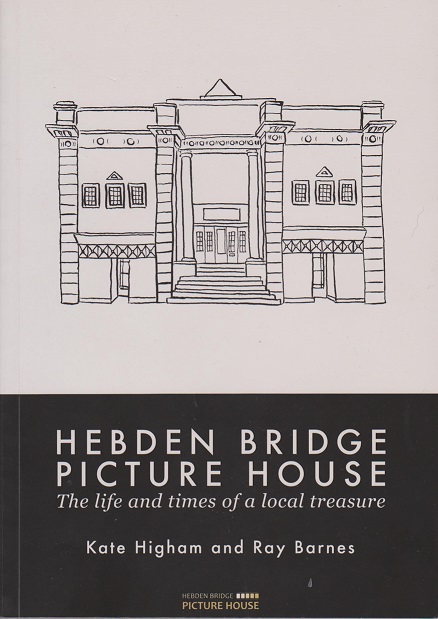
Hebden Bridge Picture House Centenary

This surviving independent cinema in the Calder Valley opened its doors on July 12th 1921. A year of celebration starts this Saturday, July 10th, with an evening event this Saturday, starting at 7.30 p.m. and including a screening [digital] of Charlie Chaplin’s The Kid (1921). The Picture House has many affinities with our own Hyde Park Picture House. Both are supported by the local council: both have an active support of a society of Friends: both have histories written and published by the said Friends: both can screen 35mm and digital, even 16mm: both have traditional auditoriums with proper masking and a low level of illumination during screenings: and both have a varied programme including mainstream titles, art and foreign language titles and early films with live music accompaniment.

Hebden Bridge’s first cinema was a wooden structure which opened in 1911. In 1913 the nearby Co-op Hall also started screening the new ‘moving pictures’. Following World War 1 a purpose built cinema was proposed and approved. The rather large building for a small town had a classical exterior and the auditorium boasted a balcony. The opening ceremony included travel and topical pictures and musical quartet. The first features at the new Picture House were two British dramas of the period. Torn Sails (1920) was a tragic romance set in Wales. The Iron Stair (1920) was a crime drama. They were followed by a film directed by Cecil Hepworth, Anna, The Adventuress, a drama of changed identity set in Paris. Hepworth also directed a film using locations around Hebden Bridge, Helen of Four Gates (1920), though that film was screened at the Co-op Hall.

The Picture House flourished through the 1930s to 1950s. There was a period closure in the 1960s and again in the 1970s. But then it came under the control first of the local council, then the Metropolitan Council and finally Hebden Royd Town Council.. It continues furnishing theatrical entertainment for the area though it has suffered in local flooding, most recently in 2016. In the year of celebration there will be screenings of titles from its history, 35mm prints and ‘silents’ with live music..

There is a programme with The Adventures of Prince Achmed / Die Abenteuer des Prinzen Achmed, a dazzling animation by Lotte Reiniger from 1926 using silhouette techniques. In December there is a screening of Pandora’s Box / Die Büchse der Pandora; G. W. Pabst’s film version of Franz Wedekind’s famous or infamous play. The film is illuminated by the luminous Louise Brooks in the main role. And the year ends with a screening of Helen of Four Gates; a print of what was though a ‘lost film’ was discovered in Canada in 207 and has now been fully restored.

The cinema is only ten minutes from Hebden Bridge railway station on the line with regular services between Leeds and Manchester. The balcony is rather cramped with wooden seats; however, the ground floor of the auditorium spacious and comfortable with a commendable low level of illumination during screenings. And the foyer offers real cups of tea with homemade cakes. So a trip to see ‘reel’ film in a real cinema should help assuage the absence until 2022 of our own Picture House.


Two films by Satyajit Ray

May 2nd was the centenary of this outstanding film-maker and a seminal figure in Indian cinema. The British Film Institute is planning a complete retrospective of his films later this year. Whilst we wait and wonder how many actual films will make it to Yorkshire Film 4 offers transfers of two of his fine titles in the coming week.

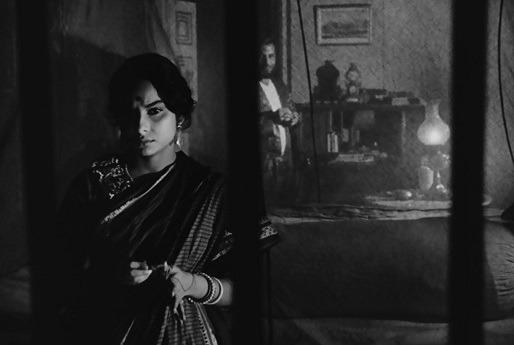
The family in ‘Mahanagar’

Monday / Tuesday night  at 01.15 a.m. [now available on All4].

Mahanagar (The Big City) – the film was shot in 1963 in black and white academy ratio: the language is Bengali with some English and with English sub-titles: and is set in Ray’s home city of Kolkata (Calcutta). The film follows the experiences of a family home which contains parents, two children and the grandparents on the husband’s side. The husband, Subrata Mazumdar (Anil Chatterjee), works as a senior clerk in a private bank; part of Bengali ‘bhadralok culture’ which Europeans would think of as lower middle class. The large family place a strain on his income and his wife, Arati (Madhabi Mukherjee) offers to help by taking a job. Despite the disapproval of the grandfather Arati obtains a post selling knitting machines door-to-door in middle class areas. Arati is the centre of this fascinating film; Madhabi is splendid as the young wife and the whole cast are excellent. Ray’s direction is beautifully and effectively restrained and his production team are excellent, especially the regular cinematographer Subrata Mitra.

Ray won the prestigious Silver Bear Award at the 1964 Berlin International Film Festival whilst the film won the Golden Bear.. However, the film itself failed to achieve a nomination by the Hollywood academy in the Best Foreign Language Film category; this was typical of the Academy. Mother India made a nomination in 1957; the next success was not until 1988 with Salaam Bombay. Three of Ray’s fine films failed to get nominations.

Wife and husband in ‘Charulata’

Tuesday / Wednesday night at 1255 a.m. [now available on All4].

Charulata (The Lonely Wife) – the film was shot in 1964 in black and white academy ratio: the language is Bengali with some English and with English sub-titles:it is set in Kolkata (Calcutta) in the 1880s. Thus this is a period film which is set in a Bengal and India under the rule of the Raj. This period also follows the 1857 ‘first war of independence’ [termed a mutiny by the British rulers). At one point in the film the Bengali men discuss a British general election contested by the the political parties led by Benjamin Disraeli and William Gladstone.

As the title suggests the film focuses on the young wife, Charu and her relationship with her husband and a visiting relative. Bhupati Dutta plays the husband whilst two actors from Mahanagar, Madhabi Mukherjee and Anil Chatterjee, play Charulata and Bhupati’s younger cousin Amal respectively. The cast are excellent. Ray’s direction provides a slowly paced portrait of the marriage interspersed with some fine lyrical moments. The opening and closing sequences are especially highly praised, [so stay awake].

The scenario was adapted by Ray from a story by Rabindranath Tagore, the leader of the Bengal Renaissance and an important influence of Ray himself. Ray is an auteur in the fullest sense of the term; in this film providing the scenario, costume design, direction and music. However, he relies on a really skilled production team. In particular this film contains some of the finest cinematography by Subrata Mitra.For the second year running Ray won the Silver Bear Award at the Berlinale. Whilst the film did not follow Mahanagar in winning the Golden Bear it is to my mind the finer film and one of Ray’s great achievements.

With adverts both titles will run over two hours. Especially with the Charulata there are few cinematic double hours which offer the same quality and pleasure. If you are new to Ray, or indeed if you are familiar with his films, then the Saudha International Satyajit Ray Congress [available on You Tube] offers a range of interesting comments on Ray’s art.

Manchester by the Sea on BBC 2

Friday May 14th at 11.20 p.m. and then the BBC iPlayer

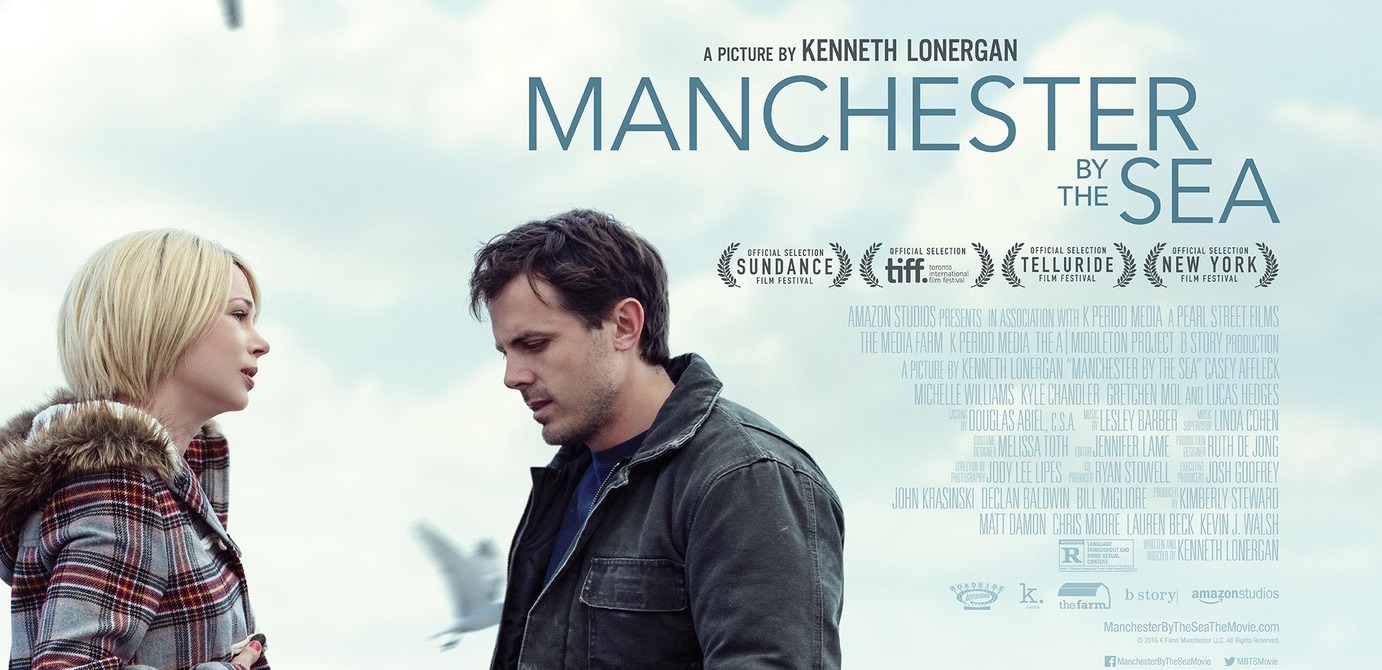
This 2016 release won a Best Actor Oscar for Casey Affleck in the role of Lee Chandler. The whole cast are fine and Michelle Williams has a small but well crafted sequence. The film was written and directed by Kenneth Lonergan; his earlier writing includes working on Martin Scorsese’s epic Gangs of New York. This film is set on the New Hampshire coast. It starts in Boston where Lee is a handyman with an ‘anger management’ problem. It is some way into the film and in the Manchester seaside town that we learn the back story to his situation. A family tragedy haunts Lee. It is partly a relationship with a nephew and their outings together on the sea that start a healing process.

This is a film about grief; part of a cycle of films [most of which are exceptionally fine] dealing with bereavement and grief. The film is long, 137 minutes, and slowly paced. But the production is as good as the acting; I especially like the cinematography by Jody Lee Lipes. As a bonus we get a Duke Ellington number performed twice, once by Ella Fitzgerald.

The film was shown at the Picture House in 2016; I saw it twice and I am looking forward to seeing it again.

‘Happy Lazzaro’ on Film 4

Film 4 Monday-through-Tuesday at 12.55 a.m. and now available on All 4.

Happy as Lazzaro / Lazzaro felice (Italy / France / Switzerland / Germany 2018

This film was one of the outstanding releases in 2018. I enjoyed immensely both the screening at the Leeds International Film Festival and again when it returned to the Picture House in 2019. And I look forward to seeing it again on terrestrial television. It should look reasonably good as long as Film 4 stick to the 1.66.:1 aspect ratio. It runs just over two hours and has both Italian and English dialogue with sub-titles for the former.

Directed by Alice Rohrwacher, one of her earlier films was The Wonders (2014). This film has been described as magic realist. It combines naturalistic observation with a plot that includes references to myth and folk tales, social exploitation and a touch of fantasy. Lazzaro of the title is a sweet natured and apparently simple minded peasant. He is part of a village cut off from modern Italy and involved in some form of share cropping. Later in the film a migration leads members into a lumpen-proletarian existence. The film shares tone and tropes with recent migrant films. It is fascinating and at times moving. Visually Hèléne Louvart’s cinematography is both beautiful and atmospheric and the overall production is excellent. I thought this the best film I saw at the Festival. A friend commented,

“I greatly admired The Wonders … and this was even better. This tale of a holy fool in a setting which blurs the borders between realism and the fantastic is not, perhaps, for the literal-minded but should delight most of the rest of us.”

The number of foreign language titles screened on terrestrial television has severely reduced in recent years. So a film like this is a rare pleasure. It is unconventional and the narrative tends towards the picaresque; and it is also really imaginative.

Peterloo on C4

Saturday March 13th on C4 at 10 p.m.

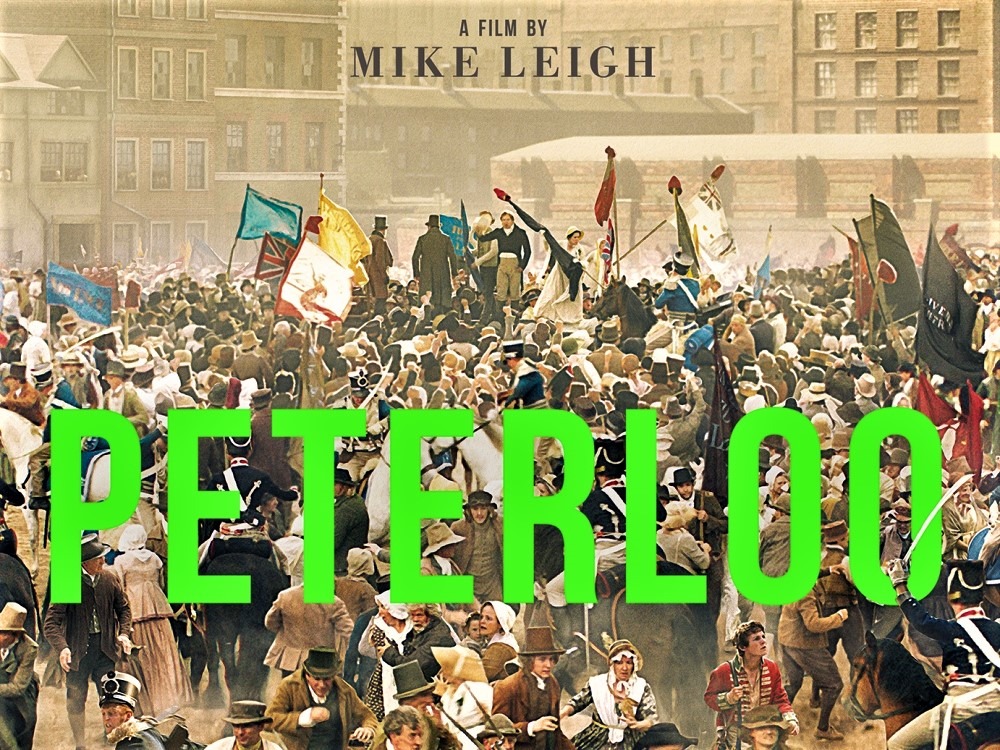
So if you missed this title on release or you want to enjoy it again this very fine film is screening tonight on C4 (and will be available on All4 ). Quite a few reviewers did not really appreciate the film on its release. British film critics, with some exceptions like Derek Malcom, do not really engage with actual and detailed politics in dramas. Even when they admire Ken Loach they tend to prefer his dramas built round personal lives rather than those constructed around political movements. This would seem to be one reason why British cinema has never quite equaled the output  from the continent.

This is one of the finest films to be made in Britain in this new century and it is certainly one of the most interesting. It is flawed in some ways. This seems to have been due to the project being rushed in its final stages. Originally planned for the Centenary of the Peterloo Massacre in 2019 it came out a year early. This seems to have affected in particular the final sequences of the title which seem less developed, especially after the lengthy treatment of the causes and actual violence of this historic protest in Manchester.

It has been very well filmed by a talented craft team with excellent cinematography by Dick Pope and sharp editing by Dick Gregory. It has a very intelligent script from Mike Leigh.  Care has been taken to render accurate local dialects and the setting shave been well reconstructed . But what stands out is that the politics of the emerging working class are given full expression here; something not often seen and heard in British films though it is also found in the other fine study of C19th working class radicalism Comrades (Bill Douglas, 1986). The cast of proletarian characters and their middle class allies are generally very fine. And the opposing local functionaries and the rising bourgeoisie are convincing.

The major weakness is in the representation of the aristocracy and the dominant political figures. Other Mike Leigh films have presented upper and middle class characters close to caricature and the royal and authority figures here are not convincing. Nevertheless their preening narcissism and their  ruthless and violent defence of undeserved and unearned privileges is accurate. .

This is a film that combines documentary style recreation, powerful and emotional sequences with a compelling political representation. It is amazing that it has taken over a hundred years of British cinema till we have a film of such a major historic event. It should be noted that Peterloo is a motif in the earlier Fame is the Spur (the Boulting brothers 1945 adaptation of Howard Spring’s novel) which is also well worth viewing. I cannot think of much else  this coming Sunday evening to match this presentation. And Jacqueline Riding’s ‘ Peterloo: The Story of the Manchester Massacre’ (2018) is worth reading as well.

A Festive Treat On Line

Kennington Bioscope Presents [on YouTube].
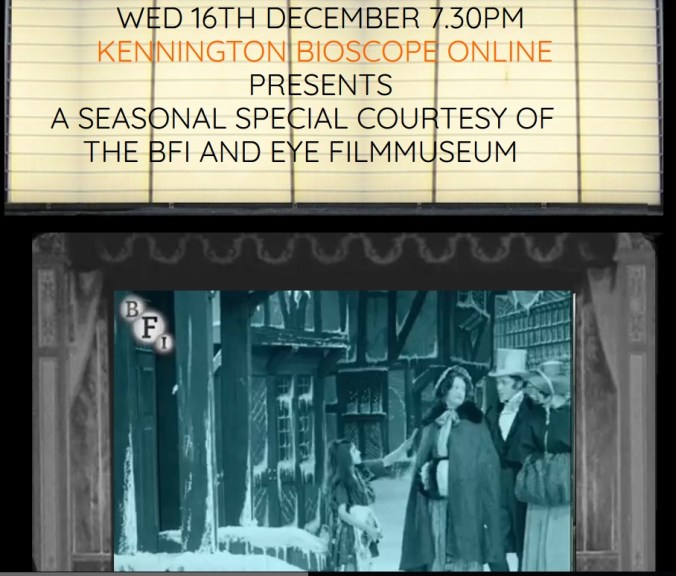
The Kennington Bioscope is a film club at London’s Cinema Museum.  It used to run on Wednesday evenings and usually offered screenings in 35mm [or sometimes 16mm] enhanced by live musical accompaniments. The prints were always from early cinema and from a ranger of territories. The musicians were really able performers; several have played for silent titles at International Film Festivals. With the arrival of the pandemic The Bioscope has gone on line; earli8er programmes are still available on You Tube and now a Festive special is panned for the coming week.

A Christmas Special courtesy of the BFI and the EYE Filmmuseum, Amsterdam.

Featuring a whole array of shorts of Winter and Christmas by the enormous generosity of EYE Filmmuseum and the British Film Institute (BFI).

 Holland in Ijs (NL 1917) – Scenes from the Netherlands in what was an extremely cold winter for them – Daan van den Hurk

Expedition to the North Pole (USA 1916) – Animated adventure by airship to the frozen North – Cyrus Gabrysch

 Il Natale di Cretinetti (IT 1909) – Early film comedian André Deed wreaks havoc with an outsize Christmas tree – José María Serralde Ruiz

Ida’s Christmas (USA 1912) – Dolores Costello and John Bunny star in this heart-warming tale from the Vitagraph studios – Colin Sell

Snowstorm in New York (NL 1926?) – A blizzard paralyzes Manhattan – Ben Model

Scrooge; or Marley’s Ghost (UK 1901) – R.W. Paul’s early and ingenious depiction of Dickens’ seasonal story – Meg Morley

Snowballs (UK 1901) – Schoolboy scamps besiege passers-by with handfuls of the cold white stuff – Lillian Henley

 Santa Claus (UK 1898) – The wonder of Christmas. British filmmaker G.A. Smith’s film features his children and wife Laura Bayley – Stephen Horne

The Little Match Girl (UK 1914) – Percy Nash directs this, the second British adaptation of Hans Christian Andersen’s heartrending story – Donald Sosin

The Mistletoe Bough (UK 1904) – An unlucky bride is locked in a trunk in this early film – Costas Fotopoulos

Broncho Billy’s Christmas Dinner (USA 1911) – Villainous Broncho Billy finds himself accidentally invited to the Sheriff’s home for the festive repast – Philip Carli

 Santa Claus and the Fairy (UK 1898) – Have you been naughty or nice? Stockings at the ready! – John Sweeney

This will offer a pleasure for fans of early cinema.  The titles [facsimiles versions] are provided by the support of our own National Film Archive and the fine archival collection at the Eye Museum in Amsterdam. During the pandemic, The Eye, like a number of archives is offering access on line to parts of their collections; though these screenings are usually silent. The Bioscope music is a real cachet and, in a nice touch, the pianist’s hands and instrument can be seen in a small  additional frame. The Bioscope organisers also ensure sub-titles for films with foreign language title cards. You also get introductions to the titles by film historian Michelle Facey and a chance to see the Cinema Museum.

If  interested you can read more about the Bioscope af Early and Silent Cinema.
A virtual Palestinian Film Festival

The Leeds Palestinian Film Festival 2020

This year’s programme is, as with so many events, on line. It runs from November 14th until November 28th. The programme is structured through four themes:

Annexation, Occupation Defiance

As Seen by Annemarie Jacir

As Seen by Children

As Seen Through Creative Eyes

All told there are fourteen features that include both dramas and documentaries. In addition there are several supporting videos. As with earlier Festivals there are a range of views and experiences from amongst Palestinians and the few critical voices found among Israelis

The Festival is available on line through ‘InPlayer’ which is an online streaming platform. It claims to be ;

‘the world’s leading pay-per-view and subscription solution’.

It appears to be based in Britain and be an independent company. It relies on the Vimeo provision. There does not appear to be a test video to check reception but when I looked both the image and sound were of a good quality.

You can check yourself on the Festival Web Pages by looking at one of the ‘free’ videos like ‘Through the Eyes of Others – Launch Event’. This is useful as there is an introduction and a conversation regarding grassroots film provision.

You can buy a festival pass for the whole period or buy tickets for individual titles. Note, with the latter your viewing window is 48 hours. I assume that the pass enables you to view right through the period.