Hyde Park Picture House, 101 years old.

Screen-Shot-2014-10-31-at-13-06-51

This Monday, 2nd November, exactly one hundred years ago, the Picture House opened for its second year of business. Already in the first twelve months of film entertainment it had successfully established itself. The log books, donated to the West Yorkshire Archive Service in 2015, record the box office takings. Weekly attendances were now regularly over 2,000. At a Bank Holiday they could exceed 3,000. And the same happened when there was a really popular film. So the log books record key titles, and show that Charlie Chaplin had already registered with his amazingly fast rise to fame and stardom.

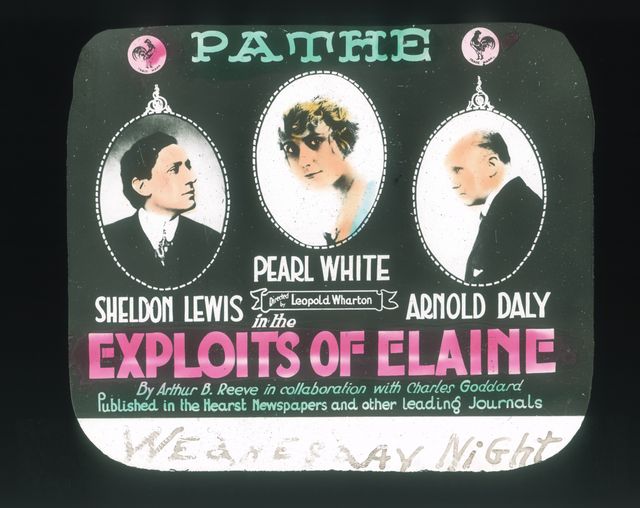
On the Thursday of that week another popular title opened at the cinema: The Exploits of Elaine (Pathé USA, 1915). The Exploits of Elaine was a serial, with fourteens separate episodes. The Hyde Park appears to have screened the separate episodes weekly, as part of the Thursday programme, as the box office increased towards the weekend.

Elaine poster

Continue reading

Make More Noise! Suffragettes in Silent Film, BFI 2015.

Sunday November 1st at 1.30 p.m.

1442414331-d0bdd242ecd22cbea030a917aa71f1c8-600x449

This is a compilation of early films about the early C20th British Suffragette Movement. The selected titles are relatively short and are predominately newsreel footage or equivalent. There is the famous action by Emily Davison at the 1913 Derby. There is also coverage of her funeral. This latter film was used behind the closing credits of the feature Suffragettes: though unfortunately in the increasing contemporary habit of re-sizing it into a widescreen frame. Film of an action in Trafalgar Square features Sylvia Pankhurst, inexplicably missing from Suffragette.

The selection carries on into World War I when the Pankhurst’s and the movement split over whether to support the imperialist war or not. Sylvia Pankhurst was among those socialists who opposed the conflict.

There are also some short fictional films, mainly in the comic mode. There are shorts that send up the movement and ridicule it. But there are also several films by Cecil Hepworth which take a less hostile view. Two of these feature a popular female character of the period, Tilly, a tomboy who was constantly getting involved in and surviving scrapes.

Continue reading

Black Orpheus| / Orfeu Negro, France 1959.

Screening on October 18th at 1.30 p.m.

blackorpheus_091

This is an early success from the burgeoning art cinema of the late 1950s. It won the Palme d’Or at the Cannes Film Festival and Best Foreign Language Film at the Academy Awards. Set during the Rio de Janeiro Carnival it transposes the classic tale of Orpheus and Eurydice to that setting. The idea of such a mythic tale in one of the most famous and colourful events in Latin America was brilliant. And the film is well served by the fine colour cinematography of Jean Bourgoin. The film opts for a very simple depiction in terms of characters but the excitement of the masquerades, dance and music in the Carnival make it visually and orally compelling. There is though more than a trace of ‘exoticism’ in the representations.

The film is screening in its original format of 35mm, which should do proper justice to the stunning colour palette in which the drama is set. It was filmed in Eastmancolor, which sometimes suffers the ravages of time. Intriguingly for the date it was also filmed in the old Academy ratio, i.e. a nearly square frame. The language is Portuguese, though I think there was also some patois in there: it will have English sub-titles. On its original release in the UK it was certified as an A: now it is PG: ‘mild violence and sex references’ according to the BBFC. Note, two important characters are children and I thought they were very good.

Shirley Clarke Double Bill

Sunday September 27th from 1.30 p.m.

Connection

This is a must for film buffs and jazz buffs alike.

Shirley Clarke was an important independent filmmaker in the USA. She directed numerous short and feature length films between the 1950s and the 1980s. Most fell into the field of documentary. She also won a number of awards, of which the 1989 Maya Deren Independent Film and Video Artists Award is possibly the most apt.

The Connection is an example from what we would call  ‘the beat generation’. It is a fine adaptation of a play by Jack Gelber. It also includes music by a number of jazz luminaries including saxophone player Jackie McLean. The film runs for 110 minutes and is in black and white academy ratio.

Ornette

Ornette: Made in America (1985) is in the modern widescreen and in colour. The subject is one of the truly great players of the modern jazz era: Ornette Coleman. I still treasure vinyl recordings of this master at work. Clarke’s highly praised film gives us not just the music but also the context of this outstanding artist.

Sadly the director, the playwright and the jazz men are no longer with us. So this is a welcome posthumous tribute to key contributors to the culture and art of North America.

L’eclisse/The Eclipse, Italy – France 1962.

Screening on Sunday September 20th at 12 noon and again in BYObaby Wednesday September 23rd at 1100.

An interior - Monica Vitti as Vittoria.

An interior – Monica Vitti as Vittoria.

It is good to see two screenings at the cinema of this art film classic. Even more that it will be an opportunity for very young film buffs to become acquainted with one of the masters of modern European cinema. Michelangelo Antonioni achieved fame with a trio of films at the start of the 1960s: L’avventura (1959), La notte (1960) and this final film in the trilogy. People differ about which is the finest; my favourite is L’avventura. However, I think most would admit that this film is the most challenging: a challenge that offers its own rewards.

Antonioni has been described as the ‘poet of alienation’. The films describe failed or rootless relationships: metaphors for the wider social dislocations of the period. But these are relationships embedded in evocative landscapes: both natural and urban. The central relationship in this film is between Vittoria, played by one of the icons of sixties cinema Monica Vitti: and Riccardo, played by Alain Delon, a fine actor who moved easily between French and Italian films.

The predominant landscape is Rome, following in the footsteps of the neo-realists and Federico Fellini. But Antonioni concentrates on the city’s Stock Exchange and city’s modern and fashion conscious EUR zone. In these films the landscape is an accompanying character, here presented in the luminous black and white cinematography of Gianni Di Venanzo. Interiors are equally impressive and suggestive. It is the landscape and its architecture that dominates the final moments of the film: a series of beautifully composed shots which close with another metaphoric image.

The film has been restored by the BFI onto a digital package, running 126 minutes with English subtitles.

Marshland / La isla minima, Spain 2014.

Screening this Wednesday Sept. 9th and Thursday 10th.

Marshland pic


This combines the police procedural genre with that of the serial killer: a common combination these days. This is very much a genre film, and it is easy to detect the influences of earlier film. I was struck by the parallels with True Detective (HBO, 2014). The film is well produced and the detective duo, Pedro (Raúl Arévalo) and Juan (Javier Guttiérrez) are excellent. But what makes the film really interesting is that the story is set back in late 1980. This was the transitional period after the end of the Franco dictatorship and the ushering in of a ‘democratic’ Spain. This was the period following the ‘Pact of Silence’, also known as the ‘Pact of Forgetting’ by those who had opposed and suffered under fascism. And 1981 was the year that saw an attempted military coup against the new Spain. The film references both of these [in the latter case the reactionary military establishment] and intriguingly in the characters of the detectives references both the reactionary and the radical currents about in Spain at that time.

The parallels are carried in both the visual and aural patterns of the film: which also bear the influence of other serial killer films. The director, Alberto Rodriguez, has a penchant for dramatic overhead shots; emphasising the distance of the contemporary audience. The opening such shots also strike an interesting variation of the serial killer labyrinth.

The English title is a variation rather than a direct translation, I suspect the settings in the film have strong resonances in Spain. We are in the province of Andalucía where the events occur. Much of the film takes place in the Doñana National Park and the Guadalquivir marshes: the Park was established under the Franco regime in the 1950s. Whilst the name of the town [fictitious?] is Villafranco!

I did have reservations regarding the gender and the victims and the violence. This is one of the problematic aspects of the serial killer genre: though the best films treat this critically. There are brief but disturbing visual images, and a short but disturbing description of the violence in the dialogue. I wondered once again about the criteria of the British Board of Film Classification. This film has a fifteen certificate, meanwhile the recent The Diary of a Teenage Girl received an 18 certificate. I am sure that Marshland is the more disturbing film: perhaps being a foreign language film the supposed audience differs.

45 Years, UK 2015

Continuing until Thursday September 10th.

Berlin

The film garnered Best Actor Awards for both Charlotte Rampling and Tom Courtney at the Berlin Film Festival – serious critical prizes. Both are deserved, but it is Rampling’s character Kate who is the centre of this film. She is a skilled actress with an ability to use extremely subtle expressions and movements. The film is a pleasure to watch as we explore the character and situation of Kate and her husband Geoff (Courtney). And they are well supported by a several fine British actors in minor roles. They are preparing for the forty-fifth wedding anniversary party: the unusual anniversary is something we learn about in the course of the film.

The film is beautifully crafted around these performances. The cinematography by Lol Crawley is especially fine. There is a precision in the use of close-ups and two-shots: and well judged use of long shots and long takes, with the occasional slow forward track. The design, sound and editing all ably support this: and visually and aurally [at a second viewing] I was struck by minor but significant detail. A good example is the opening credits with non-simultaneous sound, which acts as a plant for later in the film. Max, the German Shepherd, the settings in the Norfolk Broads, and a piece of piano music by Liszt, all bring resonances to the story.

Director and writer Andrew Haigh has adapted the film from a short story by David Constantine. Apparently he has shifted the focus of the film to Kate. It is beautifully judged. This is a character study and tale with great complexity. It also [consciously I assume] references a British film tradition of denial. There are subtle parallels with the classic Brief Encounter (1945): more recently The Deep Blue Sea (2011).

It is a film of ambiguities, as with the characters. Inattention can mean you miss an important point: and I think you need the big screen and a clear sound system to take in all its aspects. Whilst it is immensely rewarding I suspect that it will generate different responses, depending what experiences and values audiences bring to the film. After a screening I heard the tail-end comment of a discussion in the foyer:

“I’ve come to see a wonderful film with a bunch of cynics!”

Scalarama, 2015

Various venues between September 1st and 30th.

Scalarama heading

This ‘unofficial month of cinema’ runs throughout September. Following the mantra ‘Go forth and fill the land with cinemas’ there are a varied range of events in major urban areas in England and in Scotland: there is also an event listed in the north of Ireland. To help punters there is a free Newspaper which includes listings which can be found at the various venues: in Leeds I picked one up at the Hyde Park Picture House and at the Arch Café.

As well as listings the Newspaper includes a range of articles on the various forms of cinema. The filmmaker Peter Strickland looks back at his experiences, including visiting one of the key venues for alternative and counter cinemas, The Scala. I remember many fine screenings there, including great all-nighters. Other writers sing the praises of 35mm, digital and [even] VHS. This is cinema in all its shapes and guises.

At the Hyde Park on Saturday September 12th at 11.00 p.m. we will have La Grande Bouffe (Blow-Up, France, 1973), a film that rather puts John Waters in the shade. And there is a Scalarama Special on Saturday September 26th themed round Creatures of the Night.

There will be two more of the excellent films from Martin Scorsese Presents: Masterpieces of Polish Cinema. On Sunday September 13th at 3.00 p.m. we have Provincial Actors (Aktorzy prowincjonaini , 1979). The film was co-scripted and directed by Agnieszka Holland. She worked in Polish film as a writer, director and occasional actor. The film is set in a small town, [partly filmed in Lodz] as a theatre company prepare a classic play for performance. On September 22nd at 6.30 p.m. there is The Illumination (Iluminacja, 1973) written and directed by Kryzstof Zanussi, another major filmmaker drawn to moral concerns. The protagonist in the film works as a physicist and the film explores his search for identity: his personal life affected by the larger social world.

On September 27th there is a double bill of films by US independent filmmaker Shirley Clarke. One film is a must for jazz enthusiasts, Ornette – Made In America (1985). Alongside this is her early and rarely seen The Connection (1961), a fine film adaptation of a ‘beat generation’ play. You can read about her in the profile in the Festival newspaper.

Other film venues in Leeds are also participating in the Festival. There are several screenings at Minicine, at the Oblong Cinema, and individual screenings at Little Reliance Cinema and Leeds Queer Film Festival. And there are events at The Heart and the Arch Café. You can check events here and in other cities on the Scalarama website, impressively put together. Note, fresh events are being added, so check the website and do check individual events, I have discovered a couple of minor errors. If you going to the Hyde Park over the next week you may enjoy among the trailers a showreel of the films on offer. It make September a great month for film buffs.
13 Minutes, Germany 2015.

Screening from Friday August 21st.

13_minutes_poster-620x877

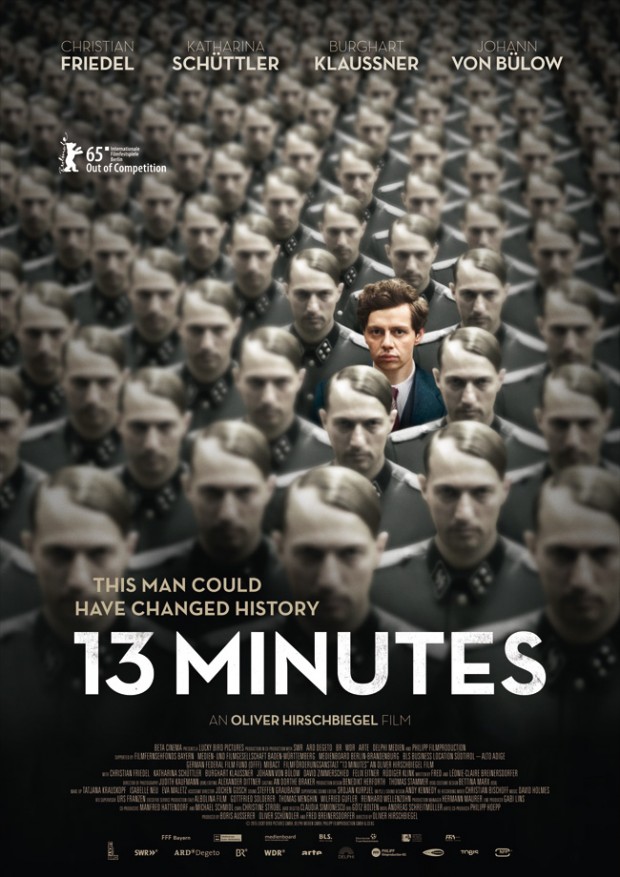
This is the new film by Oliver Hirschbiegel. Like his earlier Downfall (2004) this deals with the Third Reich. However, rather than the drama round the leading figures of German fascism and their violent demise this film deals with ordinary Germans, including an oppositional figure. It combines a political thriller [note the title] with the Heimat genre – films that deal with, not quite homeland but, a sense of belonging to a place and its people.

The film opens on the eve of World War II: it is November 1939 and the eve of an important Nazi celebration in Munich. Then a series of flashbacks fill in the characters and background to the events of that night. The film is well produced though not as powerfully destructive as Downfall. There is a strong cast, with Christian Friedel excellent as Georg Elser, the protagonist increasingly horrified by Nazi rule. Katherine Schüttler is Elsa the girl he falls for. And Burghart Klaußner is also strong as the investigator and interrogator Arthur Nebe.

The sense of the village Heimat is strongly drawn. The actions of the police and the SS are [as you might expect] brutal and there are several disturbing sequences in the film. Georg and his developing responses as Nazi rule is cemented occupy the centre of the film. The story is based on actual characters and events and appears to have followed those fairly closely. By focusing on character it handles the issue that the outcome is known. It provides an absorbing two hours and a distinctive take on the operation of the fascist state and experiences within it.

Man With a Movie Camera/Chelovek S Kinoapparatom, USSR 1919.

Screening on Tuesday August 18th at 7.00 p.m. Vertov32 The film hardly needs recommendation. A Soviet classic, from an excellent print from the Nederlands Filmmuseum and digitally restored by Lobster Films: both the latter are in the forefront of early cinema archival work. And this silent film is presented with a musical accompaniment by the Alloy Orchestra, who went back to the archives and Vertov’s own musical notations for the original screening, [to accompany a screening at the 1995 Le Giornate del Cinema Muto].

Dziga Vertov is usually credited as director, but the credits read ‘Author and Supervisor’. The film sprang from a collective of Kinocs [the cinema of kino-eye]: with cinematographer Mikhail Kaufman and editor Elizaveta Svilova. Other radical Soviet artists were also involved in their work, so that the famous posters for the film were designed by Georgii and Vladimir Stenberg. It is worth adding some context. The film was produced by the Ukrainian Film and Photography Administration [VUFKU]. 1929 saw the cementing of a new political line in the Soviet Union, best represented by ‘Socialism in One Country’. The emphasis was on technology rather than social relations and in art and culture there was a retreat from radical form to the more conventional. However, for a while, an outpost of more radical style and content continued in the Ukraine: VUFKU had already produced Alexander Dovzhenko’s Arsenal in 1928. Thus much of the city footage was shot in Kiev and Odessa, with some found footage from the Kinocs’ earlier films for Goskino in Moscow. The radical form of the film can be seen in the opening credits and introduction, one of the most reflexive sequences in all cinema.

“This film, made in the transitional period immediately preceding the introduction of sound and excluding titles, joins the human life cycle with the cycles of work and leisure of a city from dawn to dusk within the spectrum of industrial production. That production includes filmmaking (itself presented as a range of productive labour processes), mining, steel production, communications, postal service, construction, hydro-electric power installation and the textile industry in a seamless organic continuum, whose integrity is continually asserted by the strategies of visual analogy and rhyme, rhythmic patterning, parallel editing, superimposition, accelerated and decelerated motion, camera movement – in short, the use of every optical device and filming strategy then available to film technology. …. ‘the activities of labour, of coming and going, of eating, drinking and clothing oneself,’ of play, are seen as depending upon the material production of ‘life itself’. (Annette Michelson in the Edited Writings of Vertov).

The film is often compared to the cycle of city films of the period: e.g. Berlin: Symphony of a Great City (1927). However, this is a film about people in the city and it is consciously political. In fact, it is a paean to Socialist Construction, a still meaningful term in 1929. Thus the final sequences of the film address themselves directly to the audience, the workers and peasants of the Soviet Union. This remains not only a great documentary but one of the outstanding products of the revolutionary 1920s Soviet Cinema.