The End of St. Petersburg / Konets Sankt-Peterburga, USSR 1927

Saturday September 16th at 3.30 p.m.

This was one of several films commissioned in order to celebrate the 10th anniversary of The Great October Revolution. The most famous of these is Sergei Eisenstein’s October Ten Days that Shook the World (1928). Both films include sequences showing the storming of the Winter Place: in fact the filming of these sequences found the two productions ‘stepping on each others’ heels’.

However, Vsevolod Pudovkin, the director, has a different approach to drama and to ‘montage’ from Eisenstein. There are parallels between this film and his earlier adaptation of a Maxim Gorky’s novel, Mother / Mat (1926). This film follows the experiences of a young rural worker who migrates to St Petersburg in search of employment. We follow him in a linear fashion as he experiences the exploitation of the proletariat in Tsarist Russia and he becomes politicised. The film includes very fine sequences showing the advent of war, the experiences of the Russian army and then the series of conflicts that led to the overthrow, first of the Tsarist regime, and then of its bourgeois successor.

Pudovkin, together with his script writer Nathan Zarkhi and the cinematographer Anatoli Golovnya, present the city, the social movements and its representative characters with a strong sense of the world they live in and of the historic events in which they were involved. Whilst Eisenstein’s film ends with the Vladimir Lenin announcing the start of Socialist Construction Pudovkin’s film ends on a quieter note, expressive of the victory but also of the cost it has levied.

The film is screening in a 35mm black and white print. It should have English sub-titles for the Russian title cards and lasts about 85 minutes. This screening enjoys a specially composed musical score by the Harmonie Band who specialise in Silent Film accompaniments.

This is fine film and a signal celebration as we approach the anniversary of the most important event of the C20th. Hopefully we can look forward to other significant dramas and records of 1917.
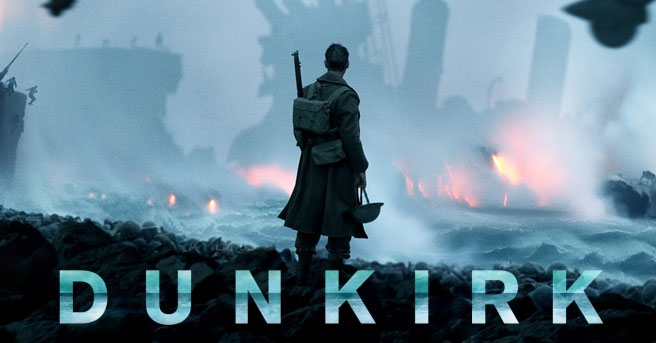
 

Dunkirk, Netherlands, UK, France, USA 2017

Opens on Friday  July 21st at 6.15 p.m.

This is the new film directed by Christopher Nolan. He is not only an extremely talented filmmaker but also one who appreciates the superior qualities of ‘reel’ film. In an interview in Sight & Sound (August 2017) he explained that

“The entire film is shot on 65mm film. Seventy per cent of the film is 15 perf IMAX 65 and the other 30 per cent is 5 perf 65mm [‘perf” refers to the number of perforations on the print: the IMAX format runs horizontally rather than vertically]. …

Also, the entire film is finished photo chemically and so where we’re doing 70mm prints and were doing reductions of the IMAX photography, those are done on an optical printer. [A device for copying or altering film prints].”

However, the 70 mm version does not appear to be screening in West Yorkshire and the IMAX screenings all seem to be digital. So the screening of a 35mm print at the Hyde Park is definitely the best version on offer locally.

The epic of Dunkirk, a ten day military disaster that somehow is presented as a victory, looms large in the British psyche. And it also figures frequently in British cinema.

The Foreman Went to France (Ealing Studio 1942, in black and white) presents a parallel story about the evacuation of vital machinery from France to Britain.

A fictional treatments of the actual evacuation appears in a Hollywood product, M-G-M’s Mrs Miniver (1942 in black and white) with Greer Garson holding up the home front whilst husband Walter Pidgeon joins the heroic armada rescuing British and allied soldiers.

The definitive version to date is Ealing Studio’s Dunkirk (1958, in black and white and standard wide-screen) with John Mills, Richard Attenborough and Bernard Lee leading a familiar cast of British characters. This is very much in the mould of the low-key British war movies. It combines scenes of military action with the intervening moments of the troops waiting and watching as the evacuation proceeds.

Intriguingly there is a French treatment, Week-end à Zuydcoote / Weekend at Dunkirk (Paris Film Production, 1984 in colour and a scope format). This deals with French troops stranded on the beaches.

More recently Atonement (Universal Pictures and Studio Canal 2007, in colour and standard wide screen) has a fine sequence as James McAvoy’s Private Turner waits and dies on the crowded beaches.

Most recently Their Finest (BBC Films, Pinewood Pictures , 2016 in both colour and black and white and a scope format] offers a film-within-a film [The Nancy Starling] celebrating the event, whilst the main narrative celebrates British filmmakers of the period with a certain amount of irony.

It will be interesting to see where the treatment by Nolan and his team fits into this cinematic discourse.

In the Mood for Love, Hong Kong 2000

24th September – 2.30 PM

02

Bill Walton takes a look at In The Mood For Love ahead of Saturday’s 35mm screening and panel discussion on the Chinese film industry.

He remembers those vanished years. As though looking through a dusty window pane, the past is something he could see, but not touch. And everything he sees is blurred and indistinct.”

The magic of cinema offers many tantalising glimpses into other cultures, other times, other ways of seeing. Whether it’s transgender sex workers in California (Tangerine, 2015), censorship in Iran (Taxi Tehran, 2015), the self-justification by Indonesian death squads (The Act of Killing, 2012), corrupt officials in Russia (Leviathan, 2013), or life on a council estate in Bradford, Yorkshire (The Selfish Giant, 2013) … we can always gain from such different ways of seeing the world.

In the Mood for Love brings to life Hong Kong in the ‘60s. While there is a powerful code of propriety it cannot completely crush the intense desires for intimacy between a man and women whose marriages are not going well. The film subtly explores loneliness and hope, love and betrayal. The cultural context is integral to the story. I found that Wong Kar-wai’s attempts to tackle such themes in the United States (My Blueberry Nights, 2007) did not work nearly as well.

Chow Mo-wan (Tony Leung): “Feelings can creep up just like that.thought I was in control.”

Everything about this film is beautiful, from the acting, the photography (Christopher Doyle), and the haunting music, to the design of the credits. No wonder it was recently voted by critics to be one of the greatest films of the 21st Century. This screening has been arranged with the Business Confucius Institute and will be preceded by a panel discussion examining the state of contemporary Chinese cinema.

Su Li-zhen (Maggie Cheung): You notice things if you pay attention.