The First Film, UK 2015

Screening on Wednesday July 1st at 8 p.m.

slide

The title may suggest Thomas Edison in New York: the Lumière Brothers in Paris: even the Skladanowsky Brothers in Berlin. In fact the events in the film took place in Leeds in West Yorkshire. Here in 1888 Louis le Prince shot several short film sequences onto a paper-backed cellulose strip using a camera that he designed and constructed. Recent research has shown that Le Prince was also working on the use of celluloid for the film rolls and was developing a projection system.

The signs of this key pioneer filmmaker can seen around Leeds. The display at the Oakwood Clock shows the site of a Roundhay Garden where he filmed two sequences. There is a Blue Plaque on Leeds Bridge where he filmed another sequence. There is a second Blue Plaque alongside the old BBC Building by the University to mark the site of his workshop. And there is an unmarked house in Chapeltown where he resided for a time.

People who attended the 1988 Leeds International Film Festival will remember how this celebrated the centenary of Le Prince’s pioneering films, including a restaging of the filming on Leeds Bridge. The Metropolitan University Film School used to have copies of the individual frames mounted on the stairwell and you could examine these as you ascended.

Both the Armley Industrial Museum and the National Media Museum have displays and artefacts about Le Prince. And the Museum has a series of online pages on his career,  his cameras and his films.

However you are less likely to come across Le Prince outside of the city and he is even not always credited in  academic histories of early cinema. This is because the life of Le Prince involves not just a first but also a mystery. This new film, a labour of love over many years by filmmaker David Nicholas Wilkinson’s  explores the life of the Pioneer, his film work and the unexplained events that meant that he failed to gain the recognition he deserved.

The screening at the Picture House is a Charity Premiere. There will be introductions, examples of Le Prince’s technology and in the film itself the audience will be able to see these creations from over a century ago.

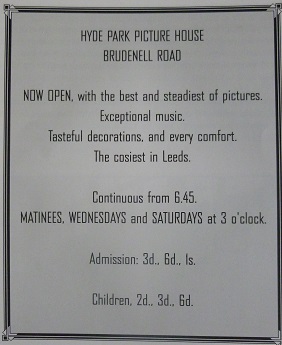
‘The Cosiest Picture House in Leeds’.

YEP Advert

This illustration is from the printed history of the Hyde Park Picture House published by the Friends in 1997: [copies still available at the cinema].

Recently a relative of Harry Childs, who was involved in the opening and running of the Hyde Park Picture House, donated a set of ‘Log Books’ that start with the opening of the cinema and carry on until the 1950s. The books record the daily performances, ticket sales in different price categories and the daily and weekly income. You can imagine that there are lots of figures to be analyzed. The performances and prices are shown in the above advertisement from the Yorkshire Evening News.

It is not clear how seats and customers were demarcated, perhaps the 1s. seats were in the balcony. The bulk of the customers fell into the 3d and 6d price range.

Firstly, the capacity of a standard rectangular theatre was increased by using a balcony .. [which] … allowed an astounding 587 people to be crammed in. [Since the 1980s the seating has been reduced to 350].

The records in 1914 offer no information about the films screened. However from early in 1915 the title of the feature is usually recorded in the margin. The norm appears to be two prrogrammes a week, one from Monday to Wednesday and one from Thursday to Saturday. This is done briefly, so it is not always possible to identify the film: and about two thirds of titles from this period have been lost. However there are also other sources.

Continue reading

A Night at the Cinema in 1914 

Screened at the Hyde Park Picture House as part of the Centenary Programme on November 7th 2014.

thYF814ALO

Looping the Loop at Hendon (March 1914)

Pioneering British aviators Gustav Hamel and Bentfield Hucks perform stunts at the legendary Hendon airfield. Although not hard news, this was a topical story.

Palace Pandemonium (May 1914)

The leading campaigner for votes for women, Emmeline Pankhurst, goes to petition the King in person at Buckingham Palace. The campaign for votes for women was very high-profile and often featured in the news. The suffragettes would stage appearances at events for maximum impact. 

Austrian Tragedy (July 1914)

Following the assassination of Archduke Franz Ferdinand in Sarajevo, this newsreel shows footage of the Austro-Hungarian royal family, including the wedding of Archduke Karl who succeeded Franz Ferdinand as heir to the imperial throne.

Dogs for the Antarctic (August 1914)

Following the death of Captain Scott, Sir Ernest Shackleton plans another expedition to Antarctica, taking plenty of dogs. This is typical of the ‘magazine’ style film shorts of the time.

Continue reading

Safety Last, USA 1923

Screening on Sunday June 21st at 3 p.m. from a 35mm print with live musical accompaniment

SafetyLast_007Pyxurz

Friends who have seen Martin Scorsese’s Hugo will have seen a clip from this film. It is famous for the stunts performed by its star Harold Lloyd. Lloyd was one of the three great comic stars of Hollywood in the 1920s; along with Chaplin and Keaton. He had his own distinctive persona with a straw boater and earnest and spectacled visage and a sort of ‘college boy’ character. He shared his mentors’ gift for timing but was especially skilled in stunt work.

This is ‘small town’ boy makes good in the big city. Much of the film uses the setting of the Department Store, one of the canonic images in 1920s cinema. The film offers the romantic  sweetheart back home, the trials and tribulations which the hero must overcome, and some of the most dare-devil stunts in films of that era. The screenplay moves deftly from gag to gag whilst developing an increasing drama and tension.

The last time I saw a print it had an added soundtrack, but this can be switched off. Certainly when it originally played at the Picture House it would have had a musical accompaniment. And the same pleasure will be available this Sunday with an accompaniment by Darius Battiwalla. Darius is an experienced and accomplish accompanist and he has a particular skills in adding to the action and pointing up character.

P1000009

This is a film that is a ‘must’ for your ‘have seen’ list.

The Act Of Killing

As The Look Of Silence starts it’s run at the Picture House, Friends committee member Bill Walton takes a look at Oppenheimer’s earlier companion piece The Act Of Killing.

The Act Of Killing poster
Truth can be stranger than fiction. This is my favourite film documentary of all time … but maybe it will take second place in my heart after I have seen its follow-up The Look of Silence showing daily from Friday 19th June.

A military dictatorship took power in Indonesia in a coup in 1965. The new regime gave its blessing and protection to death squads who massacred over a million communists and other activists, particularly among the ethnic Chinese population. With Western assistance, the Suharto dictatorship kept its grip on power and ensured that their propaganda version of their rise to power remained largely unchallenged.

What is a radical film director to do?

Continue reading

Masterpieces of Polish Cinema

Ashes and Diamonds Thursday 18th June 6.20 p.m.
Leeds Movie Fans Meetup is planned for this screening.

 fo_film_popiol_i_diament_09_51761

Between June 18th and September 22nd the Hyde Park Picture House will be presenting eight films produced in Poland over three earlier decades. Masterpieces of Polish Cinema presented  by Martin Scorsese, together with The Film Foundation and the Polish Film Institute and supported by a number of other agencies. Scorsese is not only a respected and important filmmaker, he is also a collector, archivist, educator and, through his involvement in The Film Foundation, responsible for restoring and distributing key films from World Cinema.

In the case of these films the focus is on the work of the Polish National Film School at Łódź. Numerous and talented film artists have studied here. And the work that has emanated from the school has influenced not only Scorsese but also other filmmakers such as the UK’s own Lindsay Anderson.

The programmes commence with Ashes and DiamondsPopiół i diament , 1958,

Continue reading

The Music of Mali

As TIMBUKTU starts it’s run at the Picture House, projectionist and music aficionado Mike Shapowitz , gives us a brief overview of the music of Mali.

The music of Mali is as rich and varied as the country itself. Consisting of eight regions and a number of ethnic groups, local languages and cultures supersede colonial borders which preserves a distinct regionalism. Much of the cultural heritage can be traced back to the West African empires that controlled vast areas of the region for several hundred years in the early to mid 1000’s. Musical tastes also transcend some expected divisions both ethnic and political; songs of Tuareg rebellion alongside Bambara hip hop.

Many cultures in the region are traditionally attached to a birth caste system. The Griot caste was a repository for oral tradition and they were expected to be historians, storytellers, praise singers, poets and/or musicians. Griots would also use their vocal expertise for gossip, satire, or political comment. Most villages had their own Griot, who told tales of births, deaths, marriages, battles, hunts, affairs, and hundreds of other things. There are many great Griot families that trace their ancestry back for many generations. The Kouyaté line of Griots that exists to this day has its roots in the Mali Empire. Continue reading

Timbuktu

Directed by Abderrahmane Sissako, Mauritania, 2014.

Screening from Saturday 13th June

timbuktu_ver3_xlg

This film is set in Mali and depicts the occupation of the titular ancient city by Jihadists. The director, Abderrahmane Sissako [Bamako, 2006] avoids the crude representation found in many Western films and its media. This is a subtle and complex portrait of both the local people and the rather disparate army of religious warriors. In an interview reprinted in Sight & Sound (June 2015) Sissako explains:

“Generally, when the world speaks about my country, or indeed Africa in general, it does so in a tone which is, quite frankly, condescending, as if there’s one continent which is simply wretched and others which are rich. The world may speak about Ebola on a daily basis, but it hardly ever mentions that the African is also beautiful, strong and moving forward.”

Continue reading

Federico Fellini’s Otto e Mezzo / , Italy 1963.

Klat_otto_e_mezzo

I am afraid if you’ve just noticed this then you missed seeing this great film – it was screened on Thursday June 4th. There was a fairly good audience, 70 or more I reckoned. And they were clearly divided about the film. A couple passed me as the end credits rolled by – he hated it, she thought it was great. In the foyer a group of four were debating the merits or demerits of the film. Outside there were trios and pairs, one couple considering their responses. I was surprised so many people were seeing the film for the first time: I have had the pleasure of being familiar with the film for years. But it is reassuring that a film can stimulate so much intense discussion.

The HPPH Brochure notes that the film was selected in the Top Ten in the 2012 S&S Critics Poll: at number 10. Mote notably, it was number 4 in the parallel Director’s Poll and Federico Fellini was top director.

The film has so many virtues, fine cinematography by Gianni Di Venanzo; a great score by Nino Rota; and superb editing by Leo Catozzo. And the cast! – at times it felt as if Fellini was throwing a party for all the wonderful actors who had graced his films. This screening was sourced from a DCP. I thought the transfer was good, but the digital version did not do full justice to sparkling contrast tween black and white, especially in the long shots. But the sound was great.

And despair not. I last saw this film two or three years ago – so it will come round again. And it is worth waiting to see it ‘real’, on the big screen.


Contributors Wanted

We started this website because we realised that there were a lot of things happening with the Friends (such as registering as a charity) and we wanted a place to be able to share things with all the members. We also wanted this to be a place where you could have your voices heard. We’re open to ideas about the type of things we should be including but we thought it would be good to hear your views on the films showing at the Picture House. Perhaps there’s a classic film coming up that you think more people need to see, or you’re excited about a new release, or the latest critically lauded film left you cold.

We’re not expecting any literary masterworks or much commitment, so if you are interested in writing something then please use the Contact Us page to get in touch.