LIFF preview – Pyaasa, India 1957.

LIFF screening Saturday November 7th 1400.

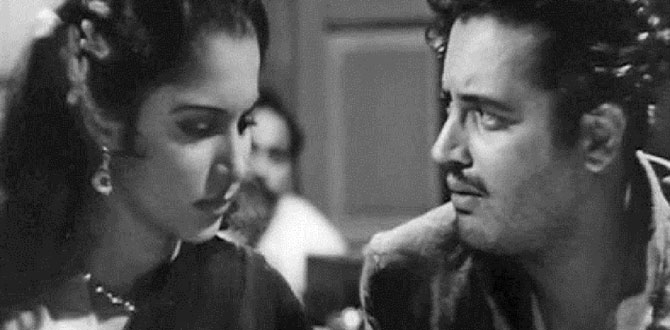
A memorable film from the 1950s Hindi Cinema. “Producer and director Guru Dutt’s intensely original film [The Thirsty One] is widely considered one of India’s unquestionable classics, striking a chord with its  vision of the romantic artist in conflict with an unfeeling materialistic world.” (Cinema Ritrovato Catalogue, 2014).

Gulab and Vijay

Gulab and Vijay

Guru Dutt also appears in the film as the poet Vijay, opposite Mala Sinha as Meena and Waheeda Rehman as Gulab. The film has a distinctive use of music and songs and exemplary black and white cinematography with fine use of crane shots. The music is by Y. G. Chawhan and the cinematography by V. K. Murthy. Dutt’s collaboration with these two artists and with the cast and production team offers a control of sound and image that stands out in the period.

Pyaasa is among a number of films from The Golden Age of Indian cinema, [late 1940s and 1950s] which have been restored and made available in either 35mm or digital versions by the recently established Film Heritage Foundation. The films offer the pleasures of the distinctive Indian musical film form. They combine melodrama and emotion with great dance and musical sequences. Pyaasa is in Academy ratio and runs 143 minutes. So this is a rare opportunity to see not just an Indian classic but an outstanding film of World Cinema.

Make More Noise! Suffragettes in Silent Film, BFI 2015.

Sunday November 1st at 1.30 p.m.

1442414331-d0bdd242ecd22cbea030a917aa71f1c8-600x449

This is a compilation of early films about the early C20th British Suffragette Movement. The selected titles are relatively short and are predominately newsreel footage or equivalent. There is the famous action by Emily Davison at the 1913 Derby. There is also coverage of her funeral. This latter film was used behind the closing credits of the feature Suffragettes: though unfortunately in the increasing contemporary habit of re-sizing it into a widescreen frame. Film of an action in Trafalgar Square features Sylvia Pankhurst, inexplicably missing from Suffragette.

The selection carries on into World War I when the Pankhurst’s and the movement split over whether to support the imperialist war or not. Sylvia Pankhurst was among those socialists who opposed the conflict.

There are also some short fictional films, mainly in the comic mode. There are shorts that send up the movement and ridicule it. But there are also several films by Cecil Hepworth which take a less hostile view. Two of these feature a popular female character of the period, Tilly, a tomboy who was constantly getting involved in and surviving scrapes.

Continue reading

Horse Money, Portugal 2014.

Jake Baldwinson takes a look at Horse Money, this week’s Tuesday Wonder on October 27th at 6.30 p.m.

Horse Money

The last feature length fiction film by Portugal’s Pedro Costa, Juventude em Marcha (Youth on the March/Colossal Youth 2010) looked, in part, at the destruction of the Fontainhas district of Lisbon and the rehoming of it’s residents. Fontainhas had been Costa’s filmmaking home since Ossos in 1997, and with his familiar surroundings empty, Pedro looked further afield for inspiration. Whilst promoting his concert film Ne Change Rien (Change Nothing 2009) in New York, and looking at music history there, Costa was struck by physical similarities between legendary New York poet and musician, Gil Scott-Heron, and star of Colossal Youth, Ventura. This led to talks between Costa and Scott-Heron on a possible film, which were sadly halted by the poet’s death in 2011.

With fragments of film ideas, and with the project in limbo, Costa moved his thoughts back to the former residents of Fontainhas, including Ventura, and started to develop a new film imbued with the spirit of Scott-Heron’s work, and possibly with the shared history of poverty and social unrest in Lisbon and New York. Going as far as opening with a series of photographs by Jacob Riis, a photographer documenting the New York slums at the turn of the 20th century.

Pedro Costa’s films, especially the ones set in Fontainhas, are recognisable as intersections between fiction and documentary; fusing the personal recollections of Costa’s non-professional actors, with his interest in film history, of expressionism and the ‘dark cinema’ of Hollywood in the 1940’s and 50’s. That hasn’t been more noticeable than it is in Horse Money, where our characters stalk the halls of shadowy hospital, reliving their lives, their uprooting from Cape Verde, and connection to the Portuguese revolution in the mid-70’s. This haunting, poetic, musically-minded film is in my opinion, Pedro Costa’s most accomplished, and possibly my favourite of this year. I can’t wait to see it again.

London and Leeds Film Festivals

Jake Baldwinson reports back from the London Film Festival and looks forward to Leeds annual film festival next month.

London Film Festival

Last Friday saw the launch of the Leeds International Film Festival programme. Now, I would normally spend the following weekend poring over the free guide, working out a schedule for my filmgoing highlight of the year. This time around, however, I was attending part of  the BFI London Film Festival. I ended up packing in 7 films over a hectic couple of days, including two that have been selected for the Leeds Film Festival this year.

What I find exciting about attending a film festival, even if just for a day or two, is experiencing a melting pot of different narrative voices in a short period of time. On my Saturday in London, I went to 4 screenings; beginning with a fiction feature set in Mexico, shot in an eye-catching circular frame using innovative techniques by the filmmakers. I then finished with a documentary about a culture under threat in Thailand and Burma, filmed in a collage-style using several different formats underwater and on land. These are the complementary screenings (or ones that intriguingly clash) that you would only find at a film fest. The former, entitled Lucifer, is screening a total of three times in Leeds as part of the festival in November, and I would really recommend it. Another from LIFF’s Official Selection that I caught in London was Jafar Panahi’s extremely enjoyable, Taxi, also showing three times (including once at The Hyde Park Picture House.)

Continue reading

Black Orpheus| / Orfeu Negro, France 1959.

Screening on October 18th at 1.30 p.m.

blackorpheus_091

This is an early success from the burgeoning art cinema of the late 1950s. It won the Palme d’Or at the Cannes Film Festival and Best Foreign Language Film at the Academy Awards. Set during the Rio de Janeiro Carnival it transposes the classic tale of Orpheus and Eurydice to that setting. The idea of such a mythic tale in one of the most famous and colourful events in Latin America was brilliant. And the film is well served by the fine colour cinematography of Jean Bourgoin. The film opts for a very simple depiction in terms of characters but the excitement of the masquerades, dance and music in the Carnival make it visually and orally compelling. There is though more than a trace of ‘exoticism’ in the representations.

The film is screening in its original format of 35mm, which should do proper justice to the stunning colour palette in which the drama is set. It was filmed in Eastmancolor, which sometimes suffers the ravages of time. Intriguingly for the date it was also filmed in the old Academy ratio, i.e. a nearly square frame. The language is Portuguese, though I think there was also some patois in there: it will have English sub-titles. On its original release in the UK it was certified as an A: now it is PG: ‘mild violence and sex references’ according to the BBFC. Note, two important characters are children and I thought they were very good.

Pasolini, Italy – France, 2014

Jake Baldwinson takes a look at Pasolini, showing this week at the Picture House on Sunday 4th at 1:30pm and Wednesday 7th at 4pm.

Pasolini

Inspired by the structure of 44:44 Last Day on Earth (2011), and his recent experiments in dramatising recollections of Naples residents in Napoli, Napoli, Napoli (2009), director Abel Ferrara looks at the final days of the controversial yet revered Italian poet, writer, philosopher and film maker, Pier Paolo Pasolini, in his latest film, Pasolini.

Pier Paolo Pasolini, “contradictory, Marxist, mystic, Catholic, and atheist,” was killed 40 years ago this year, just outside Rome. He had just completed Salò, his most controversial film, and was in the process of writing a novel (Petrolio), and directing one of his own screenplays entitled Porno-Teo-Kolossal. Before his body was discovered, a prostitute named Pino Pelosi was arrested for speeding, it was found that the car, an Alfa Romeo, belonged to the famous director, and when Pasolini’s body was eventually found, Pino confessed to his murder. In 2005, however, Pino retracted his confession, saying that three men “with southern accents” killed Pasolini. Appeals have been made to reopen the case, to no avail, and the real motives for Pasolini’s murder still remain a mystery.

In interviews, Ferrara recalls seeing Pasolini’s The Decameron (1971) as a young man, just as he was starting to make his own films, and cites him as an early influence as a filmmaker. Yet you could attribute a stronger connection to Pasolini’s earlier films, like Accatone and Mamma Roma, which look at society in the margins of Rome, the world of pimps and prostitutes, much like the seedy side of New York, that made Ferrara’s name; Driller Killer, Ms. 45 and Bad Lieutenant.

In Ferrara’s film, Pasolini is played by Willem Dafoe, a long time friend and collaborator of Ferrara’s, having starred in three of his previous films. Another notable member of the cast is Ninetto Davoli, Pasolini’s one time lover, friend, collaborator and muse, who starred in a total of 8 of his films, and was involved in the writing and filming of Porno Teo-Kolossal. According to Ferrara, Ninetto also provided useful insight into Pasolini’s final days, including the events leading to his untimely death.
Shirley Clarke Double Bill

Sunday September 27th from 1.30 p.m.

Connection

This is a must for film buffs and jazz buffs alike.

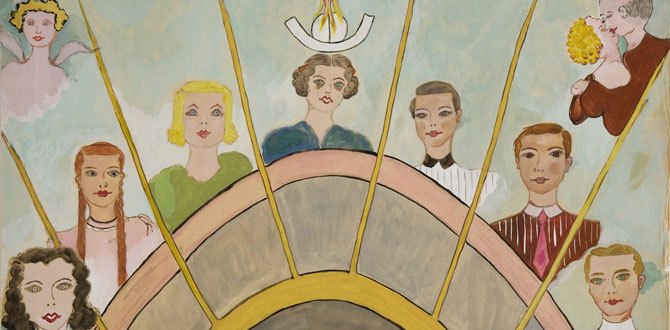
Shirley Clarke was an important independent filmmaker in the USA. She directed numerous short and feature length films between the 1950s and the 1980s. Most fell into the field of documentary. She also won a number of awards, of which the 1989 Maya Deren Independent Film and Video Artists Award is possibly the most apt.

The Connection is an example from what we would call  ‘the beat generation’. It is a fine adaptation of a play by Jack Gelber. It also includes music by a number of jazz luminaries including saxophone player Jackie McLean. The film runs for 110 minutes and is in black and white academy ratio.

Ornette

Ornette: Made in America (1985) is in the modern widescreen and in colour. The subject is one of the truly great players of the modern jazz era: Ornette Coleman. I still treasure vinyl recordings of this master at work. Clarke’s highly praised film gives us not just the music but also the context of this outstanding artist.

Sadly the director, the playwright and the jazz men are no longer with us. So this is a welcome posthumous tribute to key contributors to the culture and art of North America.

L’eclisse/The Eclipse, Italy – France 1962.

Screening on Sunday September 20th at 12 noon and again in BYObaby Wednesday September 23rd at 1100.

An interior - Monica Vitti as Vittoria.

An interior – Monica Vitti as Vittoria.

It is good to see two screenings at the cinema of this art film classic. Even more that it will be an opportunity for very young film buffs to become acquainted with one of the masters of modern European cinema. Michelangelo Antonioni achieved fame with a trio of films at the start of the 1960s: L’avventura (1959), La notte (1960) and this final film in the trilogy. People differ about which is the finest; my favourite is L’avventura. However, I think most would admit that this film is the most challenging: a challenge that offers its own rewards.

Antonioni has been described as the ‘poet of alienation’. The films describe failed or rootless relationships: metaphors for the wider social dislocations of the period. But these are relationships embedded in evocative landscapes: both natural and urban. The central relationship in this film is between Vittoria, played by one of the icons of sixties cinema Monica Vitti: and Riccardo, played by Alain Delon, a fine actor who moved easily between French and Italian films.

The predominant landscape is Rome, following in the footsteps of the neo-realists and Federico Fellini. But Antonioni concentrates on the city’s Stock Exchange and city’s modern and fashion conscious EUR zone. In these films the landscape is an accompanying character, here presented in the luminous black and white cinematography of Gianni Di Venanzo. Interiors are equally impressive and suggestive. It is the landscape and its architecture that dominates the final moments of the film: a series of beautifully composed shots which close with another metaphoric image.

The film has been restored by the BFI onto a digital package, running 126 minutes with English subtitles.

Marshland / La isla minima, Spain 2014.

Screening this Wednesday Sept. 9th and Thursday 10th.

Marshland pic


This combines the police procedural genre with that of the serial killer: a common combination these days. This is very much a genre film, and it is easy to detect the influences of earlier film. I was struck by the parallels with True Detective (HBO, 2014). The film is well produced and the detective duo, Pedro (Raúl Arévalo) and Juan (Javier Guttiérrez) are excellent. But what makes the film really interesting is that the story is set back in late 1980. This was the transitional period after the end of the Franco dictatorship and the ushering in of a ‘democratic’ Spain. This was the period following the ‘Pact of Silence’, also known as the ‘Pact of Forgetting’ by those who had opposed and suffered under fascism. And 1981 was the year that saw an attempted military coup against the new Spain. The film references both of these [in the latter case the reactionary military establishment] and intriguingly in the characters of the detectives references both the reactionary and the radical currents about in Spain at that time.

The parallels are carried in both the visual and aural patterns of the film: which also bear the influence of other serial killer films. The director, Alberto Rodriguez, has a penchant for dramatic overhead shots; emphasising the distance of the contemporary audience. The opening such shots also strike an interesting variation of the serial killer labyrinth.

The English title is a variation rather than a direct translation, I suspect the settings in the film have strong resonances in Spain. We are in the province of Andalucía where the events occur. Much of the film takes place in the Doñana National Park and the Guadalquivir marshes: the Park was established under the Franco regime in the 1950s. Whilst the name of the town [fictitious?] is Villafranco!

I did have reservations regarding the gender and the victims and the violence. This is one of the problematic aspects of the serial killer genre: though the best films treat this critically. There are brief but disturbing visual images, and a short but disturbing description of the violence in the dialogue. I wondered once again about the criteria of the British Board of Film Classification. This film has a fifteen certificate, meanwhile the recent The Diary of a Teenage Girl received an 18 certificate. I am sure that Marshland is the more disturbing film: perhaps being a foreign language film the supposed audience differs.

45 Years, UK 2015

Continuing until Thursday September 10th.

Berlin

The film garnered Best Actor Awards for both Charlotte Rampling and Tom Courtney at the Berlin Film Festival – serious critical prizes. Both are deserved, but it is Rampling’s character Kate who is the centre of this film. She is a skilled actress with an ability to use extremely subtle expressions and movements. The film is a pleasure to watch as we explore the character and situation of Kate and her husband Geoff (Courtney). And they are well supported by a several fine British actors in minor roles. They are preparing for the forty-fifth wedding anniversary party: the unusual anniversary is something we learn about in the course of the film.

The film is beautifully crafted around these performances. The cinematography by Lol Crawley is especially fine. There is a precision in the use of close-ups and two-shots: and well judged use of long shots and long takes, with the occasional slow forward track. The design, sound and editing all ably support this: and visually and aurally [at a second viewing] I was struck by minor but significant detail. A good example is the opening credits with non-simultaneous sound, which acts as a plant for later in the film. Max, the German Shepherd, the settings in the Norfolk Broads, and a piece of piano music by Liszt, all bring resonances to the story.

Director and writer Andrew Haigh has adapted the film from a short story by David Constantine. Apparently he has shifted the focus of the film to Kate. It is beautifully judged. This is a character study and tale with great complexity. It also [consciously I assume] references a British film tradition of denial. There are subtle parallels with the classic Brief Encounter (1945): more recently The Deep Blue Sea (2011).

It is a film of ambiguities, as with the characters. Inattention can mean you miss an important point: and I think you need the big screen and a clear sound system to take in all its aspects. Whilst it is immensely rewarding I suspect that it will generate different responses, depending what experiences and values audiences bring to the film. After a screening I heard the tail-end comment of a discussion in the foyer:

“I’ve come to see a wonderful film with a bunch of cynics!”