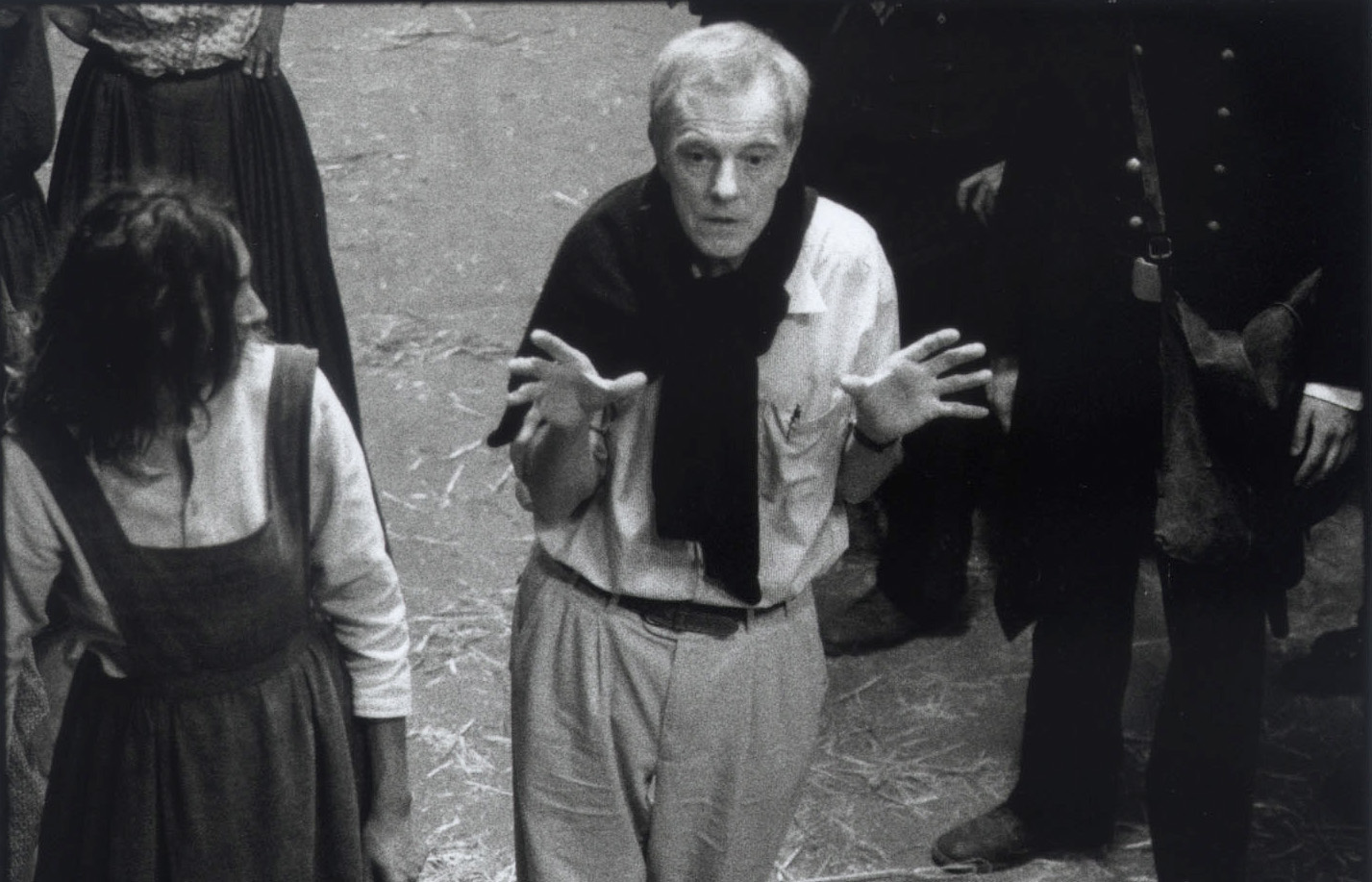
This British-born director who became an important international film-maker died in October last year, aged 90. He made a number of important films categorised as docudramas, though alternative documentaries would cover his varied work better. His distinctive approach was to present historic, contemporary or possible future events in a newsreel or TV style, highlighting both political narratives but also thee treatment of these by the media. His uncompromising approach did not fit with the dominant values of the mainstream media and his work was censored, banned or just difficult for audiences to access.
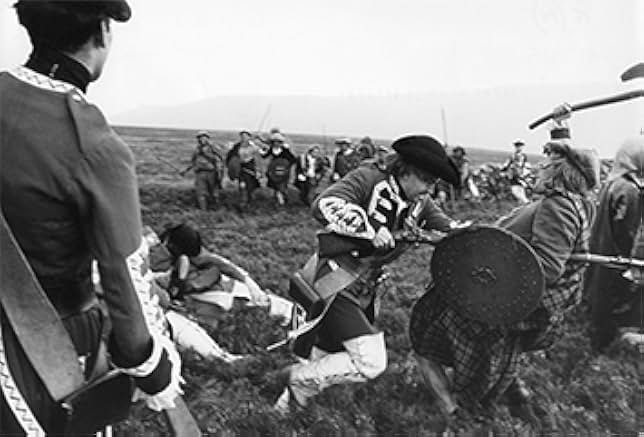
In the early 1960s he was working at the BBC. He first made a docu-drama about the battle of Culloden, 1745. His innovation was to present the battle through the eyes of a C20th reporter and film crew, with the reporter interviewing participant from the Highland and British armies during the battle. This radical presentation met with critical and audience praise.
The BBC then commissioned Watkins to direct a documentary about the effects of a nuclear attack; at a time when disquiet and opposition to nuclear weapons was a central issue in Britain. The finished film, The War Game, presented a dystopian vision of a post-nuclear attack in Kent, likely to shock viewers. It certainly shocked the BBC and the Government; the film was banned from Television though ‘selected audiences’ were able to view it in the cinema. In one of those ironies in the transatlantic alliance the Hollywood Academy awarded the film Best Documentary.
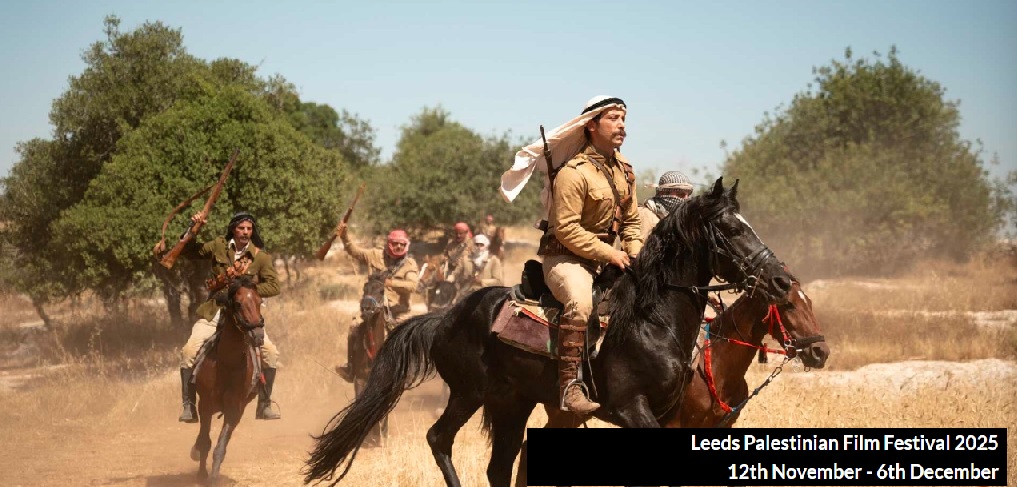
This year’s Festival runs from November 12th until December 6th, including two titles appearing in the Leeds International Film Festival. The complete programme is presented on the LPFF webpages. There are twelve events, both feature titles and documentaries, and art/activity events.
Happily, several of the screenings are at the Hyde Park Picture House. These include two much anticipated new works from Palestinian and Arab film-makers.
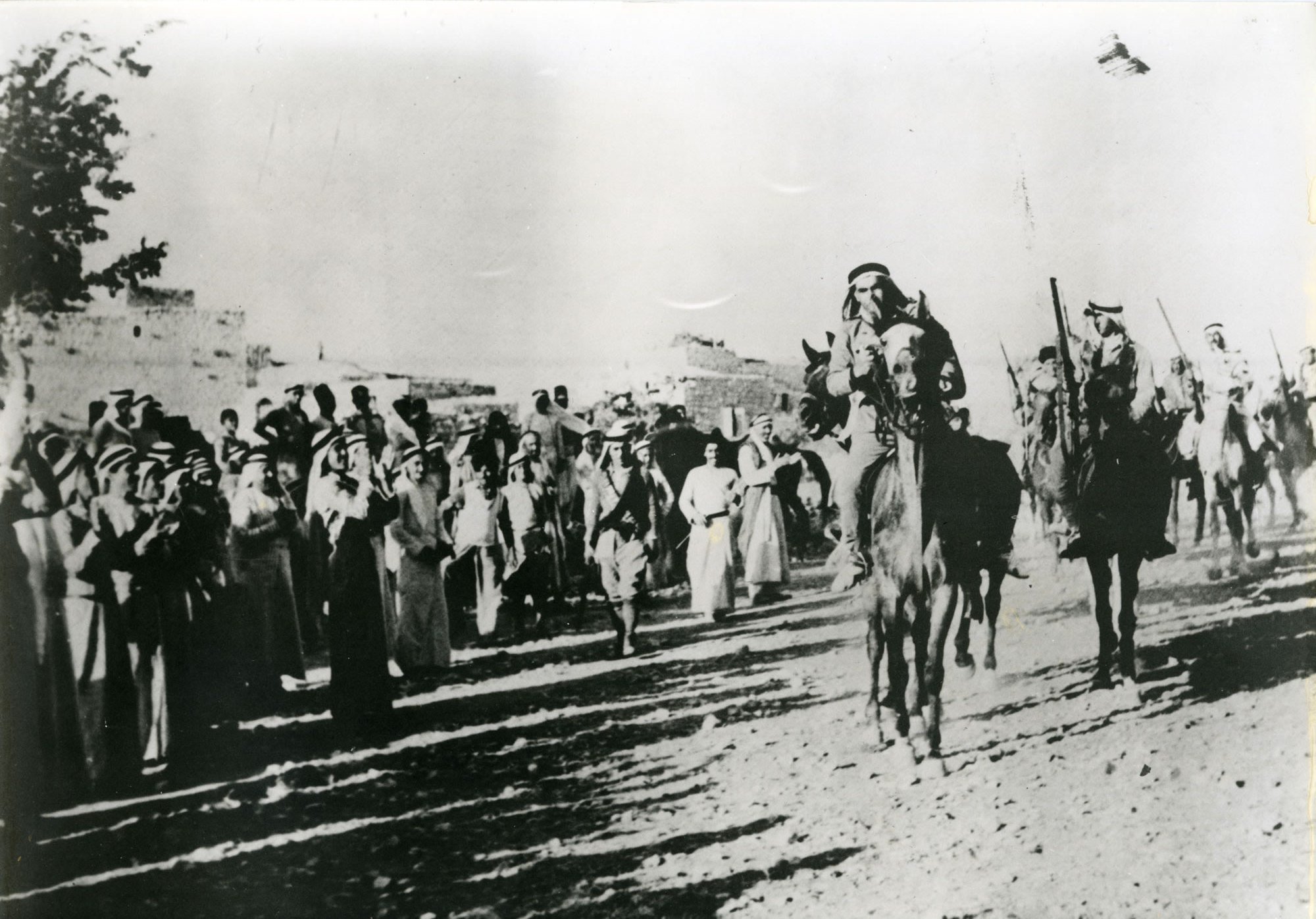
The Great Arab Revolt 1936 -1939
In the coming week there is a screening of Palestine 36 (2025); it is already sold out but there are further screenings of the feature in December. This is the latest feature from Annemarie Jacir and the screening on the 20th includes an introduction with a recorded video from the director. Her two previous productions are among the most interesting of recent Palestinian movies. Wajib ( 2017) is set in contemporary Nazareth and explores the Palestinian community as a father and son hand out invitations to a wedding. When I Saw You (2012) is set in Jordan in 1967 as another Nakba forces more Palestinians into exile while Fedayeen develop the armed resistance to Zionist occupation and aggression. Now with Palestine 36, Jacir returns to the Great Palestinian Revolt against British occupation from 1936 to 1939. A rebellion by the dispossessed Palestinian people against British colonial rule, it was brutally suppressed by the British military, aided by the armed Zionist militia. The defeat of the rebellion laid the ground for the 1947/8 Nakba. Yet it has been over-looked in much of the discussion of the settler colonial occupation in the west. Note, Wikipedia has a detailed page on the rebellion.
Then there is The Voice of Hind Rajab (2025), a drama-documentary that recreates the ordeal and death of a five-year old child under fire from the Zionist military; it is harrowing viewing. The case was widely publicised in the media and the details of the atrocity are given on a Wikipedia page. The feature is directed by the Tunisian film-maker Kaouther Ben Hania. Her previous feature, 4 Daughters (2023) was a really distinctive drama-documentary exploring women’s situation in Tunisian society. This title also has further screenings at the Picture House in December.
There has already been a screening of Yalla Parkour (2024) and there will be Put Your Soul on Your Hand and Walk (2025). These and other presentations in the Festival explore Palestinian resistance and their support across the world. As well as offering varied examples of fine film-making and supporting activities the Festival continues to present the the resistance of the Palestinian People to the ongoing Zionist genocide and ethnic-cleansing. As has been the case for decades the ruling classes in Europe and North America continue to support Zionist war crimes, though among the oppressed peoples support for the Palestinians is strong. So the Festival is an important part of the ongoing support for Palestine and for the Boycott, Divestment and Sanctions Campaign.
Showing as part of their reRun strand, the Picture House presents Wong Kar-wai’s esteemed masterpiece, In the Mood for Love.
Set against a smoky, rain-soaked 1960s Hong Kong, the lives of neighbours Chow Mo-wan and Su Li-zhen become quietly entwined after discovering a shared betrayal. What unfolds is a visually sublime, temporal meditation on desire, longing and human connection, and an aching love letter to a Hong Kong that no longer exists.
This year marks the 25th anniversary of the film’s release. A quarter-century on, it is enduringly beloved and celebrated not only as a landmark in Asian cinema, but as one of the greatest films ever made.
A stunning, sensory collage of colour and movement – paired with a gorgeous soundtrack – In the Mood for Love is definitely one to experience on the big screen.
Showing this Sunday 12th October at 2:30pm (last few tickets) and Wednesday 15th October at 1:45pm.
Last Thursday I caught the showing of the lurid, controversial and oh so millennial work that is Harmony Korine’s Spring Breakers as part of the Guilt-free Pleasures season at the Picture House. Having never seen the film in cinemas before, I was eager to revisit it in all of its neon-clad glory.
The existing cult following of Spring Breakers has seen a revival in recent years thanks to the pop culture phenomenon that was Charli XCX’s BRAT – a conceptual dance album that echoes the film’s motifs of party culture – and the track Spring Breakers that appeared on its deluxe edition last summer. This screening then seemed perfectly apt following the film experiencing somewhat of a renaissance, thirteen years after its initial release.
Intercut with frenzied, Skrillex-scored beach montages of (real life) spring breakers, the film follows Faith (Selena Gomez), Candy (Vanessa Hudgens), Brit (Ashley Benson) and Cotty (Rachel Korine), four young women studying in a Kentucky University town. Listless, jaded and left to their own devices during spring break, they hatch a plan to break free from their dorms and party with the masses. What begins as a quest for freedom and empowerment quickly turns sideways when we meet Alien (James Franco), a local drug dealer and wannabe gangster who has his own plans for the girls. As the third film to be picked up and distributed by A24, Spring Breakers certainly played its part in establishing the studio’s distinctive brand; It served as a stylistic and narrative precursor to later releases in the A24 catalogue like American Honey (2016), Good Time (2017) and Zola (2020), films that also employed naturalism, hyperreal elements and dream-like imagery to explore the intricacies of American life.
Before going into the rewatch, I hadn’t realised just how much of Spring Breakers I was missing watching at home. With the film being shot on 35mm, the intention behind the texture, colour and lighting was felt rather than just seen on the big screen. The encompassing warm pink hues briefly lure the audience into the same naive fantasy that the characters inhabit, where wealth and adventure promise escape from the boredom and emptiness of their lives back home. Sickly, seedy greens and moody blues soon seep in though, and they serve as a gnawing reminder of the rot that lies just beneath. The constant flux between these two states captures the familiar feeling of a night out turned sour – when the party goes on, but the fun ended hours ago.
The film lays its themes on thick, turning the American Dream inside out to expose the corruption, exploitation and violence that are indelibly tied to the pursuit of wealth and power. The hyperreal, oneiric world Korine builds around these forces warps them into their most absurd and heightened form. With a narrative that centres around the corruption and exploitation of four young women, it was of course by design that Disney starlets (Gomez and Hudgens) and their teen show adjacent (Benson) – women who grew up in the industry, mythologised as icons of teen girlhood and innocence – were cast for the starring roles. The same can also be said for Britney Spears, whose music features recurrently. The depiction of women has been a key point of contention for audiences from the film’s outset; it is left for us to decide whether or not the objectification of the film’s female subjects informs Korine’s satirical commentary on 2010s popular media, and the hypersexualised representations of women that were prevalent within it. Regardless of its intention, the voyeuristic gaze makes for uncomfortable viewing and cultivates a constant sense of foreboding for these women.
The performances are less than standout, with most veering into the ridiculous (Franco’s appearances especially elicited groans from the room). The dialogue and dynamics between characters are bizarre, and they more so monologue and chant ritualistically than talk to each other. This unpolished approach has, to me, always given the film its charm and only emphasised the parodic tone as it riffs off of the moment in which it was conceived. I would go as far as to say that there is no film that embodies 2012 quite like Spring Breakers. It emerged as part of the zeitgeist alongside – or perhaps in reaction to – cultural productions being churned out in the US during the late 2000s and early 2010s with a focus on hedonistic, party culture (see: Project X; Jersey Shore; Indie Sleaze; “Recession Pop” and every song released by LMFAO), material excess and celebrity scandal. It exists as a vestige of a bygone era in the not so distant past, when Instagram was in its infancy, “YOLO” was plastered everywhere, and being a care-free young adult was a novelty.
Despite being Korine’s arguably most accessible and definitely most mainstream film, it still stands today as one of the most polarising works I’ve seen. At the showing, both positive and negative post-credit debriefs could be overheard leaving screen one, but one phrase seemed to unite first-time watchers: “What was that?!”. Throughout the years, the film has amassed a slew of labels: messy, sleazy, vulgar, gratuitous, nonsensical – but I think this is also precisely what grants it staying power and keeps audiences coming back. Whether you see it as empty provocation or biting satire, Spring Breakers has undeniably left its mark.
Spoiler warning for Fire Walk With Me and Twin Peaks (TV Series)
Enveloping totality: the scalding heat of violence tears open the moment. In simultaneity, violence is birthed and combusts, an eclipsed instant of creation and destruction. White-hot, flashing and brazen, shattering the present into fractals of unspooled being. In these still frames of bloodied frenzy, a scream speaks manifestation to the unutterable presence of evil. Its figure, physical and otherwise, finds prevalence.
Twin Peaks: Fire Walk With Me is a tapestry of inflicted violence, a throbbing suture between its moments of rearing horror. The suffering inflicted upon Laura Palmer, each assault, rape, and her eventual killing, is a blinding mirror set equally between a symbolic and lived experience. Much like her representational force as idol and character, her experience pertains to the violence inflicted against all women, non-conforming, and non-masculine flesh; it is that of total debasement at the grasping hands of a masculine force. Inflicted by Leland as individual, his abuse choking Laura’s corporeal self, and tied to Bob as ephemeral, his perversion of Laura’s after-self constant, violence is foundational to the masculine. It is crafted in the image of omnipresence, a suffocating replication pasted upon every figurehead of our society, and beyond the confines of anything singular. David Lynch does not tie violence and its masculine face to one character, rather, infects all his creation with its miasma – the opposing symbol of Laura’s idolatry. Violence, captured upon film, is not bound to the hopeful tangibility of death.
Primarily, it is in this complete lack of anchoring that Lynch most deftly renders violence, severing it from the possibility of a solely physical presence. The constancy of The Black Lodge and Bob, their totality in dreamscape placing them aside from the binds of place and time, lives in all myth, religion, and folkloric tale. Violence and its channels are found woven into all pieces of scripture, consecrated or otherwise, fluid in position and clung, parasitic, to the very base of spoken human narratives. FWWM draws close to collagic, pasting together iconic images of religion, the capital-W Woman, vague esoteric grafts, and America to craft a motion of feverently worshipped visual language. Lynch recognises the near-blandness of their appearance, their complete crossover in implied meaning, and brings them close enough together to sap all simularity from them, conclusively drawing out an unspoken through-line of pervasive evil. Vitaly, it is in these images’ perversion, sullied in flashing light and drawn blood, that the violence begetting the impetus of our stories, in all their forms, becomes visible. Narrative, at Lynch’s level, is the retelling of the same story. Precisely like the violence that imbues it, narrative is cyclical and told in circles. Laura Palmer’s story will happen again. It will be told again. Violence finds no end in the image.
To watch FWWM is to watch Laura Palmer’s torture play out in repeat, her construct destined to be mutilated by the desire for conclusion we have bred narrative to bring. Linearity, in perspective and construction, grants nothing but the constancy of violence, birthing itself without the shackles of temporal structure.
FWWM deems violence to be its own progenitor, lacking in origin, and granted creation only in its moments of infliction. Its nature is that of transness, of mutability, and fluidity, tied into the fabric of being and time, separate from binary constraint, and enacted by all through misguided action. Our hand feeds the presence that kills: it is our ignorance that lets cyclicality form imposition, riding as companion to humanity. It is not inherent to us, merely sickness regurgitated. Lynch does not offer the comfort of plain hope to this, nor gives away the blanket of conclusion – so what lies in solution?
An equal transness, one of total encompassment: perspective beyond linearity and vision struck from the restraint of expectation. We cannot do-away with violence, with the reenactment of Laura’s story, without existence as mutable as violence itself. Lynch sees the oppositional, binary tone of people (“The good Dale is in the Lodge…”) and acknowledges these selves in flux, caught in forever-battle. To welcome transness, as Lynch’s ‘absurdity’ does, is to challenge every force, structure, and institution that upholds the present evil. Transness must be brought to the iconic image, to faith, to belief, to system, to society, in order to rid visual distraction and view the maliciously plain, logical, and glaring simpleness of violence. FWWM sees violence configured beyond the hopes of language, if anything, utilising the inbetween of meaning to generate potency – it is without a real or defined syntax. It speaks through absurdity, resting in dream, and must be matched with the full force of feeling. Opposition comes most ferociously when the burden of expectation, of translatability, is shed. Lynch’s work cries for us to build our own dream, to occupy the possibility of its genuine hope, and to relish in its transness. Dreams, seemingly, come unfettered from ignorance, capable of pulling all weight from evil.
The tragedy of FWWM is exactly that: inevitable and blandly foretold. Laura’s horror, our own reflection of that, is destined to repeat, fed by an apparatus of suffering. Do away with your ignorance, point to the violence that lives among you and within you, and finally open the ground for the capacity of betterment.
Written in response to the David Lynch: Between Two Worlds season at Hyde Park Picture House
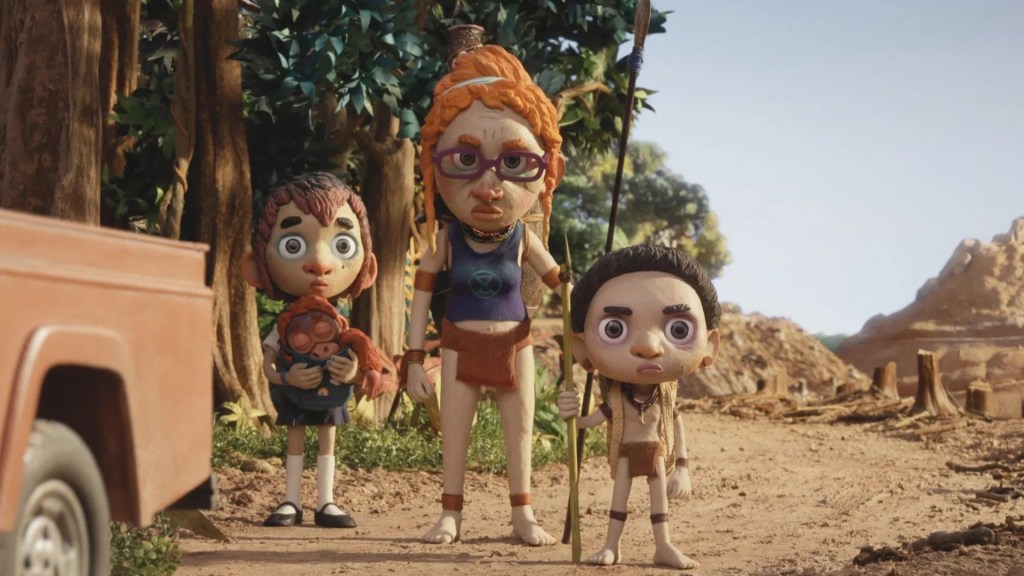
Here we have the long-awaited new film from Claude Barras, and for those indie animation fans, he previously made the beautiful My Life as a Courgette/Zucchini (2016).
But even without Celine Sciamma as a co-screenwriter, he still impresses with his sophomore feature.
“Savages” is set in a French colonial country in which young girl Kéria, living with her father on a settlement by the indigenous forest, ends up adopting a baby orangutan, orphaned by those cutting down the trees killing its mother. Kéria’s indigenous cousin, Selaï, comes to stay but when he runs off into the forest, the trio soon end up connecting with their indigenous roots.
The eco message for an animated film sounds reminiscent of Ferngully (1992) or masterpiece Rio 2 (2014) but this film is refreshingly grounded, mature and human. The focus here is on reconnecting with and appreciating family roots, as the city girl learns of her indigenous family and gets to appreciate her culture, and learn more about her late mother.
It’s an unhurried but peaceful film with a touch of melancholy and very much in tune with the spirit of the habitat it presents. And when the need to fight back against colonisers occurs, the rebellion is still grounded.
The stop-motion is an ambitious step up from Barras’s last film. Similar character design of large heads and wide-eyed protagonists, making that orangutan adorable, but the setting is warm and luscious in detail and texture.
It’s wonderful to see indie animation get the spotlight it deserves. One to seek out, no matter your age.
Danny and Michael Phillipppu strike again, rather than go more commercial, they instead lean further into the arthouse horror direction than their prior nightmarish thrill ride sensation Talk to Me (2022).
Grief is not a new topic for the Racka Racka duo, but here it is handled in a more nuanced way than their prior film. Both interpret grief as an addictive drug, but this grapples with the moral repercussions of this addiction.
The story follows Andy and his partially blind step sister Piper, whose father has recently passed. They are taken up in the “care” of Laura, who lost her daughter years back. Laura wants to “Bring Her Back”, but has devised a rather demonic way of doing so. Andy sees Laura’s malnourished son Oliver, who appears possessed. Piper is however blind to this blatant abuse, so Laura twists her web to enact her outlandish plan.
Sally Hawkins plays Laura, a very clever casting decision. She plays Mrs Brown in the Paddington movies after all and has such a sweet voice she wouldn’t hurt a fly. It’s that feeling of comfort in her voice the film subverts, as very quickly she becomes this unsettling presence able to put on this kind persona.
It’s a slow burn piece of intrigue, as the depths of the grief and where they take the characters deepen. Laura is still in the denial stage, whereas Andy suffers PTSD- a product of the very different kinds of love lost.
And with Oliver, there’s certainly effective body horror to be found, making for gory scenes but beneath the genre thrills comes this tragic layer of the cycle of abuse and grief to be felt.
The cinematography also feels like a major upgrade, with the limited location providing more creativity with making stunning shots.
A dark horror that doesn’t just use grief as a set-up but as a key part to the narrative. This continues the Phillippou’s streak of harsh and moving horror that sticks.
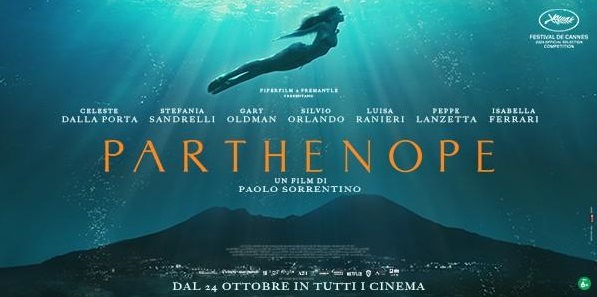
This new film from Paolo Sorrentino is screening at the Picture House over the coming days. His earlier films have been really impressive with great style but also a heart at the centre. I found this film a little disappointing because it did seem to lack heart to a degree. However, the visual and aural quality is very fine and Sorrentino is clearly working with a very talented group of craft people.
Parthe [for short] is the central character and at her birth in 1950, in the wealthy suburb of Naples, she is christened after a mythical Greek siren. Legend has it that the original Parthenope drowned in the waters off Naples and gave her name to an early settlement there. So Parthe is a reflection of the city, birthplace of the director.
From her birth the movie cuts to 1968 when Parthe is eighteen and is part of a triangle of her older brother Raimondo and the son of the family housekeeper, Sandrino. As in The Great Beauty events in this period mark both Parthe and her family for years to come.
The movie follows Parthe’s career as a student of anthropology and then as an academic who specialises in the study of miracles. She briefly toys with becoming an actor but settles for University life. She also has a number of relationships and affairs. The theme of miracles in reflected in several episodes.
She leaves Naples in later life but this is covered by an ellipsis in the narrative and the movie ends back in Naples. The narrative is absorbing, the characters and setting are finely presented, as are the sets and costumes. It is a visual feast and the soundtrack of sound and music is also excellent. The cast are very good though the script does not develop all the characters sufficiently; Gary Oldman is wasted in a cameo. I found some scenes and/or dialogue humorous and witty.
The title is in colour, with black and white, and 2.39:1; with the dialogue, Italian, Neapolitan and English, translated in subtitles. It runs 147 minutes but did not seem overlong. The production was made on digital formats and mastered at 4K. The DCP is also in 4K which does proper justice to the cinematography and music. The screening on May 25th at the Picture House is in auditorium one and the laser projector there will present the title to proper effect.
This is an annual event and the good news this year is that titles will be screening at the Hyde Park Picture House. In all the programme will be visiting 33 venues across Britain. There are 24 contemporary titles, released since 2018 and there are two ‘classics’ from the last century. The programme offers a variety of genres and themes whilst the title,
Am I Right? Justice, Justification and Judgement in Japanese Cinema
suggests a strong social element. The Programme web pages provide links to all the participating venues, with lists of the titles screening there and links to individual title pages.
The Hyde Park is screening four titles from mid-February to early March. One of these is a ‘classic’, though unlike in earlier years, we will not enjoy a 35mm print.
Carmen Comes Home / Karumen kokyô ni kaeru, (1951) is a comedy starring Takemine Hideko. Okin has left her rural home town in Nagano prefecture to work in Tokyo as a stripper, stage name Lily Carmen. She returns to the town with a friend where the local people are both fascinated and scandalised by this entertainer from the capital. Takemine Hideko was one of the major stars of Japanese cinema in a long career from late silent period (1929) until the 1970s. She worked with many of Japan’s most celebrated film-makers. This film was directed by Kinoshita Keisuke, whose very fine Snow Flurry / Kazabana (1959) was the classic film in the 2024 programme. Carmen was the first film to be made in colour in Japan, in Fujicolor and academy ratio. It was produced at the Shochiku Studio and the digital restoration was completed in 2012.
‘Ghost Cat Ansu’
The other titles at the Picture House are all recent. Ghost Cat Anzu/ Bakeneko Anzu-chan is a colour animation released in 2024. Anzu of the title is a Ghost Cat or Bakeneko; a supernatural entity found in a number of Japanese folk tales. In this quirky drama Anzu takes eleven-year-old Karin on a magical journey. In the Wake / Mamorarenakatta mono-tachi e (2021) is a social thriller with serial killings but set in the city of Sendai (on the east coast of central Japan), struck in 2011 by the earthquake and subsequent tsunami, raising the wider problems of life there. Sakura / Kuchinai Sakura (2024) is another type of policier, here an investigation delves into the murky world of police and the national intelligence agency.
Oddly, it appears that none of the titles will be screening in Bradford at the Media Museum. But York’s City Screen and the Sheffield Showroom are screening some of the other titles, seven not in the Picture House programme. The Showroom will include the other classic in the Foundation programme, The Inugami Family / Inugami-ke no ichizoku (1976). The film was directed by Ichikawa Kon, a prolific film-maker whose best known works in the west are The Burmese Harp / Biruma no tategoto (1956, and remade in 1985) and An Actor’s Revenge / Yukinojô henge (1963). This film is reckoned to be an example of Japanese noir. The titular family come together for the will of the rich deceased family patriarch. The beneficiaries of the will and its surprising requirements lead to family dissensions. Then a murder occurs and a detective has to come in and solve the crime. Surprises abound right through the movie. It runs over two hours in colour and an unusual widescreen format.
‘The Inugami Family’
In past years the programmes have offered a rich and varied menu from one of the world’s most interesting and rewarding cinemas; so these screenings promise to be a cinephiles’ treat.
After a successful Festive Screening of Perfect Days in December our next ‘First Thursday’ Film Club meet up is on February 6th after the 5:00pm screening of A Complete Unknown. Come along and watch the film with us, or see it anytime from the 31st January, and then join us in the bar around 7.45pm on the 6th to discuss it.
“Even a skeptic can be swept away by its heady mix of laidback assessment and genuine awe.” – Richard Lawson, Vanity Fair
“The wonder of A Complete Unknown isn’t just that it manages to be good anyway but that it finds an angle on Dylan as unexpectedly electric as that amplified Newport set.” – Alison Willmore, New York Magazine/Vulture





 Friends of Hyde Park Picture House