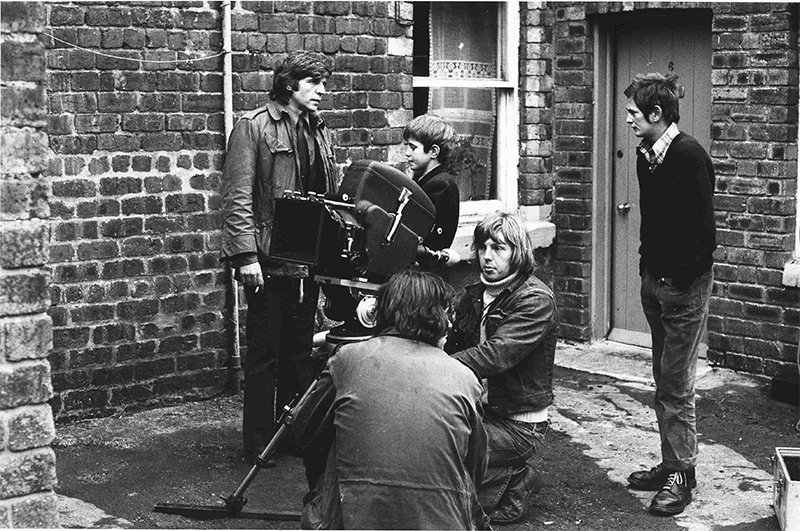
Douglas and crew filming a scene
This first part of this film trilogy was screened for members following the Friends’ Annual General Meeting. This was in the new Screen 2 of the redeveloped Picture House and was screened from a good quality 16mm print.
Scottish film-maker Bill Douglas was born in a small mining village close to Edinburgh in 1934. He was, sadly, lost to British film having only made, [apart from student films], the trilogy and a one feature film. Douglas came late to film; it was only in 1969 that he enrolled at the London School of Film Technique. This is actually the oldest school for film-making study in Britain, founded in 1956 and sited now in the Convent Garden area. Douglas made four short films while a student. However, on completing his studies he faced the usual barriers for independent film-makers.
Finally in 1972 he secured support from the British Film Institute’s production fund for three interrelated films. The first, at time with the title of ‘Jamie’, had been turned down by Films of Scotland because of the bleak view it provides of war-time Scotland. The film is based on experiences of Douglas’s own upbringing in the 1930s and 1940s. It became My Childhood, shot in black and white, academy and running 46 minutes.
The film is set in 1945, as World War II draws to a close. Jamie (Stephen Archibald) and Tommy (Hughie Restorick) live with their grandmother (Jean Taylor Smith). Their housing, diet and clothing all show the deprivation given the poverty of the family. The boys have pets which suffer from their situation. Jamie’s one outside relationship is with a German prisoner of war working locally on the land; Helmuth (Karl Fieseler). We see a celebratory bonfire at the end of the war and then Helmuth returns to Germany. There are also times when the boys (and the audience) see their father, who co-habits nearby, (Bernard McKenna). His mother is confined on some sort of mental institution. The bleakness of their lives is almost unparalleled in British film. It does have a moment of change; with a long shot of a departing figure on a train. The latter a familiar trope in films concerning children and rites of passage.
The cinematography was by Mick Campbell: the editing by Brad Thumin: and there were additional craft people on sound and a second unit. The imagery is stark but effective: the sound track is sparse, especially the dialogue, but it contributes to the overall impact: and the exteriors provide both a comparison and contrast to the central setting. The craft team, like the writer and director, seem to have a small number of credits. The quality should have led to a far greater output.

The second film of the trilogy is My Ain Folk (1973). This film picks up where My Childhood finished. The characters are the same, with the addition of other family members, as Jamie goes to live with them. Tommy is taken into welfare so this film concentrates on the experiences of Jamie. This is as harsh as his earlier life but with greater isolation. There is a brief moment of colour earlier in the film. It is in black and white and academy, running for fifty five minutes.
The final Part of the trilogy, My Way Home (1978) is also in black and white and academy but runs for 79 minutes. The film takes Jamie’s story into adulthood, entering work and then National Service. Jamie is again played by Stephen Archibald. The film takes the narrative outside of Scotland and Britain for the first time. It also presents a full and continuing friendship that leads to a change in Jamie’s life.
The National Film Archive has 35mm prints of both the second and third parts of the trilogy. It would be good if the Friends could cooperate with the Picture House to arrange screenings so that members and the public can see the rest of this outstanding work. The Archive also has a 35mm print of Douglas’ final film, Comrades (1987). The presents the story of The Tolpuddle Martyrs, agricultural labourers in the early C19th criminalised and then transported for daring to form a Trade Union. This is an important film on working class history in Britain and a fine representation in colour and widescreen which makes interesting use of early picture technologies.

 Friends of Hyde Park Picture House